
13+ Real-World Examples of Capacitance in Farads
 written by Sidra Batool
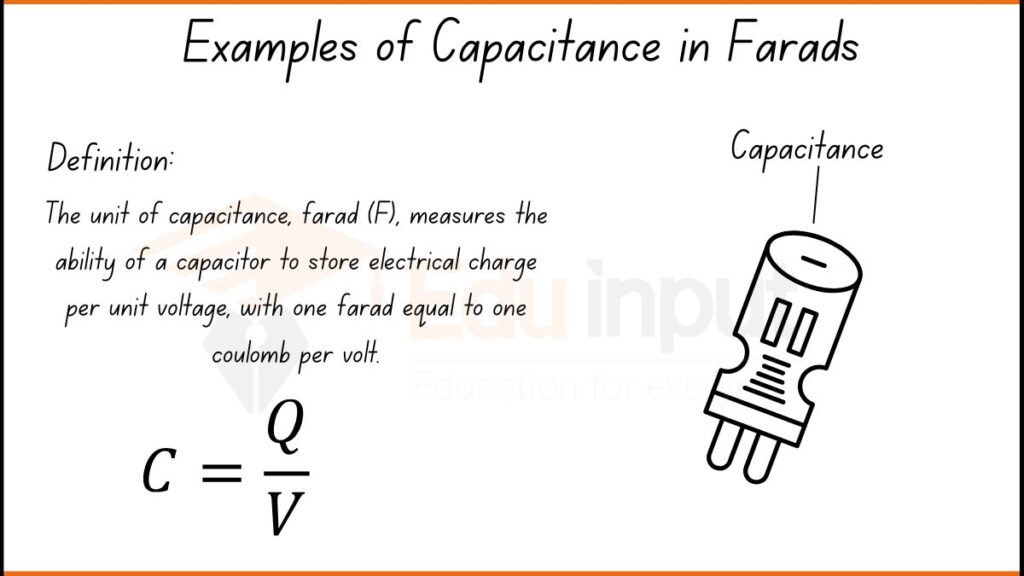
Capacitance, measured in farads (F) and its subunits like microfarads (μF) or picofarads (pF), is the ability of a capacitor to store electric charge. Capacitors are found in nearly every electronic device, from camera flashes to electric cars. The higher the farad value, the more charge it can store. Below are real-world examples showing how different types of capacitors are used across energy, electronics, and industrial systems.
What Are Capacitors Used For?
Capacitors are used to store energy, smooth out voltages, and help with signal processing in all kinds of electrical and electronic systems.
1. Supercapacitors in Electric Vehicles
Supercapacitors can store huge amounts of charge, often around 1000 to 5000 farads. In electric cars, they help during quick actions like braking or speeding up. They store energy and release it fast. This helps reduce battery strain and makes the car more efficient.
2. Capacitors in UPS (Uninterruptible Power Supply)
A UPS uses capacitors to keep power running during blackouts. These capacitors usually have 0.1 to 10 farads. If the main power goes out, the capacitor releases stored energy to keep computers and machines working for a short time.
3. Renewable Energy Systems
Solar panels and wind turbines use capacitors to make power smoother. These capacitors are about 0.01 to 1 farad. When the power from the sun or wind changes, the capacitor helps even it out so the energy supply stays steady.
4. Camera Flashes
Inside a camera, a capacitor charges up using electricity. When you press the flash button, it releases that energy all at once as a bright light. These capacitors are usually 100 to 1000 microfarads (μF). They store enough energy for one quick flash.
5. Electrolytic Capacitors in Power Supplies
Your phone charger has a power supply with an electrolytic capacitor. These capacitors are about 10 μF to 10 millifarads (mF). They smooth out any bumps or waves in the electricity so your device charges safely and steadily.
6. Ceramic Capacitors in Smartphones
Smartphones have ceramic capacitors that are tiny but powerful. They have very small values like 10 picofarads (pF) to 100 nanofarads (nF). These help block noise or extra signals, making sure the phone works clearly.
7. Capacitors in Audio Systems
In speakers and radios, capacitors carry only the parts of signals that we want to hear. They remove unwanted parts (like static). These capacitors are usually 1 to 100 μF, helping keep the sound clear and smooth.
8. Variable Capacitors in Radios
Old radios let you turn a knob to find stations. This works because a variable capacitor changes its value as you turn it. These are around 10 to 500 pF and help tune to different frequencies to find the exact station.
9. Medical Defibrillators
A defibrillator stores electricity and gives a quick, strong shock to restart a heart. It uses a capacitor around 100 to 500 μF. This fast energy release is what makes the heart shock work in emergencies.
10. Power Factor Correction in Factories
Large machines use a lot of power, but sometimes not efficiently. Capacitors of 10 to 1000 μF are used to balance the power and reduce waste. This is called power factor correction and helps save electricity.
11. Parallel-Plate Capacitors in Science Labs
In school or college labs, students use parallel-plate capacitors to learn how capacitance works. The size and distance of the plates affect the capacitance, which is often around 10 to 1000 pF. These experiments teach the basic idea of how capacitors store charge.
12. Capacitors in Touchscreens
Your phone screen uses capacitors to know when and where you touch it. These are small, usually between 1 to 100 pF. When your finger gets close, it changes the charge, and the phone detects that as a touch.
13. MRI Machines in Hospitals
MRI machines use capacitors to send strong magnetic pulses. These capacitors are around 1 to 100 μF. The pulses help create detailed images of your body. Capacitors make sure the pulse is strong and accurate.
Capacitance is everywhere in your phone, your car, your home, and even in hospitals. Whether it’s supercapacitors with thousands of farads or tiny capacitors in a touchscreen with just a few picofarads, they all do the same job: store and manage electric charge. Understanding how capacitance works helps explain many of the electronics we use every day.


Leave a Reply