
Difference Between Gram Positive and Gram Negative Bacteria
May 29, 2023  written by Sidra Batool
written by Sidra BatoolThe main difference between Gram positive and Gram negative bacteria is the difference of composition of their cell wall. Gram-negative bacteria have an outer membrane and a thin peptidoglycan layer, while Gram-positive bacteria lack an outer membrane and have a thick peptidoglycan layer.
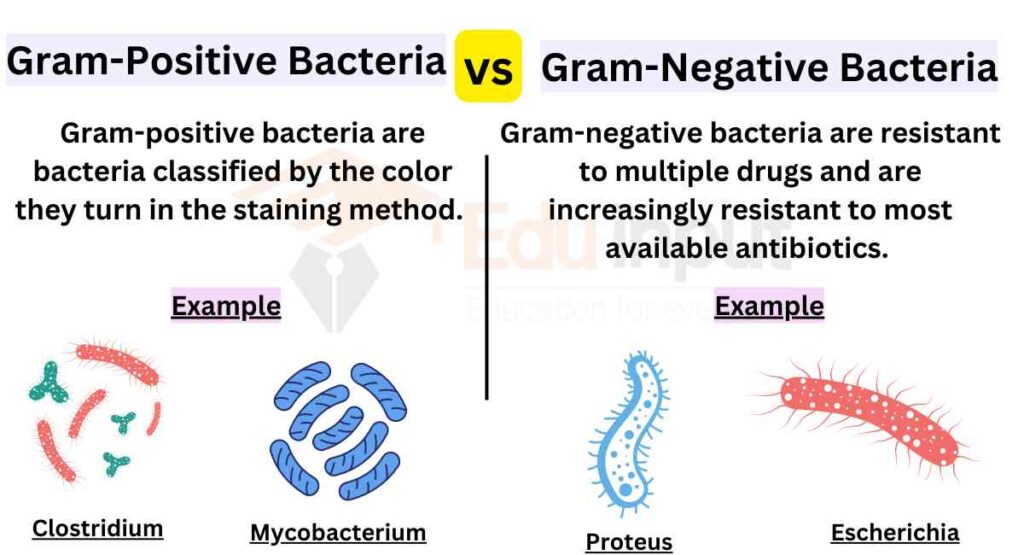
Gram Positive vs. Gram Negative Bacteria
Here are the main differences between Gram Positive and Gram Negative Bacteria:
| Characteristic | Gram-Positive Bacteria | Gram-Negative Bacteria |
|---|---|---|
| Gram Staining Reaction | Retain crystal violet dye and appear blue or purple | Accept safranin after decolorization and appear pink or red |
| Cell Wall Thickness | Thick (20-80 nm) | Thin (8-10 nm) |
| Peptidoglycan Layer | Thick and multilayered | Thin and single-layered |
| Presence of Outer Membrane | Absent | Present |
| Teichoic Acids | Mostly present | Absent |
| Lipopolysaccharide (LPS) Content | Virtually None | High |
| Flagellar Structure | Basal body has 2 rings | Basal body has 4 rings |
| Endospore Formation | Some species can produce endospores | Typically do not produce endospores |
| Toxin Production | Primarily exotoxins | Endotoxins or exotoxins |
| Pathogenicity | Few pathogenic species belong to this group | Most pathogenic species are in this group |
| Resistance to Physical Disruption | High | Low |
| Susceptibility to Antibiotics | More susceptible to penicillin and sulfonamide | More susceptible to streptomycin, chloramphenicol, and tetracycline |
File Under:





Leave a Reply