
Examples of Desert Plants and Animals and Their Adaptations
 written by Sidra Batool
Desert ecosystems contain diverse desert plants and animals adapted to low rainfall, high temperatures, and limited water. Common desert plant names include cactus, creosote bush, Joshua tree, and agave, while desert animals names include fennec fox, camel, addax, sand cat, and desert tortoise.
These desert habitat plants and animals have developed specialized adaptations for survival. Desert plant adaptations include water storage, reduced leaves, deep roots, waxy surfaces, and CAM photosynthesis, while animal adaptations include nocturnal activity, burrowing, heat tolerance, and water conservation.
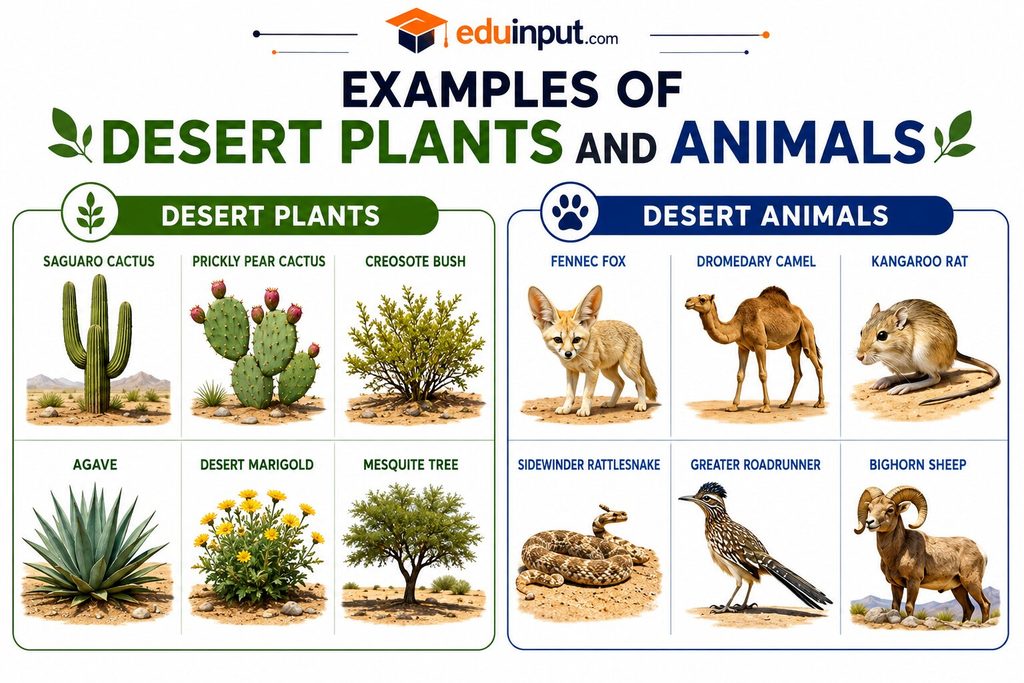
Together, these adaptations allow plants and animals in the desert to survive harsh environmental conditions.
Examples of Desert Animals
The following table gives examples of animals found in desert regions, along with their scientific names and habitats. These species represent the diversity of desert biome fauna found in different parts of the world.
| Desert Animal | Scientific Name | Habitat |
| Fennec fox | Vulpes zerda | Sahara Desert and other arid regions of North Africa |
| Sand cat | Felis margarita | Deserts of North Africa, the Middle East, and Central Asia |
| Addax | Addax nasomaculatus | Sahara Desert and Sahel region of Africa |
| Kangaroo rat | Dipodomys spp. | Arid regions and deserts of North America |
| Camel | Camelus spp. | Desert and arid regions of Africa and Asia |
| Meerkat | Suricata suricatta | Kalahari Desert and arid regions of southern Africa |
| Gila monster | Heloderma suspectum | Deserts and semi-arid regions of southwestern United States and northwestern Mexico |
| Arabian oryx | Oryx leucoryx | Deserts and arid regions of the Arabian Peninsula |
| Desert horned viper | Cerastes cerastes | Deserts of North Africa and the Middle East |
| Desert tortoise | Gopherus agassizii | Mojave and Sonoran deserts of North America |
| Dromedary camel | Camelus dromedarius | Deserts and arid regions of North Africa, the Middle East, and parts of Asia |
| Deathstalker scorpion | Leiurus quinquestriatus | Desert and semi-desert regions of North Africa and the Middle East |
| Thorny devil | Moloch horridus | Arid and desert regions of central and western Australia |
| Bighorn sheep | Ovis canadensis | Rocky and arid regions of western North America |
| Desert iguana | Dipsosaurus dorsalis | Mojave and Sonoran deserts of the southwestern United States and northwestern Mexico |
Adaptations in Desert Animals
Animals living in deserts have special adaptations that help them survive extreme heat, limited water, and scarce food. Desert habitat animals may be nocturnal, shelter in burrows, or have body features that reduce water loss.
For example, camels can tolerate dehydration, kangaroo rats obtain most of their water from food, and desert foxes use their large ears to release heat. These adaptations explain what animals live in the desert and how different species survive there.
The type of animals that live in the desert depends on the climate, available food, water, and physical conditions of each desert.
Examples of Desert Plants
Desert plants are species adapted to survive in environments with low rainfall, high temperatures, and limited water availability. Plants in the desert include cacti, shrubs, trees, grasses, and flowering plants. The types of plants vary between deserts depending on climate, soil, rainfall, and available moisture. These species form an important part of desert biome plants and provide food and shelter for other organisms.
The following table provides examples of desert plants with names, along with their scientific names and habitats. It includes common desert plants names from deserts and other arid regions around the world.
| Desert Plant | Scientific Name | Habitat |
| Prickly pear cactus | Opuntia spp. | Arid and semi-arid regions of North and South America |
| Saguaro cactus | Carnegiea gigantea | Sonoran Desert of the United States and Mexico |
| Joshua tree | Yucca brevifolia | Mojave Desert of the southwestern United States |
| Creosote bush | Larrea tridentata | Deserts of the southwestern United States and northern Mexico |
| Ocotillo | Fouquieria splendens | Arid regions of the southwestern United States and northern Mexico |
| Desert marigold | Baileya spp. | Sonoran, Chihuahuan, and Mojave deserts |
| Brittlebush | Encelia farinosa | Deserts of the southwestern United States and northern Mexico |
| Desert lily | Hesperocallis spp. | Deserts of the southwestern United States and northwestern Mexico |
| Palo verde | Parkinsonia spp. | Desert regions of North and South America |
| Cholla cactus | Cylindropuntia spp. | Arid regions of North and South America |
| Agave | Agave spp. | Arid and semi-arid regions of the Americas |
| Mesquite | Prosopis spp. | Desert and arid regions of North and South America |
| Barrel cactus | Ferocactus spp. | Desert regions of North and Central America |
| Desert ironwood | Olneya tesota | Sonoran Desert of the southwestern United States and northwestern Mexico |
| Desert broom | Baccharis sarothroides | Deserts of the southwestern United States and northern Mexico |
Adaptations in Desert Plants
Desert plants have developed desert plant adaptations that help them survive high temperatures, low rainfall, and limited water. These adaptive features of desert plants reduce water loss, improve water absorption, and protect plant tissues from heat and drought.
1. Water Storage
Many desert plants store water in their stems, leaves, or roots. This adaptation, called succulence, allows them to survive long periods without rainfall. Cacti are common examples of plants with specialized water-storage tissues.
2. Reduced Leaves
Many desert plants have small leaves or no leaves at all. Reduced leaf surfaces decrease transpiration and help conserve water. In cacti, leaves are modified into spines while the green stem performs photosynthesis.
3. Waxy Cuticle
A thick, waxy cuticle covers the leaves or stems of many desert plants. This protective layer reduces evaporation and helps prevent excessive water loss. It is an important example of plant adaptations in the desert.
4. Deep Root Systems
Some desert plants develop deep or widespread root systems to absorb water from the soil. These roots allow plants to access moisture below the surface or quickly collect water after rainfall.
5. CAM Photosynthesis
Many cacti and other succulents use CAM photosynthesis. Their stomata open mainly at night when temperatures are lower, reducing water loss. Carbon dioxide is stored and later used for photosynthesis during the day.
6. Drought Dormancy
Some plants become dormant during prolonged dry periods. They may shed their leaves or greatly reduce their metabolic activity until rainfall returns. This is an important adaptation of desert plants to unpredictable water availability.
7. Spines, Thorns, and Hairs
Spines, thorns, and hairs can protect plants from herbivores and reduce water loss. They may also provide shade and reduce the temperature around plant surfaces. These are common desert plants and their adaptations.
8. Heat Tolerance
Desert plants can tolerate high temperatures through features such as light-colored surfaces, specialized tissues, and changes in leaf orientation. These desert flora adaptations help protect cells from heat damage.
9. Efficient Reproduction
Many desert plants reproduce rapidly after rainfall. They may produce seeds that remain dormant until suitable conditions occur. This allows plants to take advantage of short periods of available water.
10. Salt Tolerance
Some plants growing in dry or salty desert soils can tolerate high salt concentrations. Specialized mechanisms help them regulate salt and maintain water balance.
These adaptations of desert plants allow different species to survive under extreme environmental conditions. Together, they show how desert plants and adaptations are closely related to water conservation, heat tolerance, reproduction, and survival.



Leave a Reply