
Affixes in Grammar-Definition, Types, Examples, and Usage
 written by Muhammad Hasnain
What are Affixes in English Grammar?
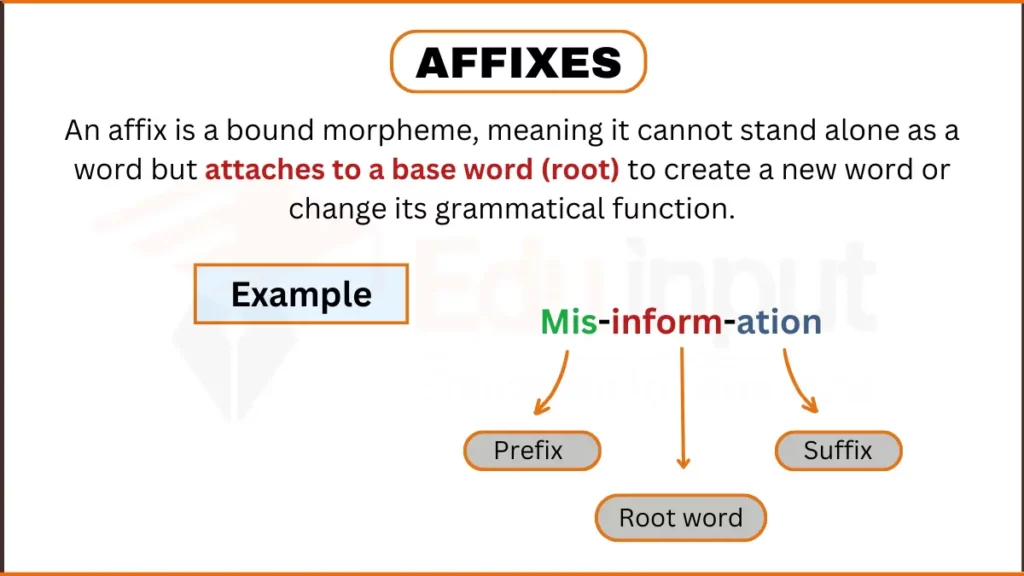
In English grammar, an affix is a bound morpheme, meaning it cannot stand alone as a word but attaches to a base word (root) to create a new word or change its grammatical function.
What are Types of Affixes?
Here are the different types of affixes with examples:
1. What are Prefixes?
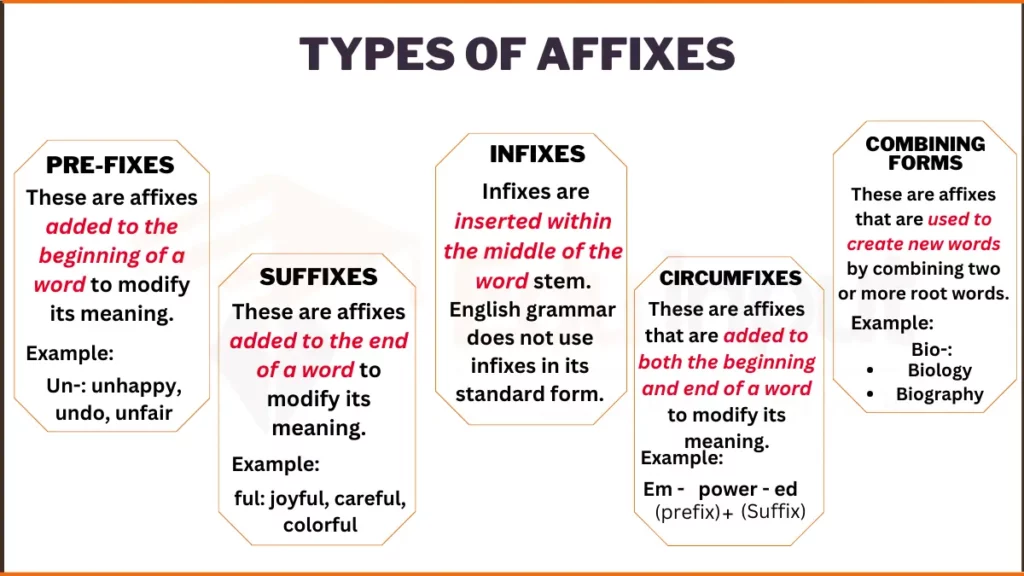
Prefixes are affixes that are added to the beginning of a word to modify its meaning.
Examples of Prefixes in Grammar
Affixes and their meaning become easier to understand when you see how affixes in a sentence change the base word. Here are some common prefixes and examples of words that use them:
- Un – unhappy, undo, unfair
- Dis- disagree, disconnect, disapprove
- Re- redo, rebuild, reorganize
- Pre- prefix, preheat, preview
- Post- postdate, postgraduate, postmortem
- In- inactive, incomplete, indirect
- Im- impossible, imperfect, impatient
- Il- illegal, illegible, illogical
- Mis- misunderstand, misinterpret, mislead
- Over- overlook, overcook, overestimate
2. What are Suffixes?
Suffixes are affixes that are added to the end of a word to modify its meaning.
Examples of Suffixes in Grammar
Here are common suffixes and their usage in words:
- Ful- joyful, careful, colorful
- Able-comfortable, notable, lovable
- Less- hopeless, useless, endless
- Ment– excitement, development, requirement
- Ness– happiness, kindness, darkness
- Tion- adaptation, attention, explanation
- Er-teacher, runner, singer
- Est– biggest, tallest, happiest
- Ive- creative, effective, informative
- Ly- quickly, happily, slowly
3. What are Infixes?
These are affixes added within a word to modify its meaning. Infixes are inserted within the middle of the word stem.
English grammar does not use infixes in its standard form. Infixes are more common in other languages like Tagalog, Malay, and several Native American languages.
4. What are Circumfixes?
These are affixes that are added to both the beginning and end of a word to modify its meaning.
In English, circumfixes are a relatively rare type of affix.
Examples of Circumfixes in Grammar
Here are some examples of English words that use circumfixes:
- En-en – Enlighten (The circumfix is “en-…-en” which means “to put into a certain state”. The root word is “light”)
- Be-ed – Befriended (The circumfix is “be-…-ed” which means “to make or cause something”. The root word is “friend”)
- En-ed – Enriched (The circumfix is “en-…-ed” which means “to make or cause something”. The root word is “rich”)
- Em-en – Embolden (The circumfix is “em-…-en” which means “to put into a certain state”. The root word is “bold”)
- En-d – Enraged (The circumfix is “en-…-ed” which means “to cause someone to be in a certain state”. The root word is “rage”)
- Be-ed – Bejeweled (The circumfix is “be-…-ed” which means “to adorn or cover with something”. The root word is “jewel”)
5. Combining forms
These are affixes that are used to create new words by combining two or more root words.
Examples
Here are five examples of combine forms in English:
Bio
The word Bio is derived from the Greek word for life, this combine form is commonly used in scientific and medical language to refer to living organisms or their properties
- Biology
- Biography
- Biosphere
Electro
This combine form comes from the Greek word for amber and refers to electricity.
- electronic devices
- electrocardiograms
- electrolytes.
Mal
Derived from the Latin word for bad or evil, this combine form is often used to indicate something that is abnormal, defective, or harmful.
- malpractice
- malnutrition
- malfunction
Poly
This combine form comes from the Greek word for many and is used to indicate something that has many parts or is characterized by plurality
- polysyllabic
- polytheism
- polygamy
Psycho
Derived from the Greek word for soul or mind, this combine form is used to refer to mental processes or psychological phenomena.
- psychopath
- Psychology
- psychoanalysis




Leave a Reply