
Most Endangered Biomes and Why They’re Disappearing
 written by Sidra Batool
Biomes are large ecological regions shaped by climate, vegetation, and wildlife. Many are being changed by agricultural expansion, habitat loss, overgrazing, pollution, invasive species, and climate change.
But not all biomes face the same level of risk. Research shows that some have lost much more habitat, have lower levels of protection, or contain a particularly high proportion of species affected by human pressures.
What Are the Most Endangered Biomes?
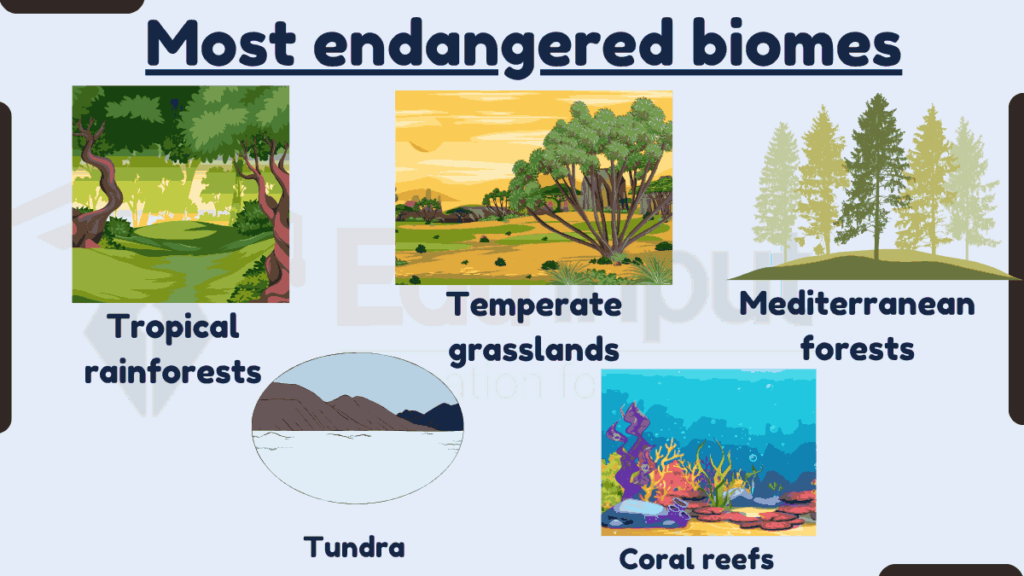
There is no single global ranking that measures every type of ecological risk. However, a major global ecoregion analysis published in BioScience identified tropical and subtropical dry broadleaf forests as the most endangered biome based on remaining habitat and protection levels. Only 2 of its 56 ecoregions were classified as “Half Protected,” while 26 were classified as “Nature Imperiled.”
Other heavily altered and poorly protected biomes include tropical grasslands and savannas, Mediterranean ecosystems, and temperate grasslands.
1. Tropical and Subtropical Dry Broadleaf Forests
Tropical dry forests are found in regions with pronounced wet and dry seasons. Their fertile soils and relatively accessible terrain have made many areas suitable for agriculture and other human land uses.
The global ecoregion study found that this biome had the highest level of endangerment in its analysis. Of 56 ecoregions, 26 were classified as Nature Imperiled, 20 as capable of recovering naturally, and only 2 as Half Protected.
A separate global study of human impacts on terrestrial vertebrates found that tropical and subtropical dry broadleaf forests had the highest mean proportion of impacted species, at 98.3%.
2. Tropical and Subtropical Grasslands, Savannas, and Shrublands
Tropical grasslands and savannas face pressure from agriculture, grazing, urban expansion, altered fire regimes, and invasive species.
A global study found that this biome experienced an 83% population increase between 1990 and 2015, increasing pressure on land and resources in many regions.
These ecosystems are also important for threatened wildlife, yet conversion and degradation continue to reduce natural habitat.
3. Mediterranean Forests, Woodlands, and Scrub
Mediterranean ecosystems occur in regions with hot, dry summers and relatively mild, wetter winters.
Historical land conversion has already greatly reduced natural vegetation. Modern pressures include agriculture, urban development, overuse of forest resources, wildfire, drought, and climate change. Research also shows that Mediterranean forests face increasing risks as several pressures act together.
4. Temperate Grasslands and Savannas
Temperate grasslands have been extensively converted to cropland, grazing land, infrastructure, and other human uses.
WWF reports that only about 4.5% of temperate grasslands are in protected areas. It also identifies agricultural conversion, tree plantations, grazing changes, pollution, invasive species, and infrastructure as major pressures.
A global vertebrate-impact study found that temperate grasslands, savannas, and shrublands had the second-highest mean proportion of impacted species, at 97.8%, after tropical and subtropical dry broadleaf forests.
5. Tundra
Tundra has historically experienced less habitat conversion than many grasslands and forests, but it is highly exposed to climate change.
Warming affects permafrost, snow cover, vegetation, and species interactions. This makes tundra an important example of a biome that may be less altered by direct land conversion but highly sensitive to climate change.
See the detailed Tundra Threats guide for the specific effects of warming and permafrost loss.
6. Coral Reefs
Coral reefs are technically marine ecosystems rather than terrestrial biomes, but they are among the world’s most threatened ecosystems.
Ocean warming can cause coral bleaching, while acidification, pollution, overfishing, and coastal development create additional stress. Their inclusion here is useful because searches for endangered biomes often overlap with searches for the world’s most threatened ecosystems.
Why Are Biomes Disappearing?
Research identifies several major drivers.
Agricultural Expansion
Agriculture is one of the largest causes of habitat conversion. FAO estimates that nearly 90% of global deforestation between 2000 and 2018 was associated with agricultural expansion, including cropland and livestock grazing.
Dry forests and grasslands are especially vulnerable because their landscapes are often suitable for farming and livestock production.
Habitat Loss and Fragmentation
Roads, cities, mines, farms, and infrastructure can divide continuous habitat into smaller patches. Fragmentation can restrict movement, isolate populations, and make it harder for species to track changing environmental conditions.
Overgrazing and Altered Fire Regimes
Heavy grazing can remove vegetation and degrade soils. In grasslands and savannas, changing natural fire patterns can also alter plant communities and habitat structure.
Pollution and Invasive Species
Pollution can disrupt soil, water, and food webs. Invasive species may compete with native organisms or change ecosystem processes.
Climate Change
Climate change can intensify existing pressures through higher temperatures, drought, changing rainfall, wildfire, sea-level rise, and shifting ecological zones.
Why Are Some Biomes More Fragile Than Others?
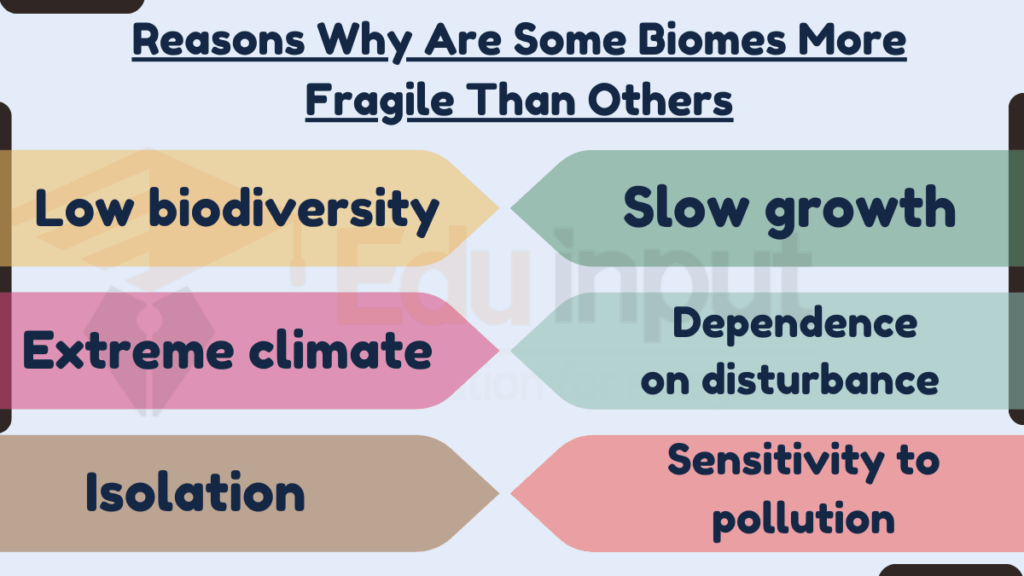
The sections above explain what is driving biome loss broadly. This section looks at the other side of the problem: why the same pressures can affect some biomes much more severely than others.
Biodiversity can affect resilience
Greater biodiversity can provide ecological buffering when conditions change. A 2022 study covering more than 57,500 plant species across the Western Hemisphere found that greater plant diversity was generally associated with lower sensitivity to temperature variability.
This does not mean highly diverse ecosystems cannot collapse. It shows that species diversity can influence how ecosystems respond to environmental variation.
Recovery can take centuries
A study based on a 20,000-year fossil-pollen record from North America found median biome residence times of about 230–460 years. After ecological transitions, only around 64% returned to their original biome type in the record studied.
This is not a universal recovery time for modern ecosystems. It does show that biome-level ecological change can persist for centuries rather than reversing within a few years.
Environmental limits matter
Some biomes depend on specific combinations of temperature, rainfall, soil moisture, or water availability. When those conditions shift substantially, species may have difficulty surviving or moving into suitable areas.
Fragmentation makes this problem worse because suitable habitat may exist elsewhere but be difficult for species to reach.
| Factor | Why it increases vulnerability |
| Low biodiversity | Fewer species may compensate for ecological losses |
| Slow recovery | Damage can persist for decades or centuries |
| Narrow environmental conditions | Small changes can create major stress |
| Habitat fragmentation | Species have fewer opportunities to move |
Which Biome Is the Most Endangered?
Based on the widely cited global ecoregion analysis, tropical and subtropical dry broadleaf forests were identified as the most endangered biome because of their low protection and the condition of their remaining ecoregions.
However, the answer depends on how “endangered” is measured. Tropical dry forests rank extremely high under habitat protection and human-impact measures, while temperate grasslands are also among the most heavily altered terrestrial ecosystems.
This is why a single ranking should not be treated as a complete measure of ecological vulnerability.
Can Endangered Biomes Recover?
Some degraded ecosystems can recover when major pressures are reduced and ecological conditions remain suitable.
Recovery may involve protecting remaining habitat, restoring damaged areas, reconnecting fragmented landscapes, controlling invasive species, reducing pollution, and managing agriculture and grazing more sustainably.
However, recovery is not guaranteed. Severe or prolonged disturbance can push an ecosystem into a different ecological state.
FAQs
What is the most endangered biome?
A global ecoregion analysis published in BioScience identified tropical and subtropical dry broadleaf forests as the most endangered biome based on habitat protection and remaining natural habitat.
Why are tropical dry forests so endangered?
Many tropical dry forests have been converted for agriculture and other human uses. Their remaining ecoregions also have relatively low protection levels.
Which biome is most affected by humans?
A global analysis of terrestrial vertebrates found the highest mean proportion of human-impacted species in tropical and subtropical dry broadleaf forests at 98.3%, followed by temperate grasslands, savannas, and shrublands at 97.8%.
Are temperate grasslands endangered?
Temperate grasslands are among the most altered terrestrial ecosystems. WWF reports that only about 4.5% are within protected areas, while agriculture, grazing, infrastructure, invasive species, and other pressures continue to affect them.
Can endangered biomes recover?
Yes, some can recover after pressures are reduced. The speed and completeness of recovery depend on the severity of disturbance, remaining biodiversity, habitat connectivity, and environmental conditions.
Which biome has the least biodiversity?
Cold and extremely dry environments generally support fewer species than many tropical environments. However, biodiversity varies considerably within each biome, so biome-level comparisons should be made carefully.


Leave a Reply