
Difference between Acrania and Craniata
November 30, 2024  written by Almas Anwar
written by Almas AnwarThe key difference between Acrania and Craniata is the presence or absence of cranium (skull) and head. Subphylum Acrania organisms lack a skull or distinguished head, while the Craniata organisms contain a skull and a distinguished head structure.
Acrania Vs. Craniata
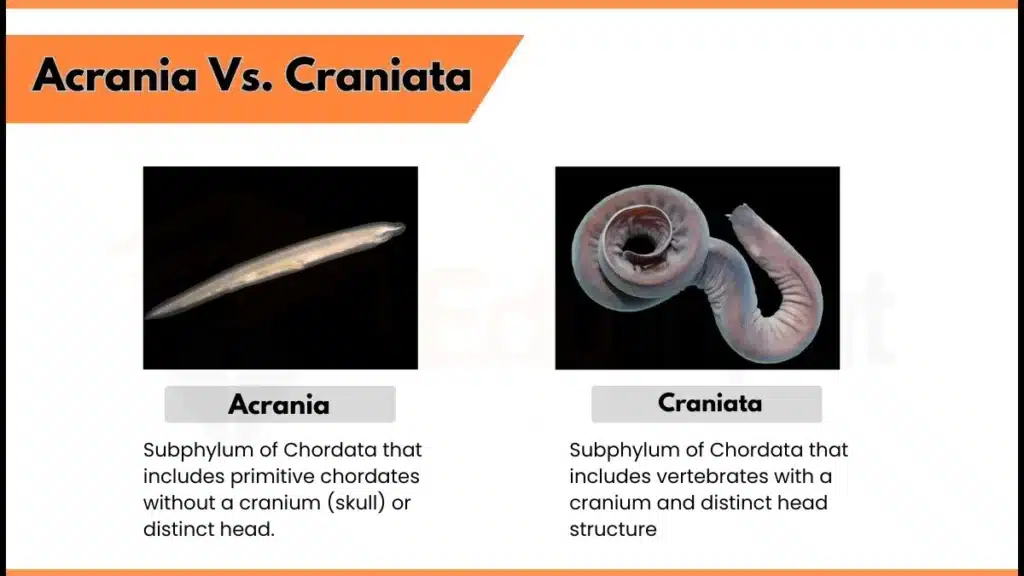
Here are some key differences between Acrania and craniata:
| Character | Acrania | Craniata |
| Definition | Acrania is a subphylum of Chordata that includes primitive chordates without a cranium (skull) or distinct head. | Craniata is a subphylum of Chordata that includes vertebrates with a cranium and distinct head structure |
| Alternative Name | Cephalochordates | Vertebrates |
| Cranium, Brain, and Jaw | Absent in Acrania | Present in Craniata |
| Head Structure | No distinct head structure | A distinct head structure is present |
| Vertebral Column | Absent. Only a notochord is present | Present. Vertebral column replaces the notochord during development |
| Heart | They lack a heart and their blood does not contain blood cells (corpuscles) | They have a chambered heart and their blood contains blood cells. |
| Circulatory System | Open and primitive circulatory system | Closed and well-organized circulatory system |
| Body Structure | Their complete body is divided into segments with the absence of a distinct head section | Their body is well-developed and contain separate head, neck, trunk and tail. |
| Respiration | Respiration through body surface or pharyngeal slits | Specific respiratory organs such as gills or lungs |
| Feeding Patterns | They feed on tiny particles floating in the water. | They eat plants, invertebrates and other vertebrates. |
| Development | Indirect development through a larval stage | Development can be either direct or indirect |
| Area | Found in marine areas or lives near coastal environments | Found in terrestrial, aquatic, or airborne areas |
| Examples | Branchiostoma, Asymmetron | Petromyzon (lamprey), frog, fish |
File Under:



Leave a Reply