
10+ Examples of Lenz’s Law in Conductive Materials
 written by Sidra Batool
Lenz’s Law states that when the magnetic flux through a conductor changes, an induced current flows in such a direction that its magnetic field opposes the change. This principle arises from conductivity interacting with changing magnetic fields and appears in everyday demonstrations, industrial tools, transportation systems, and cutting-edge technology. Here are more than a dozen real-world scenarios where Lenz’s Law actively shapes behavior.
Examples of Lenz’s Law
In each example given below, a change in magnetic flux (due to a magnet moving, a field changing, or a conductor moving) induces currents in a conductor. By Lenz’s Law, these currents always produce magnetic fields that oppose the change that created them, a direct result of conductivity acting under electromagnetic induction.
1. Magnet Dropping Through a Copper Pipe
When you drop a magnet down a copper pipe, the changing magnetic flux induces eddy currents in the pipe walls. These currents create fields that oppose the magnet’s motion, causing it to fall much slower than in free fall.
The magnet slows down deep inside the pipe because induced currents push back.
2. Swinging Aluminum Plate in a Magnetic Field
An aluminum plate swings between the poles of a magnet and gradually slows down as it cuts the magnetic field. Eddy currents form in the plate, generating magnetic fields that resist its motion.
Each swing loses speed as currents oppose the plate’s change in flux.
3. Magnet Near a Spinning Copper Disk
When a magnet is held close to a rotating copper disk, eddy currents arise in the disk that create magnetic drag, slowing its rotation. The disk resists speed changes as its induced currents oppose the magnet’s field variations.
Rotation slows because induced currents push against the change in field.
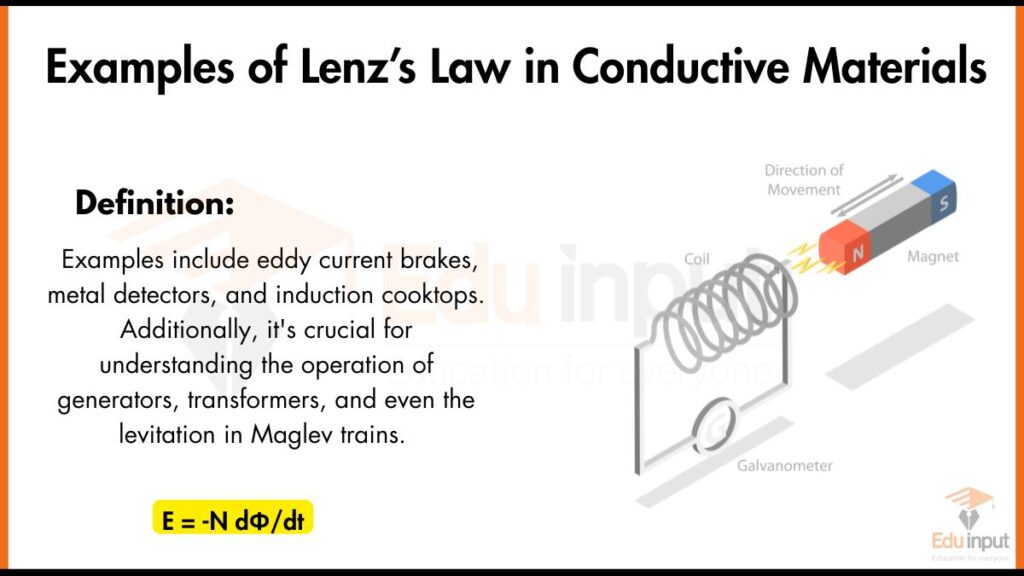
4. Magnet Moving Through a Coil
Pushing a bar magnet in or out of a coil induces a current whose magnetic field opposes the coil’s changing flux. You can observe this as a slight resistance to pushing the magnet.
Moving the magnet stretches more resistance because currents oppose motion.
5. Electric Generators
In a generator, coils spinning in magnetic fields produce a current, and that induced current’s own magnetic field resists the rotation. This is why a generator feels harder to turn when it’s producing electricity.
Generator rotation requires extra effort as induced currents resist motion.
6. Transformers
When alternating current flows through a transformer’s primary coil, the changing flux induces currents in the secondary coil that oppose the change. Lenz’s Law governs the direction of these currents, enabling efficient power transfer.
A secondary coil ‘pushes back’ to balance the magnetic change.
7. Induction Heating
An alternating magnetic field in an induction stovetop induces strong eddy currents in the bottom of a pot. These currents oppose the changing field, and the resistance turns that energy into heat.
Cookware heats directly because induced currents fight changing fields.
8. Electromagnetic Metal Forming
High-current pulses in coils generate changing magnetic fields that induce currents in nearby metal. The induced fields oppose the original flux, exerting force that rapidly reshapes the metal.
Strong pulses reshape metal as induced currents fight formation.
9. Eddy Current Testing
In non-destructive testing, an alternating magnetic field induces eddy currents in metal parts. Disruptions (like cracks) alter the current flow, and the device uses Lenz’s Law to detect them.
Flaws alter induced currents, revealing defects through opposing fields.
10. Magnetic Braking on Trains
When conductive plates on trains pass through magnetic fields, eddy currents form that oppose motion, creating a drag force. This magnetic braking system slows the train smoothly and wear-free.
Trains slow down without wearing brakes because fields push back.
11. Eddy Current Brakes in Vehicles
Trucks and roller coasters use eddy current brakes—conductive disks entering magnets induce currents that oppose rotation. These brakes slow vehicles smoothly since there’s no physical friction.
Brakes operate silently by resisting rotation with induced currents.
12. Regenerative Braking in Electric Vehicles
When an EV slows, its motor acts as a generator: the induced currents oppose the vehicle’s motion and send energy back to the battery. This efficient braking transforms motion into stored electric energy.
EVs capture motion energy as currents oppose wheel movement
13. Wireless Charging Pads
A charging pad uses an alternating magnetic field to induce currents in the receiving device’s coil. Those currents create a field that opposes the original, and their energy is captured and used to charge the device.
Your phone charges wirelessly because its coil pushes back against the pad’s field.
14. Metal Detectors
Metal detectors generate changing magnetic fields near the ground. Conductive objects induce eddy currents that create opposing fields, and the detector senses this change to signal the presence of metal.
Detected metals respond with currents that push against the detector’s field.
15. Electromagnetic Building Dampers
During earthquakes, conductive plates in building dampers move through magnetic fields, generating eddy currents that resist motion. This magnetic opposition helps reduce vibrations and stabilize structures.
Buildings stay steady as dampers resist quake motion through induced currents.
Moving a Magnet toward a Wire Loop
When a bar magnet is moved toward a conductive wire loop, the magnetic flux through the loop increases. According to Lenz’s Law, the loop induces a current that creates a magnetic field opposing the increase.
- As the magnet approaches, the loop senses a growing magnetic field.
- It induces a current in the opposite direction, producing a magnetic field that repels the approaching magnet.
- This opposing current is exactly what Lenz’s Law predicts, it resists the change in magnetic flux.
When a magnet approaches a wire loop, Lenz’s Law ensures the loop generates a current that opposes the change in magnetic field.


Leave a Reply