
10+ Examples of Linear Algebra Applications in Computer Science
 written by Sidra Batool
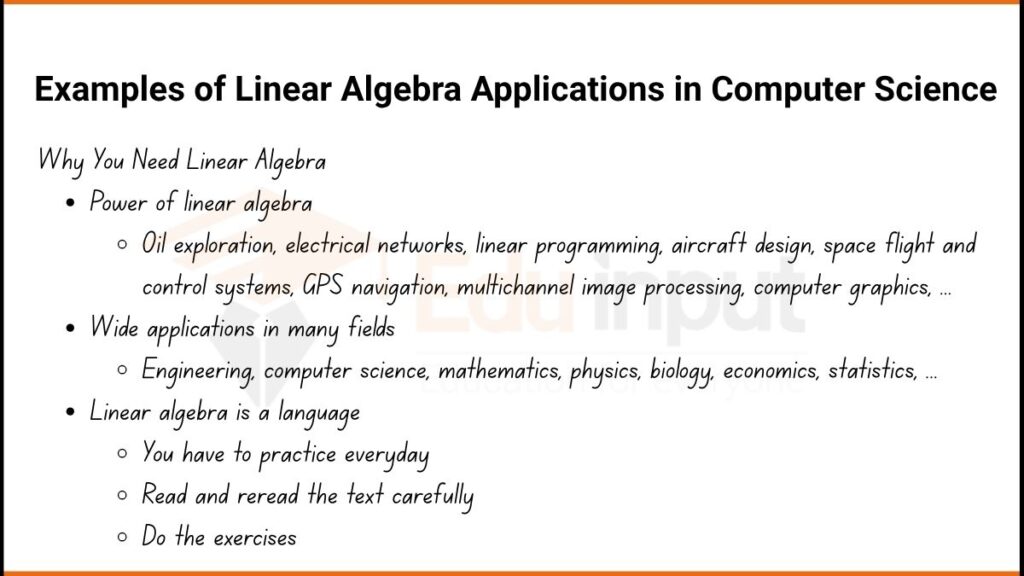
Linear algebra is one of the most foundational branches of mathematics used in computer science. It deals with vectors, matrices, linear transformations, and systems of linear equations, tools that power everything from 3D video games to machine learning algorithms. In this post, we’ll explore real-world and computer science-specific applications of linear algebra, showing how concepts like matrices, eigenvectors, and vector spaces solve complex problems in technology.
Examples of Linear Algebra in Computer Science
Here are some applications of linear algebra in computer:
1. 3D Transformations in Computer Graphics
In video games and simulations, objects don’t just sit still, they move, rotate, zoom in, and change shape. All of this happens through matrix multiplication. Every 3D object is represented by a set of vectors. When we apply 4×4 transformation matrices, we can rotate, scale, or translate those vectors to animate characters, shift camera angles, or move objects through space.
Linear algebra in computer science makes this possible by encoding movements in matrix form, which the computer multiplies with object coordinates to update their positions in real time.
2. Character Rigging and Animation
Animation software like Blender uses skeleton-based animation to bring characters to life. A digital skeleton made of joint hierarchies is controlled by matrix operations. These matrices control how one bone affects the others and how transformations propagate throughout the body.
By manipulating these matrices, animators achieve smooth motion—walking, waving, or blinking—ensuring every frame is mathematically correct and physically consistent.
3. Virtual Reality (VR) Rendering
To render immersive 3D worlds in virtual reality, projection matrices are used to map 3D environments onto 2D displays inside VR headsets. These transformations also adjust dynamically based on head movement tracking.
Linear algebra allows the system to compute the scene from the user’s viewpoint in real time, making the experience interactive and lifelike. These are powerful matrix applications in graphics that keep users engaged in digital worlds.
4. Neural Network Training in Machine Learning
Neural networks—the engines behind AI systems like ChatGPT—rely on matrix and tensor operations. During training, weight matrices are adjusted through a process called backpropagation, where the system learns from errors using gradient descent.
Linear algebra ensures that this learning is fast and scalable, especially with libraries like PyTorch and TensorFlow that use linear transformations across millions of data points.
5. Principal Component Analysis (PCA)
PCA is a dimensionality reduction technique used in data science to simplify large datasets while retaining their essential patterns. It works by computing the eigenvectors and eigenvalues of a covariance matrix to find the directions of maximum variance.
This technique helps visualize high-dimensional data and extract the most relevant features, proving how eigenvectors in machine learning simplify complexity.
6. Recommendation Systems
Platforms like Netflix or Spotify use matrix factorization to recommend content. They build a large matrix representing user-item interactions (e.g., user ratings) and apply techniques like singular value decomposition (SVD) to break it into smaller components.
These simplified matrices capture patterns like user preferences or item similarity, allowing the system to predict what users might like next.
7. Linear Regression Models
Linear regression, a fundamental predictive model in statistics and machine learning, uses systems of linear equations to fit a line to data points. Solving the normal equations or applying least squares optimization involves matrix algebra.
It’s used in applications like sales forecasting, financial modeling, and risk prediction, showing how linear algebra in computer science applies to real business problems.
8. Hill Cipher in Cryptography
The Hill cipher is a classical encryption method that uses matrix multiplication to encode messages. Plaintext is converted into a vector and multiplied by a key matrix, then transformed back into letters using modular arithmetic.
Though basic, the Hill cipher demonstrates how linear algebra contributes to data security and encryption by scrambling and unscrambling messages mathematically.
9. Facial Recognition in Image Processing
In facial recognition systems, images are treated as matrices of pixel values. Techniques like eigenfaces use eigenvectors to reduce image dimensions and capture essential features for comparing faces.
These linear algebra methods are crucial in verifying identities in phones, security cameras, or airport biometrics. The combination of matrix operations and eigen decomposition makes this technology possible.
10. PageRank Algorithm in Web Search
Google’s PageRank algorithm models the internet as a directed graph, where each website is a node and hyperlinks are edges. A transition matrix is built and its eigenvector (representing the steady-state distribution) is computed to rank pages based on importance.
This powerful use of eigenvectors in machine learning and web search transformed how we navigate the internet.
11. JPEG Image Compression
JPEG compression uses the discrete cosine transform (DCT) to convert pixel data into frequency components, which are easier to compress. DCT is a linear transformation performed using matrix operations.
By keeping only the most important frequency values, JPEG reduces file size without losing much visual quality, showing how linear algebra simplifies multimedia storage.
12. Robotic Arm Movement
In robotics, especially manufacturing, the position and orientation of robotic arms are calculated using rotation and transformation matrices. Each joint’s movement affects the others, and the overall pose is found using matrix chains.
This allows robots to assemble electronics, paint cars, or perform surgeries with incredible accuracy—all powered by matrix math.
13. Quantum Computing Simulations
In quantum computing, quantum states are vectors in a complex vector space, and quantum gates are represented by unitary matrices. Simulating qubits and their interactions involves advanced linear algebra, especially tensor products and matrix multiplication over complex numbers.
Libraries like Qiskit simulate quantum behavior using these principles, pushing the boundaries of future computing.
14. Optimizing Network Traffic
Communication networks (e.g., the internet) can be modeled using adjacency matrices, representing the connections between servers or routers. Linear systems are then solved to optimize data routing, reducing lag and congestion.
Whether it’s optimizing routes or identifying bottlenecks, linear algebra helps make our networks faster and smarter.
Summary – Linear Algebra in Computer
| Application Area | Example Use Case | Key Linear Algebra Concept |
| Computer Graphics | 3D object transformations | Matrix multiplication |
| Animation | Skeletal rigging in animated characters | Transformation matrices |
| Virtual Reality | VR headset rendering and tracking | Projection matrices |
| Machine Learning | Neural network training | Tensor operations |
| Data Science | PCA for dimensionality reduction | Eigenvectors, covariance matrices |
| Recommendations | Netflix and Amazon suggestions | Matrix factorization (SVD) |
| Regression Models | Forecasting and predictions | Solving linear equations |
| Cryptography | Hill cipher encryption | Matrix multiplication + modular math |
| Facial Recognition | Eigenface feature extraction | Eigenvectors from image matrices |
| Search Engines | Google PageRank | Eigenvector of link matrix |
| Image Compression | JPEG format | Discrete cosine transform (DCT) |
| Robotics | Robotic arm movement | Rotation/translation matrices |
| Quantum Computing | Qubit simulations | Unitary matrices, vector spaces |
| Network Optimization | Data flow management | Adjacency matrices, linear systems |


Leave a Reply