
10+ Examples of Algorithmic Thinking in Computer
 written by Sidra Batool
Algorithmic thinking is the mental process of solving problems by breaking them into precise, logical, and step-by-step procedures, also known as algorithms. In computer science, it’s the backbone of designing programs that automate tasks, solve data problems, or simulate decisions. But algorithmic thinking isn’t limited to code; it also shows up in everyday life, from morning routines to GPS navigation.
Below are 10+ examples of algorithmic thinking, organized across computer science, real-world tech, and familiar daily activities.
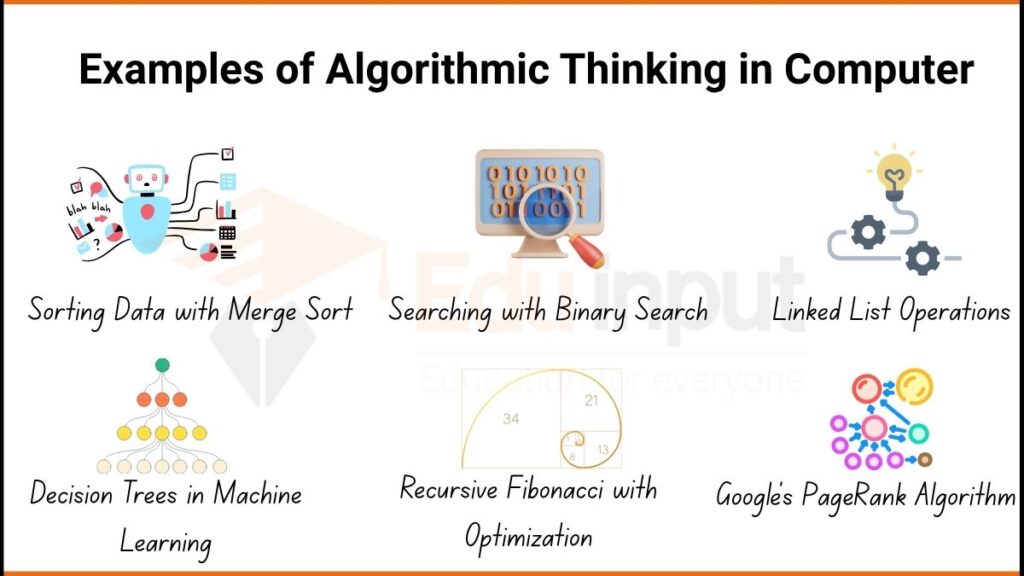
Examples of Algorithmic Thinking in Computer
1. Sorting Data with Merge Sort
Sorting a list, like names or numbers, relies on algorithmic thinking to determine the best way to arrange data. Merge Sort is a classic example. It breaks the list into smaller pieces, sorts each piece, and then merges them back together in order. The algorithm follows a recursive, divide-and-conquer approach.
Each step—splitting, sorting, and merging—is clearly defined, showcasing how algorithmic thinking builds efficient data solutions.
2. Searching with Binary Search
Binary Search finds an item in a sorted list by dividing the range in half repeatedly. If the target value is smaller than the middle, it looks in the left half; if larger, it checks the right. This repeatable halving process continues until the item is found or the range is empty.
It’s a textbook case of algorithmic thinking: each step follows a decision based on comparisons and range narrowing.
3. Linked List Operations
Working with a linked list—a linear data structure where each element points to the next—requires precise steps. Inserting or deleting a node involves updating pointers, checking if you’re at the head or tail, and making sure connections aren’t broken.
These logical, ordered actions are a clear application of step-by-step problem solving in computer science.
4. Decision Trees in Machine Learning
A decision tree is a machine learning model that classifies data by asking a series of questions. For example, is a loan applicant’s income above $50k? If yes, move to the next condition. If no, classify as “low risk.”
This recursive approach, where each decision leads to a new branch, illustrates algorithmic thinking in artificial intelligence.
5. Recursive Fibonacci with Optimization
The Fibonacci sequence (0, 1, 1, 2, 3, 5…) is often computed using a recursive algorithm, where each number is the sum of the two before it. Basic recursion is inefficient, but memoization stores results to avoid repeating work.
This blend of recursion and optimization demonstrates how algorithmic thinking improves performance through clever step management.
6. Google’s PageRank Algorithm
PageRank uses an algorithm to rank websites based on how many other pages link to them. It models the web as a graph and updates page scores iteratively until values stabilize.
Every iteration follows a defined rule set, showing how algorithmic thinking structures the web into a searchable hierarchy.
7. GPS Navigation Systems
Dijkstra’s algorithm, used in GPS apps, finds the shortest path from point A to point B by exploring all possible routes and updating distances. It continues until it reaches the destination with the least cost.
The step-by-step exploration of nodes and distances demonstrates algorithmic thinking applied to real-world travel.
8. Adaptive Testing Systems
Tests like the GRE use adaptive algorithms that change the difficulty of the next question based on how you answered the current one. The process involves scoring, comparing against thresholds, and selecting the next best question.
It’s a modern example of how algorithmic thinking personalizes user experiences through conditional logic.
9. Online Shopping Recommendations
E-commerce platforms use recommendation algorithms to suggest products. These involve analyzing behavior, scoring item similarity, and filtering results.
Each recommendation follows a pipeline: input data → similarity matrix → ranked list → display. That’s algorithmic thinking in action, tailored for personalization.
10. Morning Routine as an Algorithm
Your morning routine—wake up → brush teeth → shower → eat breakfast—is a sequence of actions repeated daily. You might even have conditional steps: if it’s a workday, wear formal clothes; if not, dress casually.
This is a clear real-life case of algorithmic thinking in everyday life, structuring tasks into repeatable steps.
11. Searching for a Library Book
Looking for a book involves multiple steps: search the catalog, locate the genre section, scan shelves alphabetically, check the title, pull the book. You follow a mental algorithm to find it efficiently.
This everyday behavior mimics data retrieval algorithms, bridging real-world action with computer logic.
12. Cleaning a Room
Cleaning isn’t random—it’s usually planned: gather items → group by type → store each in place → vacuum → check what’s left. These steps form a tidy process, often repeatable and optimized over time.
It’s an example of step-by-step problem solving that mirrors how computers solve organizing tasks.
13. Following a Cooking Recipe
A recipe lists steps like: chop vegetables → sauté onions → add spices → simmer for 20 minutes. You follow instructions, often using if-then logic (e.g., if water boils, reduce heat).
Cooking is a common example of algorithmic thinking outside tech—structured, logical, and result-driven.


Leave a Reply