
Difference Between Domestic Marketing and International Marketing
 written by Sana Sehar
Key Difference
Domestic and international marketing are distinguished by the scope and complexity of their operations. Domestic marketing focuses on selling products and services within the marketer’s home country, dealing with a single set of economic, cultural, and regulatory environments. On the other hand, international marketing involves marketing across various countries, each with its unique challenges, including different economic conditions, cultural nuances, legal regulations, and market dynamics.
Comparative Analysis
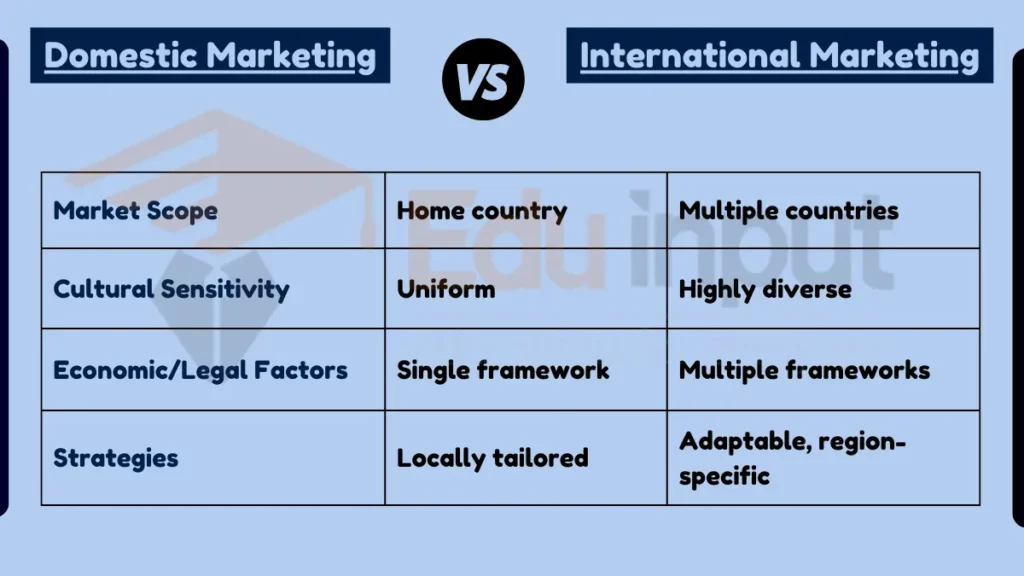
- Market Scope and Environment:
- Domestic Marketing: Limited to home country, more homogenous market.
- International Marketing: Across multiple countries, and diverse markets.
- Cultural Sensitivity and Adaptation:
- Domestic Marketing: Generally uniform cultural considerations.
- International Marketing: Requires understanding and adapting to diverse cultures.
- Economic and Legal Factors:
- Domestic Marketing: Single economic policy and legal framework.
- International Marketing: Multiple economic and legal environments.
- Marketing Strategies:
- Domestic Marketing: Strategies tailored to local preferences and norms.
- International Marketing: Strategies must be adaptable and sensitive to regional differences.
- Risk and Complexity:
- Domestic Marketing: Comparatively lower risk and complexity.
- International Marketing: Higher risk due to variability across markets.
Table Summary:
| Feature | Domestic Marketing | International Marketing |
|---|---|---|
| Market Scope | Home country | Multiple countries |
| Cultural Sensitivity | Uniform | Highly diverse |
| Economic/Legal Factors | Single framework | Multiple frameworks |
| Strategies | Locally tailored | Adaptable, region-specific |
| Risk/Complexity | Lower | Higher |
Domestic marketing operates within a more predictable, homogenous framework, while international marketing requires navigating diverse and often complex global landscapes, demanding greater adaptability and sensitivity to a variety of cultural, economic, and legal factors.


Leave a Reply