
10+ Examples of Algorithms in Computer Science
 written by Sidra Batool
What is an Algorithm in Computer Science?
An algorithm in computer science is a set of step-by-step instructions designed to solve a problem or perform a task. Just like a recipe guides you in making a dish, an algorithm guides a computer to perform specific actions in a logical order. Algorithms are the foundation of all computer programs and systems. From sorting data to finding the best route on Google Maps, they help us manage and automate real-world processes.
In this article, we will discuss examples of algorithms in computer science and how they are used in the real world.
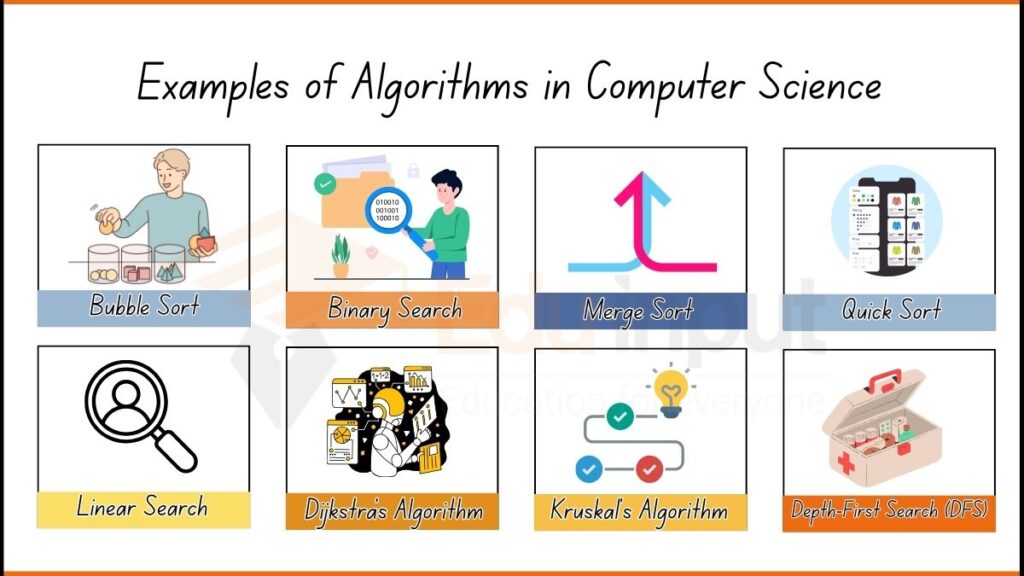
Sorting and Searching Algorithms Examples
These algorithms help organize and locate data quickly, which is essential in almost every software application.
1. Bubble Sort
Bubble Sort is a basic sorting algorithm that works by comparing two adjacent elements in a list and swapping them if they are in the wrong order. It repeats this process until the entire list is sorted. Although it’s not efficient for large datasets, it’s commonly used in educational settings to introduce the concept of sorting algorithms in computer science.
For example, in a classroom project where students write their first sorting program, Bubble Sort helps them understand how algorithms work by manually visualizing the steps.
2. Binary Search
Binary Search is a highly efficient way to find an element in a sorted list. It works by repeatedly dividing the list in half and checking which side the target item is on. This reduces the search time dramatically.
In real-world algorithm applications, Binary Search is used in search bars, dictionaries, and databases. For instance, when you look up a word in an online dictionary, Binary Search helps find it almost instantly.
3. Merge Sort
Merge Sort is a divide-and-conquer algorithm that breaks a list into smaller parts, sorts them, and then merges them back together. It is much faster than simpler methods like Bubble Sort for large datasets. In applications like Excel or Google Sheets, Merge Sort helps when users sort thousands of entries by name or value quickly. It’s one of the most efficient sorting algorithm examples used in data analysis tools.
4. Quick Sort
Quick Sort is another divide-and-conquer algorithm that picks a pivot value and rearranges elements so smaller values come before the pivot and larger ones follow it. Then it recursively sorts the smaller lists. It’s widely used because it performs very well on average.
For example, many programming languages like Python and Java use Quick Sort in their internal sorting functions, making it a key algorithm in computer science.
5. Linear Search
Linear Search goes through each element in a list, one by one, to find a match. It’s simple but effective for small or unsorted lists. When you search for a file on your desktop manually or look through a short contact list, Linear Search is at play. It’s an easy way to understand how basic search algorithms work.
Graph and Optimization Algorithms Examples
These algorithms are used when working with networks, paths, or systems that need the most efficient solution, like maps, logistics, or games.
6. Dijkstra’s Algorithm
Dijkstra’s Algorithm finds the shortest path between two points in a network. It calculates the lowest-cost route step by step, which is crucial in applications like GPS navigation. When you ask Google Maps for directions, it uses Dijkstra’s Algorithm behind the scenes to give you the fastest route. This is one of the most recognized graph algorithm examples used in everyday life.
7. Kruskal’s Algorithm
Kruskal’s Algorithm helps connect points (nodes) with the least total cost, forming a minimum spanning tree. It’s especially useful in network design. For example, when a utility company builds power lines between cities, they use Kruskal’s Algorithm to find the cheapest way to connect them without wasting resources. It’s one of the essential optimization algorithms in infrastructure planning.
8. Depth-First Search (DFS)
DFS explores as far as possible down a path before backtracking. It’s useful for exploring possibilities or detecting cycles in data structures. In video games or puzzle-solving apps, DFS is used to navigate mazes or determine all the possible outcomes from a given situation. It’s also used in website crawlers that go deep into a site’s structure.
9. Breadth-First Search (BFS)
Unlike DFS, BFS explores all nodes at the current depth before moving deeper. It’s ideal for finding the shortest path in unweighted graphs. For instance, in social media, when you see “mutual friends” or connections on LinkedIn, the system may be using BFS to find the shortest connection path between users. This is a practical application of algorithms in computer science used in social networks.
Real-World and Specialized Algorithms Examples
These algorithms go beyond sorting and pathfinding. They power recommendation engines, web search, and complex problem-solving in daily life.
10. PageRank (Google Search)
PageRank is an algorithm created by Google that ranks websites based on how many other pages link to them. It helps determine the most relevant pages for your search. If you search “history of Egypt,” PageRank helps display the most trustworthy and connected sources first. It remains one of the most important real-world algorithm applications in digital marketing and information retrieval.
11. Recommendation Algorithms (e.g., Netflix, Amazon)
These algorithms analyze your behavior and compare it with other users to suggest products or content. They use collaborative filtering or matrix factorization to predict your interests. On Amazon, for example, if you buy a camera, you’ll be shown batteries or cases others also bought.
In Netflix, these algorithms suggest shows you’re likely to enjoy. These personalized recommendations show how algorithms in computer science shape your online experience.
12. Image Processing Algorithms (Medical Imaging)
Image processing algorithms analyze and enhance images for better clarity or feature detection. In hospitals, algorithms like edge detection and neural networks help doctors examine X-rays, CT scans, or MRIs.
These algorithms identify tumors, detect fractures, and even assist in surgeries. This is a powerful example of algorithm applications saving lives in healthcare.
13. A (A-Star) Algorithm*
A* Algorithm is used to find the shortest path more efficiently by using heuristics—smart guesses—to guide its search. It is widely used in video games for enemy pathfinding, as well as in modern GPS applications where it balances accuracy with speed.
If you’re playing a game where enemies navigate complex terrain realistically, A* is likely powering that behavior.
14. Dynamic Programming (Knapsack Problem)
Dynamic programming breaks down a problem into smaller subproblems, solves each once, and stores the result. It’s useful in optimization scenarios like the Knapsack problem, where the goal is to pick the best combination of items without exceeding a weight limit.
In real life, this algorithm is used in delivery systems, budgeting, or scheduling resources in factories. It’s a classic example of problem-solving using algorithm techniques.


Leave a Reply