
13+ Practical Examples of Conductivity in Electrical, Thermal, and Measurement Applications
 written by Sidra Batool
Conductivity is the ability of a material to let electricity or heat flow through it. It’s a fundamental concept that powers everything from cities to smartphones. Here we will discuss real-world applications of electrical, thermal, and measurement-based conductivity, showing both traditional uses and modern innovations.
Electrical Conductivity Applications
Electrical conductivity determines how well a material allows electric current to pass. It’s measured in siemens per meter (S/m) and is a cornerstone of energy and electronic system design.
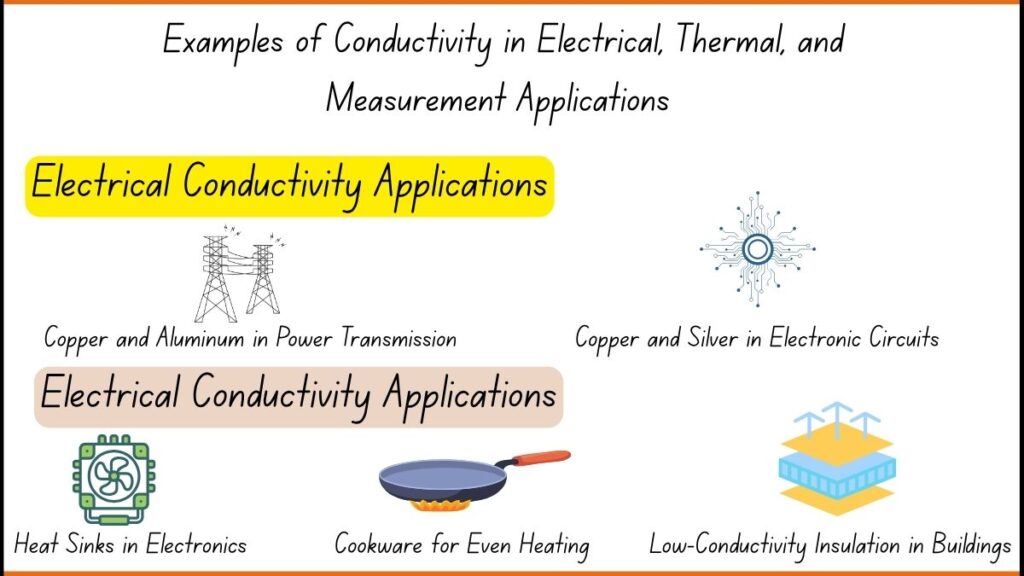
1. Copper and Aluminum in Power Transmission
Materials like copper (5.96 × 10⁷ S/m) and aluminum (3.77 × 10⁷ S/m) are essential for efficient long-distance electricity transmission. Since “copper wires light up cities with low resistance, making power delivery efficient,” power grids around the world rely on these metals to reduce energy losses.
2. Copper and Silver in Electronic Circuits
In smartphones, laptops, and TVs, copper traces and silver contacts ensure uninterrupted signal flow. Engineers choose these materials because “electronic circuits use copper and silver to deliver fast, clean signals,” ensuring performance and device reliability.
3. Carbon Nanotubes in Battery Electrodes
Advanced batteries increasingly use carbon nanotubes or graphene (conductivity ~10⁸ S/m) to enhance electrode performance. This is why “carbon nanotubes in EV batteries boost conductivity for quick charging,” a feature critical to the electric vehicle revolution.
4. Conductive Inks in Flexible Electronics
Graphene- and silver-based conductive inks are transforming wearable tech, RFID tags, and printed electronics. By printing circuitry directly onto flexible substrates, manufacturers take advantage of the fact that “conductive inks bring circuits to fabrics and plastics for wearable tech.”
5. Lightning Protection Systems
Lightning rods protect buildings by channeling massive electrical currents safely into the ground using high-conductivity copper rods. As engineers note, “copper rods in buildings direct lightning safely into the earth,” preventing fires and structural damage during storms.
Thermal Conductivity Applications
Thermal conductivity refers to how efficiently heat moves through a material. It’s measured in watts per meter per kelvin (W/m·K), and plays a crucial role in thermal management across various industries.
6. Heat Sinks in Electronics
Materials like copper (400 W/m·K) and aluminum (200 W/m·K) are widely used in heat sinks for CPUs and LEDs. These devices stay functional and cool because “laptops stay cool thanks to heat sinks that pull heat away from chips.”
7. Cookware for Even Heating
Copper and aluminum cookware are favorites in kitchens because they ensure consistent heat distribution. As chefs often say, “copper pots heat quickly and evenly, perfect for cooking meals right.”
8. Low-Conductivity Insulation in Buildings
Foam and fiberglass insulation are excellent at keeping heat from escaping. Builders choose these materials because “insulation materials block heat loss, keeping homes warm in winter” and reducing energy bills.
9. Heat Dissipation in LED Lighting
To avoid burnout, LED bulbs often include aluminum substrates that conduct heat away from the light source. This is crucial because “aluminum keeps LEDs cool so they last for years,” increasing bulb longevity.
Conductivity Measurement Applications
Conductivity sensors are used to assess purity, quality, and structural integrity in everything from water treatment to aviation. These applications rely on accurate, real-time conductivity data.
10. Water Quality Monitoring
Conductivity meters are used to test the amount of dissolved salts and minerals in water. Since “high conductivity in water can signal pollution or mineral buildup,” this method is widely adopted in water treatment plants and environmental studies.
11. Soil Conductivity in Agriculture
In modern farming, soil sensors help manage irrigation and fertilizer application. By measuring salinity and moisture, farmers know that “soil conductivity tells farmers when to water or fertilize crops” for optimal yields.
12. Conductivity in Chemical Manufacturing
In chemical plants, sensors track solution concentration to maintain consistency. This is crucial because “conductivity checks in factories prevent chemical mix-ups and waste,” ensuring quality control in sensitive processes.
13. Non-Destructive Metal Testing
Industries like aerospace use eddy current conductivity tests to detect flaws in metal parts. Here, “engineers scan aircraft with conductivity tools to catch hidden damage,” preventing failure in critical components.


Leave a Reply