
15 Examples of Developmental Courses for Students
 written by Areej Khan
Developmental courses are designed to help students improve their skills in a particular area before they move on to more advanced coursework.
These courses can be helpful for students who are struggling in a particular subject, or for students who want to strengthen their foundation in a particular area.
Here are 15 examples of developmental courses that students can choose.
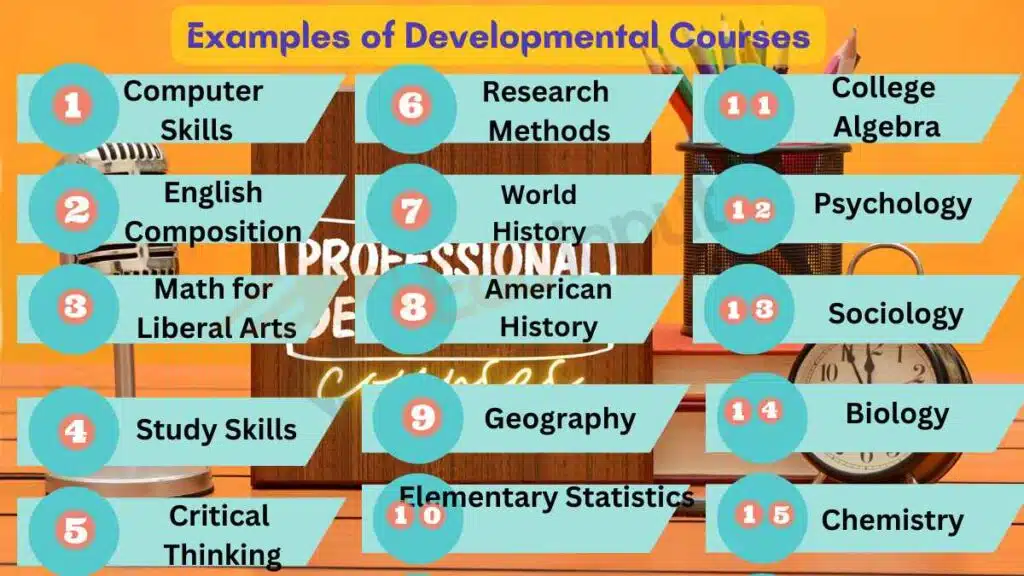
Examples of Developmental Courses
1: Introduction to Computer Skills
This course teaches students the basics of computer use, including how to use a word processor, spreadsheet, and presentation software.
2: English Composition
This course teaches students how to write clear and concise essays.
3: Math for Liberal Arts
This course covers basic math concepts, such as algebra, geometry, and statistics, at a level that is appropriate for students who are not majoring in math.
4: Study Skills
This course teaches students how to study effectively and manage their time.
5: Critical Thinking
This course teaches students how to think critically and evaluate information.
6: Research Methods
This course teaches students how to conduct research and write a research paper.
7: World History
This course covers the major events and trends in world history from ancient times to the present day.
8: American History
This course covers the major events and trends in American history from the colonial period to the Civil War.
9: Geography
This course teaches students about the physical and human features of the Earth.
10: Elementary Statistics
This course introduces students to basic statistical concepts, such as mean, median, and mode.
11: College Algebra
This course covers basic algebraic concepts, such as equations, inequalities, and functions.
12: Introduction to Psychology
This course introduces students to the science of psychology and the major theories of human behavior.
13: Introduction to Sociology
This course introduces students to the study of human society and social interactions.
14: Introduction to Biology
This course introduces students to the basic principles of biology, such as cell biology, genetics, and evolution.
15: Introduction to Chemistry
This course introduces students to the basic principles of chemistry, such as atomic structure, bonding, and reactions.
These courses are a good option for students who are looking for easy developmental courses to help them get started on their college education.
They are also a good option for students who want to strengthen their foundation in key academic areas.


Leave a Reply