
10+ Examples of Malu’s Law- Applications in Everyday Life, Technology, and Science
 written by Sidra Batool
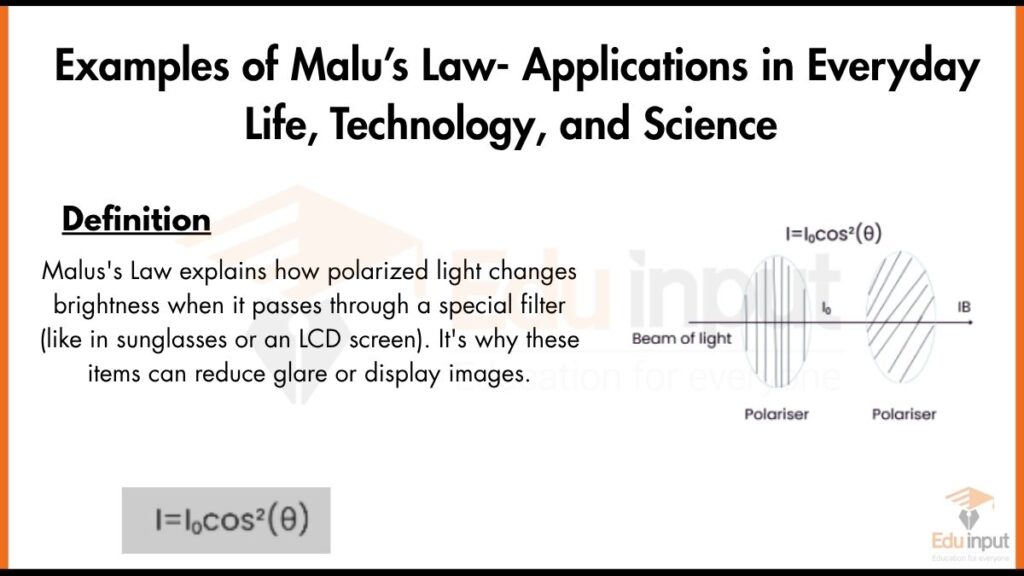
Malus’ Law explains how the intensity of polarized light changes as it passes through a second polarizer (called an analyzer). The amount of light that gets through depends on the angle between the light’s polarization direction and the analyzer’s axis. This principle is written as:
I = I0 cos2θ
Malus’ Law is not just a theoretical rule; it’s used in sunglasses, phone screens, optical fibers, 3D movies, scientific instruments, and even engineering stress analysis. The following examples demonstrate how this law is applied in real-world consumer products, optical technologies, scientific devices, industrial tools, and entertainment systems.
Malu’s Law may seem like a classroom concept, but it shapes the way we experience the world—from sunglasses and smartphone screens to art, cinema, and scientific tools. Whether you’re watching a 3D movie, adjusting your camera lens, or studying stars, Malus’ Law helps manage light intensity through polarization. Its applications span daily life, engineering, medicine, and entertainment, proving how a simple mathematical principle can transform complex systems.
Examples of Malus’ Law
Here are some real-life Examples of Malu’s Law:
1. Polarizing Sunglasses
Sunglasses with polarizing lenses block bright reflections from surfaces like water, snow, or roads. The reflected light is mostly horizontally polarized. These sunglasses have vertical polarizing filters, which reduce the light’s brightness depending on the angle, exactly as Malus’ Law predicts. The more misaligned the light and filter are, the dimmer the glare becomes.
Sunglasses fight glare by following the angle rules of polarized light.
2. Polarizing Camera Filters
Photographers use polarizing filters that can be rotated in front of the lens. These filters help reduce reflections from shiny surfaces like water or glass. The brightness of the light entering the camera changes based on how the filter is angled, just as Malus’ Law describes. By adjusting the filter angle, photographers control how much polarized light is captured.
Turning a lens filter dims reflections, thanks to the light-angle rule.
3. Polarized Watch Screens and Calculators
Some digital screens on watches or calculators become hard to see in sunlight. These displays use polarized light to help control visibility. A polarizing layer on top of the screen adjusts brightness depending on how light from the environment interacts with the display, directly linked to Malus’ Law.
Screen brightness shifts when light angles don’t match the filter.
4. Polarimeters in Chemistry
In chemistry labs, polarimeters measure how much certain substances (like sugar solutions) rotate polarized light. A second filter (called an analyzer) is rotated, and Malus’ Law tells us how the light intensity will change based on the angle. Scientists use this change to measure how much the substance rotated the light.
Polarimeters measure rotation by watching light brightness change with angle.
5. Polarization Microscopy
Special microscopes for studying crystals or plant fibers use two polarizing filters — one before the sample and one after. The light passes through the sample and gets twisted based on its structure. The second filter (analyzer) dims or brightens the view depending on how the light’s new direction matches it, exactly as described by Malus’ Law.
Microscopes reveal hidden textures by rotating filters to change brightness.
6. Spectropolarimeters in Astronomy
Astronomers use spectropolarimeters to study light from stars and galaxies. This light is sometimes polarized due to the presence of cosmic dust or magnetic fields. By rotating a polarizing filter in front of the detector, scientists can see how the light’s brightness changes, allowing them to apply Malus’ Law to learn more about the space object.
Starlight brightness helps astronomers read polarization angles across space.
7. LCD Screens (TVs, Phones, Monitors)
Liquid crystal displays (LCDs) utilize two polarizing filters with liquid crystals sandwiched between them. The liquid crystals twist the light, and how much light comes through depends on the twist angle. The final brightness of each pixel is determined by the angle between the light’s direction and the second polarizer, directly following Malus’ Law.
Each pixel’s brightness depends on how much twist the polarizers allow.
8. Fiber-Optic Communication Systems
In some optical communication systems, light is sent through fibers in a polarized form. Special devices adjust the polarization to control signal strength. Receivers use Malus’ Law to detect how much of the signal is correctly aligned, which affects how much light they detect and decode.
Fiber signals rely on angle-matching to keep light strong and clear.
9. Polarizing Beam Splitters in Labs
In physics experiments or laser setups, polarizing beam splitters send light in different directions based on its polarization. Malus’ Law is used to calculate how much light goes through or reflects, depending on its polarization angle with the beam splitter. This helps control laser beams with high precision.
Beam splitters divide light powerfully based on its angle and filter match.
10. Photoelastic Stress Analysis
Engineers test clear plastic parts under pressure using a method called photoelasticity. Polarized light shines through the stressed part, and a second filter helps visualize colorful patterns based on internal stress. The colors and brightness change because the light’s direction changes and follows Malus’ Law through the second filter.
Stress turns invisible forces into colorful patterns using light angles.
11. Factory Quality Control with Polarizing Filters
Factories use polarizing filters to check for flaws in transparent items like plastic bottles or glass sheets. When polarized light passes through the item and then another polarizer, small defects show up as bright or dark spots. The change in brightness depends on the alignment — a direct application of Malus’ Law.
Factories use filters and angles to spot tiny defects in clear products.
12. 3D Movie Glasses
In 3D movies, two images are projected with different polarizations. The glasses you wear have two polarizing filters, one for each eye. Each lens only lets in the matching image based on polarization, and Malus’ Law controls how much light each eye receives. This separation creates the 3D effect.
3D glasses split the screen’s images using filters that follow light rules.
13. Polarized Art Installations
Some artists use layers of polarizing filters and plastic films to create artworks that change as you move. When you look at these pieces from different angles, the light going through each layer shifts in brightness. This happens because of Malus’ Law — the angle between filters changes the light that reaches your eyes.
Polarized art shifts with your view, revealing new patterns through light alignment.
14. Polarized Stage Lighting
In theaters and concerts, polarized lighting systems can reduce reflections or highlight certain angles on stage. By adjusting the filter angle in front of lights or cameras, technicians can control how much light is seen based on Malus’ Law. This helps create specific moods or effects. Stage lighting gets dramatic with the smart use of light direction and filters.


Leave a Reply