
20+ Examples of Minerals and Their Uses in Everyday Life and Industry
 written by Sidra Batool
Minerals are naturally occurring inorganic solids with a certain chemical composition and crystalline structure.
Quartz, Calcite, Halite (table salt), Pyrite (fool’s gold), Mica, Feldspar, Gypsum, Copper, and Iron are a few examples of minerals.
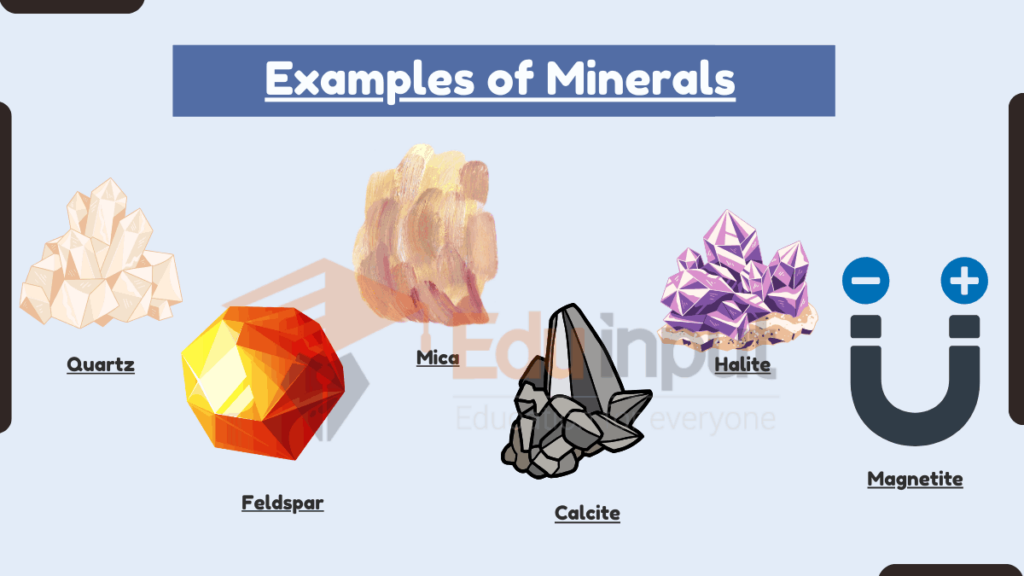
Common Rock-Forming Minerals
This group includes minerals that make up most of the Earth’s outer layer, or crust. These common minerals are found in rocks, dirt, and mountains. Builders, artists, and manufacturers use them in roads, bricks, tiles, and glass. This section highlights key examples of minerals in construction and shows how they are used in everyday life.
1. Quartz (SiO₂)
Quartz is one of the most common minerals on Earth. It is hard, clear, and shiny. People use quartz to make glass for windows, computer chips, kitchen countertops, and watches. Because it is strong and doesn’t wear down easily, quartz is perfect for both homes and technology. Quartz is a great example of a mineral that appears in both construction materials and electronic devices, showing how useful it is in daily life.
2. Feldspar
Feldspar is a light-colored mineral found in many rocks. It is a major ingredient in ceramics, tiles, and glass products. It melts at a low temperature, which helps shape pottery and smooth surfaces. Feldspar is one of the most common minerals in construction and manufacturing. You’ll find it in kitchenware, floor tiles, and even some paints. It shows how minerals are used in both practical and creative ways.
3. Mica
Mica is a shiny mineral that peels into thin sheets. It’s soft, flexible, and can resist heat and electricity. Mica is used in electrical insulation, makeup like eyeshadow, and paint coatings. It gives sparkle to cosmetics and helps prevent electric shocks in appliances. Mica is a clear example of how minerals in daily life can protect us and make things look better at the same time.
4. Calcite (CaCO₃)
Calcite is found in limestone and marble, and it reacts with acid. It is used to make cement, chalk, and antacid tablets for upset stomachs. Construction workers use crushed calcite in roads and buildings. Artists use it in sculptures and schools use it in blackboard chalk. Calcite is one of the best examples of minerals in construction and also appears in health and art supplies.
5. Kaolin
Kaolin is a soft, white clay mineral used in fine china, porcelain, and paper coating. It is also added to face powders, soaps, and medicines that help treat stomach problems. Kaolin is easy to shape and gentle on the body. This mineral is common in both art and personal care, making it a clear example of minerals in daily life and hygiene.
6. Dolomite (CaMg(CO₃)₂)
Dolomite is similar to calcite but contains magnesium. It is often crushed and used in concrete, road building, and glass production. Farmers also use dolomite to balance the pH of soil and add nutrients. Dolomite is an important part of minerals in construction and farming. It helps build stronger structures and grow healthier crops.
Ore and Industrial Minerals
This group includes industrial minerals and ores that are used to make metals, chemicals, batteries, and tools. These minerals in industry play a huge role in factories, construction, farming, and technology. From helping build cars to making fertilizers and phones, these are powerful examples of minerals that support modern life. When we talk about industrial minerals in manufacturing, we are really talking about the materials that power and build the world.
7. Halite (NaCl)
Halite is better known as rock salt. It forms clear cubes and tastes salty. People use halite to flavor food, melt ice on roads, and make chemicals like chlorine. Halite is a perfect example of how one mineral can be used both in homes and in big industries. As one of the simplest examples of minerals in daily life, it shows how minerals help us stay safe, cook, and clean.
8. Magnetite (Fe₃O₄)
Magnetite is a dark, magnetic mineral rich in iron. It is used in steelmaking, which is needed for bridges, tools, cars, and buildings. Magnetite is one of the most important industrial minerals in manufacturing. It also helps purify water and is used in magnets. This strong mineral is a key part of how we shape cities and build machines.
9. Hematite (Fe₂O₃)
Hematite is another iron-rich mineral. It can look red or silver and is a major source of iron for making steel. Hematite is also used as a red pigment in paints and cosmetics. As both a color source and a building block for metal, hematite is a powerful example of how minerals in industry can be useful in both art and construction.
10. Galena (PbS)
Galena is a shiny gray mineral made of lead. It is the main source of lead, which is used in car batteries, pipes, and radiation shields. Galena also sometimes contains silver, making it useful in jewelry and coins. Galena is a great example of how ore minerals provide the materials we need for energy storage and protection.
11. Bauxite
Bauxite is the world’s main source of aluminum. It is not a single mineral, but a mix of aluminum-rich materials. After processing, bauxite becomes aluminum — a metal used in soda cans, planes, bicycles, and foil. Bauxite is one of the top industrial minerals in manufacturing and is essential for modern transportation and packaging.
12. Pyrolusite (MnO₂)
Pyrolusite is a black mineral that contains manganese. Manganese is needed to make batteries, strong steel, and colored glass. Pyrolusite helps power electronics and improves building materials. This is another key example of minerals in industry that help support technology and energy.
13. Barite (BaSO₄)
Barite is a heavy white mineral used to control pressure in oil and gas drilling. It is also used in x-ray tests, paints, and rubber. Because it’s heavy and doesn’t react easily, barite is perfect for energy and medical industries. Barite clearly shows the connection between industrial minerals and important real-world applications.
14. Apatite
Apatite contains phosphorus, which is used in fertilizers to help crops grow. Without apatite, plants wouldn’t get the nutrients they need. It also helps make toothpaste and animal feed. Apatite is an example of a mineral in daily life that quietly supports farming and health.
15. Tungsten
Tungsten is a heavy metal used in strong tools, electrical wires, and even light bulbs. It doesn’t melt easily, so it’s used in things that get very hot. Tungsten is a rare but powerful industrial mineral in manufacturing, and it helps in everything from science labs to sports gear.
Gemstone and Specialty Minerals
This group includes gemstone minerals and other special materials used in jewelry, beauty products, artwork, and technology. These minerals are often chosen for their color, shine, or unique properties. Some are rare and expensive, while others are soft and used in makeup or sculpture. These are perfect examples of minerals in daily life that are both beautiful and useful.
16. Beryl (Be₃Al₂Si₆O₁₈)
Beryl is a mineral that comes in many colors. When green, it is known as emerald, and when blue, it is aquamarine. These are famous gemstone minerals in jewelry like rings and necklaces. Beryl is also used to make beryllium metal, which is found in satellites and aircraft. It is both a sparkling gem and a science mineral.
17. Corundum (Al₂O₃)
Corundum is one of the hardest minerals on Earth — only diamond is harder. When red, it’s called a ruby. When blue, it’s called a sapphire. These precious stones are popular gemstone minerals in jewelry. Corundum is also used in cutting tools and sandpaper because of its hardness. It shows how some minerals are both pretty and powerful.
18. Fluorite (CaF₂)
Fluorite is a colorful mineral that glows under UV light. It is used in decorations, carvings, and to make hydrofluoric acid, which helps produce glass and metal. Fluorite is a great example of a specialty mineral that is useful in both art and industry.
19. Pyrite (FeS₂)
Pyrite is known as fool’s gold because it looks like real gold. It is not used in jewelry, but it is used in making sulfuric acid, which helps create fertilizers, batteries, and paper. Pyrite is a good reminder that not all shiny things are valuable gems — some have secret powers in industrial work.
20. Talc (Mg₃Si₄O₁₀(OH)₂)
Talc is the softest mineral. It feels smooth and is used in baby powder, makeup, and paper products. Talc is a good example of a mineral in daily life that we touch and use without even noticing. It keeps things soft, dry, and easy to use.
21. Gypsum (CaSO₄·2H₂O)
Gypsum is used to make drywall for walls and ceilings, and plaster for art and medicine. It is soft, white, and easy to shape. You see it in buildings, schools, and hospitals. Gypsum is a great example of a common mineral in construction and creative work.


Leave a Reply