
10 Reflection of Light Examples
 written by Qamar Zaman
Reflection of light is the bouncing of light rays off a surface, and its reflection meaning in physics refers to the process where light waves strike a surface and are redirected rather than passing through or being absorbed. Common examples of reflection of light include mirrors, water, and other smooth surfaces. When light hits these surfaces, it bounces back in a predictable direction, creating a visible image or glow.
Examples of Light Reflection
The reflection of light allows images to form and illuminates the world around us. Below are 10 objects that reflect light in ways we encounter every day, from household items to advanced technology.
1. Mirrors
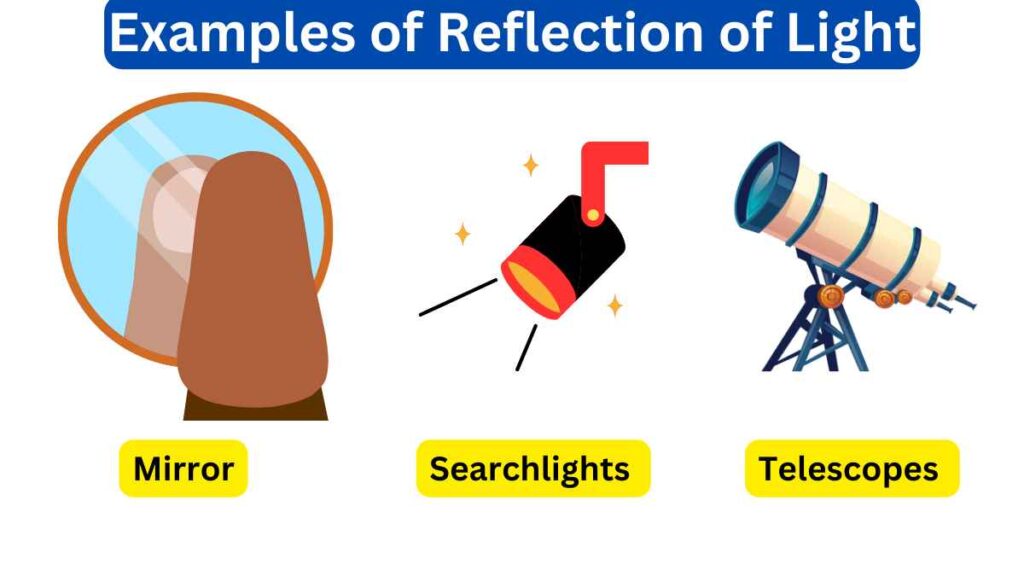
Mirrors are the most recognized example of reflection of light in daily life. Plane mirrors use reflective coatings to produce specular reflections, creating clear virtual images by bouncing light rays back toward the viewer.
2. Reflective Surfaces
Among the most practical reflective surfaces examples are polished metal, glass, and high-gloss paints. These materials bounce light rays falling on them efficiently, which is why they appear to shine so brightly under direct light.
3. Searchlights
Searchlights are a striking example of reflection in action. Parabolic reflectors inside searchlights concentrate and aim reflected light beams in specific directions, allowing them to scan vast stretches of sky with precision.
4. Telescopes
Telescopes use the reflection of light to see the objects in space. The mirrors in reflecting telescopes gather and focus faraway light sources to magnify images of distant objects in space.
5. Lasers
Laser cavities have mirrored ends that reflect light back and forth repeatedly, amplifying it to produce powerful, coherent beams. This is one of the most precise applications of reflection of light in modern technology.
6. Sapphire Gemstones
The brilliant flashes from a sapphire are a natural example of reflected light, caused by diffuse reflection and scattering of light by microscopic imperfections within the stone.
7. Cat’s Eyes
The tapetum lucidum behind a cat’s retina is one of the most fascinating reflective objects examples found in nature. It reflects light back through the rods and cones, significantly enhancing a cat’s vision in low-light conditions.
8. Flash Photography
Photographic flashes produce brief bursts of light that reflect off subjects and into the camera lens to capture images.
9. Fiber Optics
Fiber optic cables contain a mirrored internal coating that reflects light along their entire length, transmitting data over vast distances. This is one of the most impactful applications of reflection of light in modern communications.
10. Corner Reflectors
Corner reflectors, made of three mutually perpendicular surfaces, reflect light back exactly along its incoming path. They are widely used in road safety signs, satellites, and surveying equipment, making them highly practical objects that reflect light in engineering.
The precise engineering and manipulation of reflected light enable many of our most powerful technologies.
What are 5 examples of reflection of light
Five common examples include mirrors, calm water surfaces, polished metal, cat’s eyes, and fiber optic cables. Each demonstrates how light bounces off a surface in a controlled or natural way.
What are 5 objects that reflect light?
Five everyday objects that reflect light are mirrors, spoons, glass windows, aluminum foil, and gemstones. These all share smooth or polished surfaces that allow light to bounce back clearly.
What is an example of reflection in general?
A simple example of reflection is seeing your face in a still pond. The calm water surface acts like a mirror, bouncing light from your face back to your eyes to form an image.
Can you give some light reflection examples from nature?
Yes — moonlight is reflected sunlight, a cat’s glowing eyes in the dark, the shimmer of fish scales underwater, and the glitter of snow on a sunny day are all natural light reflection examples.
What are some reflections we see in daily life?
Reflections appear constantly, in bathroom mirrors, car windshields, shop windows, puddles after rain, and the screens of turned-off devices. Anywhere a smooth surface meets light, some form of reflection occurs.
What does “reflection” mean in the context of light?
In physics, reflection refers to the redirection of light waves when they strike a surface and bounce back rather than passing through it. The angle at which light hits the surface equals the angle at which it reflects, a principle known as the law of reflection.


Leave a Reply