
10+ Examples of Systems of Particles and Rotational Dynamics in Physics
 written by Sidra Batool
In physics, systems of particles involve multiple masses acting together, often analyzed using the center of mass (CM). Rotational dynamics involves motion around an axis, with quantities like torque, angular momentum, and moment of inertia playing key roles. Below are real-world and theoretical examples showing both principles across scales, from springs to stars, from molecules to satellites.
These examples show how systems of particles and rotational dynamics explain motion at every scale, from springs and rods to stars and molecules. It is important to understand how the center of mass behaves and how torque and angular momentum govern rotation in physics, engineering, astronomy, and even everyday objects like wheels and tops.
Systems of Particles Examples
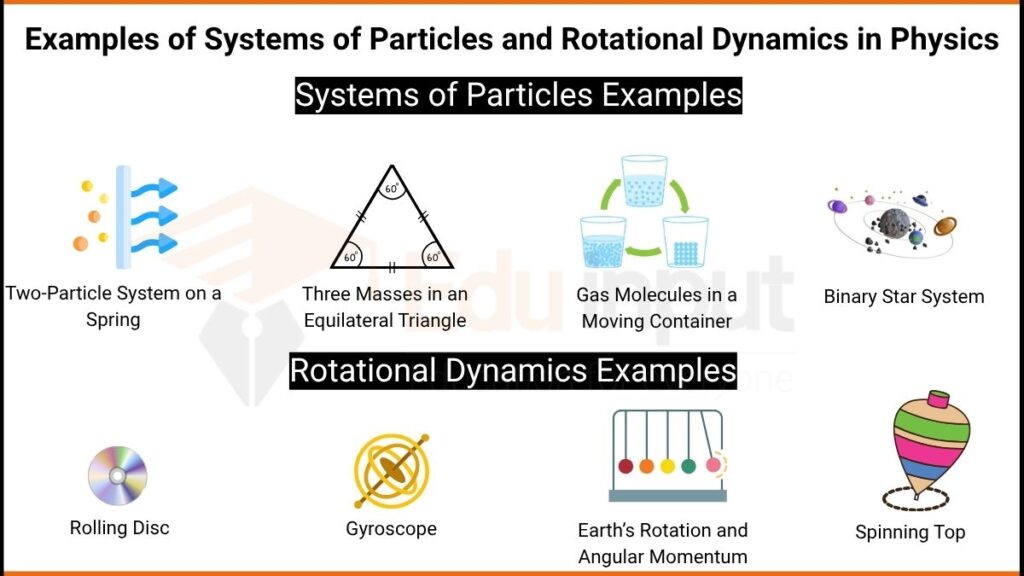
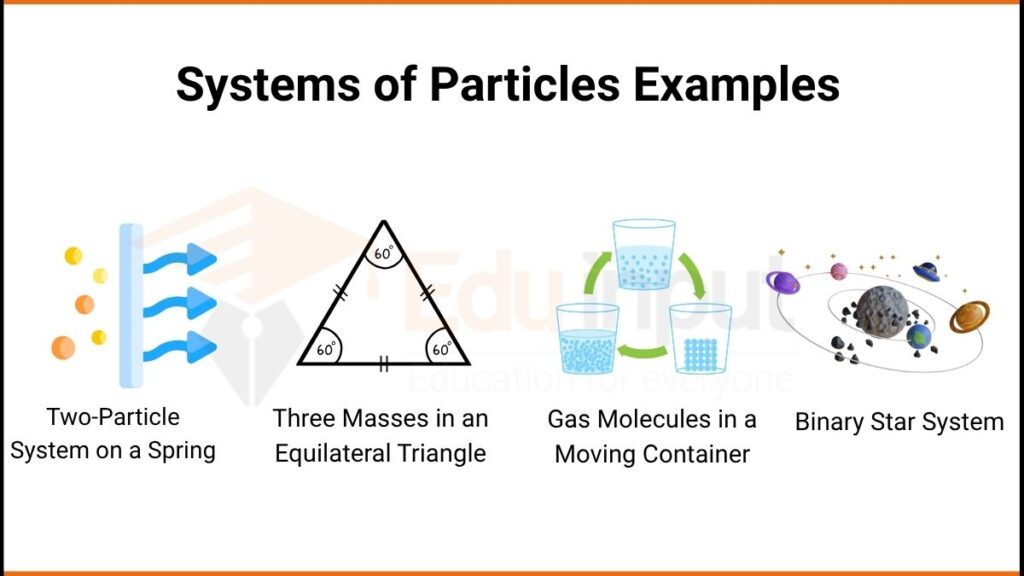
1. Two-Particle System on a Spring
Two equal masses connected by a spring vibrate toward and away from each other. While they oscillate, the center of mass moves in a straight line (or remains still) if no external force acts. This setup clearly shows how particle motion around the CM can be separated from the overall CM motion. It’s a classic example of relative motion and CM independence.
2. Three Masses in an Equilateral Triangle
Place three equal point masses at the corners of an equilateral triangle. The center of mass lies at the geometric centroid of the triangle. If the system is disturbed, all forces and torques can be analyzed to that CM point, simplifying the dynamics. This example demonstrates symmetry and CM calculation in discrete particle systems.
3. Gas Molecules in a Moving Container
In a sealed, accelerating container filled with gas, molecules move randomly. But the center of mass of the entire gas moves along with the container. Despite internal chaos, the gas behaves like a single object when observed externally. This links thermodynamics with classical CM motion.
4. Oppositely Moving Particles
Two equal masses move in opposite directions with equal speed, equidistant from a reference point. Their CM remains stationary even though each particle is moving. This highlights that opposite, symmetric motion results in zero net momentum and static CM. It’s often used in collision problems.
5. Uniform Rod
A thin, uniform rod has mass evenly distributed. Its CM lies at its geometric center. Any translational or rotational motion can be analyzed using this central point. Whether sliding, swinging, or pivoting, the rod behaves like a simple system due to its symmetrical mass distribution.
6. Binary Star System
Two stars orbiting each other—like in a binary system—move around a common center of mass. This CM may appear stationary or move uniformly through space. Astronomers use this CM to calculate orbits and infer the presence of unseen stars or black holes. It shows celestial-scale particle system behavior.
Rotational Dynamics Examples
7. Rolling Disc
A disc rolling without slipping exhibits combined translational and rotational motion. Its kinetic energy is split between the linear motion of the CM and rotation about its axis. Analyzing this motion requires torque, moment of inertia, and angular velocity. It’s a textbook case of energy partitioning in rotational systems.
8. Gyroscope
A spinning gyroscope resists changes to its orientation. When a torque is applied, it begins to precess, changing the direction of its spin axis without tipping over. This stability is due to the conservation of angular momentum. Gyroscopes are used in navigation systems, spacecraft, and drones.
9. Earth’s Rotation and Angular Momentum
Earth slowly rotates on its axis. Due to tidal interactions with the Moon, its rotation gradually slows. However, total angular momentum is conserved. As Earth’s rotation slows, the Moon’s orbit expands. This is a real-world case of angular momentum transfer in planetary systems.
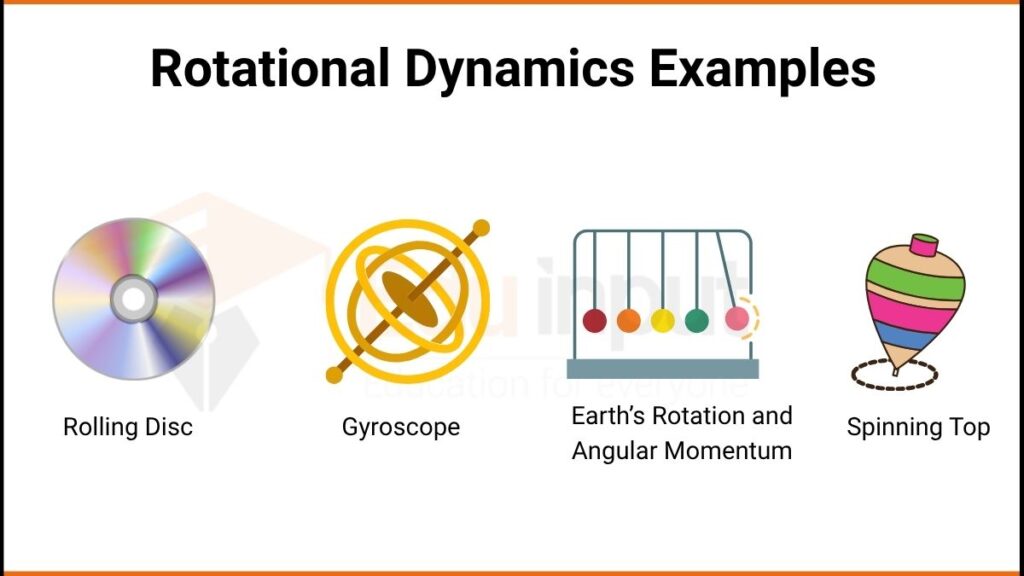
10. Spinning Top
A spinning top remains upright due to its angular momentum. Gravity applies a torque that causes precession—a slow wobble around the vertical. The top doesn’t fall immediately because the rotational axis stays stable. It’s a classic example in torque and rotational equilibrium.
11. Satellite Orbit
A satellite in circular orbit around Earth experiences rotational motion about the planet. Its angular momentum is constant if no torque acts. This principle governs satellite launches, orbits, and corrections. Orbital dynamics is a branch of rotational physics extended to space.
12. Bicycle Wheel
When you ride a bicycle, the spinning wheels help you stay upright. The angular momentum resists tilting, improving balance. This is known as gyroscopic stability, and it’s why a moving bicycle is easier to balance than a stationary one.
13. Figure Skater’s Spin
A spinning figure skater pulls in their arms to spin faster. As the moment of inertia decreases, angular velocity increases to conserve angular momentum. This visually powerful example demonstrates rotational inertia and momentum conservation in human motion.
14. Rotating Hydrogen Molecule (H₂)
Even molecules rotate. In quantum mechanics, a diatomic molecule like H₂ spins about its center of mass. Its rotational energy is quantized. This micro-level example shows how rotational dynamics work at the atomic and molecular scale, with real effects on spectroscopy and molecular physics.


Leave a Reply