
Examples of the Superposition Principle in Waves and Physical Systems
 written by Sidra Batool
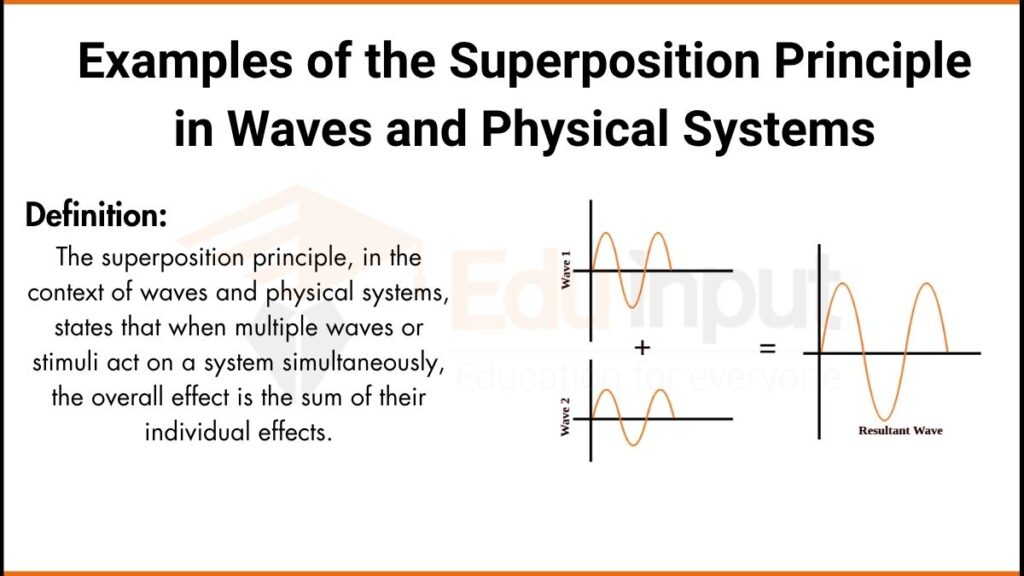
The superposition principle says that when two or more waves meet, their displacements add up. The result at any point is the sum of all the individual waves. This principle explains many natural and engineered systems involving waves. The superposition principle is simple but powerful. It explains how waves combine in water, sound, light, and more. Engineers use it to design circuits, structures, and computers.
Here are 14 clear examples grouped by type.
Mechanical Waves
These examples involve physical waves like water and sound. Superposition creates patterns through wave interaction.
1. Water Waves from Two Stones
When you throw two stones into a still pond, each one creates circular ripples. As the ripples expand, they cross paths. Where a crest meets another crest, the waves combine to form a larger crest. This is constructive interference. Where a crest meets a trough, they cancel out—this is destructive interference. The visible pattern is a direct result of wave superposition. This is often used in labs to demonstrate the principle in two dimensions.
2. Sound Waves in a Room
Imagine two people talking at the same time. Their sound waves travel through the air and reach your ear. The waves do not cancel each other. Instead, the air pressure at your eardrum is the result of all sound waves adding together. Your brain separates the sounds using pitch and direction. This is possible because of the superposition of sound waves. It allows many different sounds to exist in the same space without losing information.
3. Standing Waves on a String
When you pluck a guitar string, waves travel in both directions. These waves reflect from the fixed ends of the string. When they overlap, the result is a standing wave. At certain points (nodes), there’s no movement. At other points (antinodes), movement is at its maximum. The fixed pattern is formed by superposition of forward and backward waves. This determines the pitch and tone of musical instruments.
4. Ocean Wave Interference
In the ocean, waves come from different directions—tides, winds, storms. When they meet, they combine through superposition. Some areas experience larger waves (constructive interference), while others remain calm (destructive interference). In rare cases, these combinations produce rogue waves—massive waves much taller than normal. These events confirm how energy from multiple wave sources can align through superposition.
Electromagnetic Waves
These examples show how light and radio waves combine using superposition.
5. Radio and TV Broadcasts
Radio and television stations broadcast signals at different frequencies. All of these electromagnetic waves travel through the same space. They pass through your environment and devices. These signals do not cancel out. Instead, they superpose and coexist. Your radio or TV tunes in by filtering out the specific frequency you want. This works because electromagnetic waves obey the principle of superposition.
6. Laser Interference Patterns
In lab experiments, laser light is split into two beams. These beams travel separate paths and then recombine. When they meet again, they form interference fringes—alternating bright and dark bands. This is due to constructive and destructive interference from superposition. The laser beams are coherent, meaning they have the same wavelength and phase. Superposition here is used in interferometry, holography, and precise measurements.
7. Wi-Fi Signal Distribution
Wi-Fi routers send signals through homes and offices using radio waves. Multiple routers or devices can operate in the same area. These waves overlap and superpose in space. Devices separate signals based on frequency or coding. This ability to function despite overlapping signals is possible because of superposition. It makes modern wireless communication efficient and reliable.
Technological Applications
These tools and devices use superposition to perform useful functions.
8. Noise-Cancelling Headphones
These headphones have microphones that detect outside noise. They then produce an inverted version of the sound wave. When the two waves meet inside your ear, they cancel each other out through destructive interference. This is a clear example of superposition applied to consumer technology. It reduces engine noise in airplanes or chatter in cafes, providing a quieter listening experience.
9. Audio Mixing in Music Production
In a recording studio, different audio tracks are layered—drums, vocals, guitar. Each sound wave has its own frequency and amplitude. When these tracks are combined, they superpose to create the final mix. Adjusting volume or effects changes the way the waves add together. Music mixing relies on superposition to blend multiple sounds into one cohesive song.
10. Beamforming in 5G Antennas
5G antennas use multiple signal sources to direct waves toward a target device. These signals are timed to arrive in phase at a specific direction. When they meet, they add constructively, strengthening the signal. In other directions, they interfere destructively. This creates a focused beam. Beamforming uses superposition of waves to improve range and speed for wireless communication.
Engineering and Scientific Analysis
Superposition is used to model and solve complex systems in science and engineering.
11. Seismic Wave Interactions
Earthquakes generate multiple types of waves: P-waves, S-waves, and surface waves. These waves move through the Earth’s layers and superpose when they meet. At some locations, their amplitudes add, causing more damage. At others, they cancel, reducing shaking. Seismologists use this principle to analyze wave behavior, predict ground motion, and design earthquake-resistant buildings.
12. Superposition in Electrical Circuits
In linear electrical circuits, the total voltage or current is the sum of the effects from each source. Engineers use the superposition theorem to analyze complex circuits. They turn on one source at a time, calculate its effect, then add all the results. This simplifies design and ensures accurate results, especially in systems with multiple voltage or current inputs.
13. Beam Deflection in Structures
Beams in bridges and buildings carry loads from vehicles, people, or machinery. Each load causes the beam to bend or deflect. Engineers calculate deflection from each load separately. Then, they add them together using superposition. This method ensures the beam doesn’t fail under combined loads. It’s a core concept in structural engineering and mechanical design.
14. Superposition in Quantum Computing
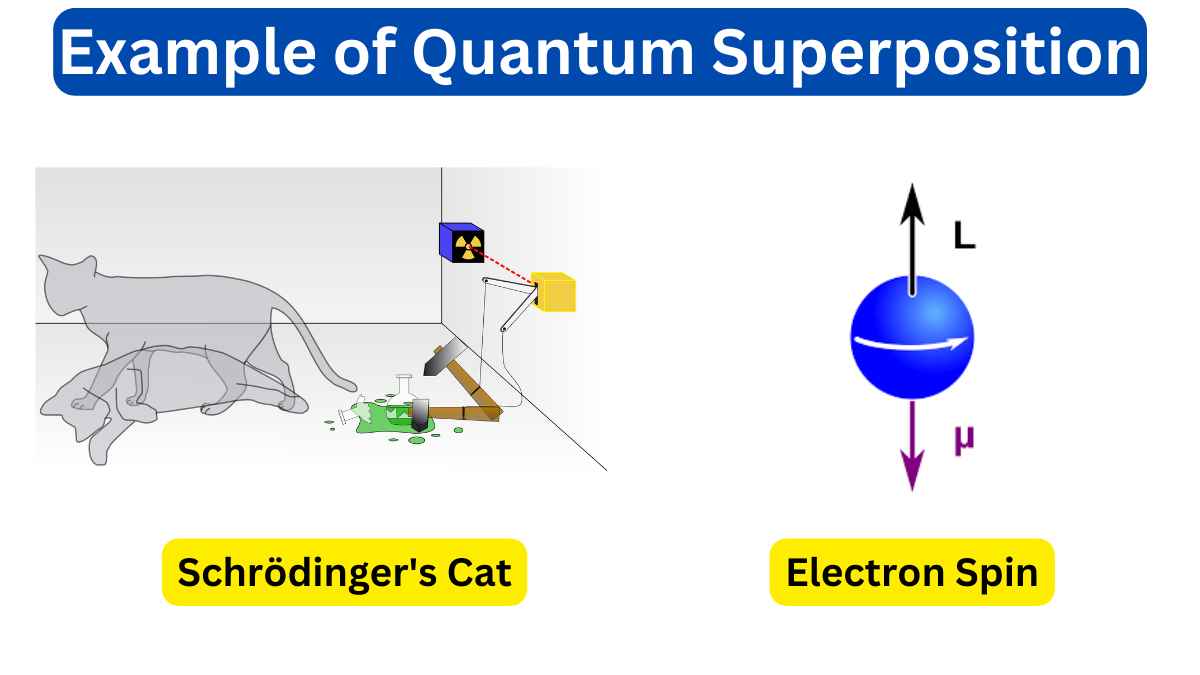
In quantum computing, qubits can exist in multiple states at once—unlike classical bits. This is called quantum superposition. A qubit can be both 0 and 1 simultaneously. This lets quantum computers solve problems in parallel. The concept is rooted in the same principle as wave superposition. It allows powerful processing in fields like cryptography, medicine, and physics simulations.


Leave a Reply