
13+ Real-Life Examples of Torr in Physics and Vacuum Measurement
 written by Sidra Batool
Torr is a pressure unit used in physics to measure low-pressure environments. Scientists, engineers, and technicians use it to control vacuum systems, monitor experiments, and simulate space.
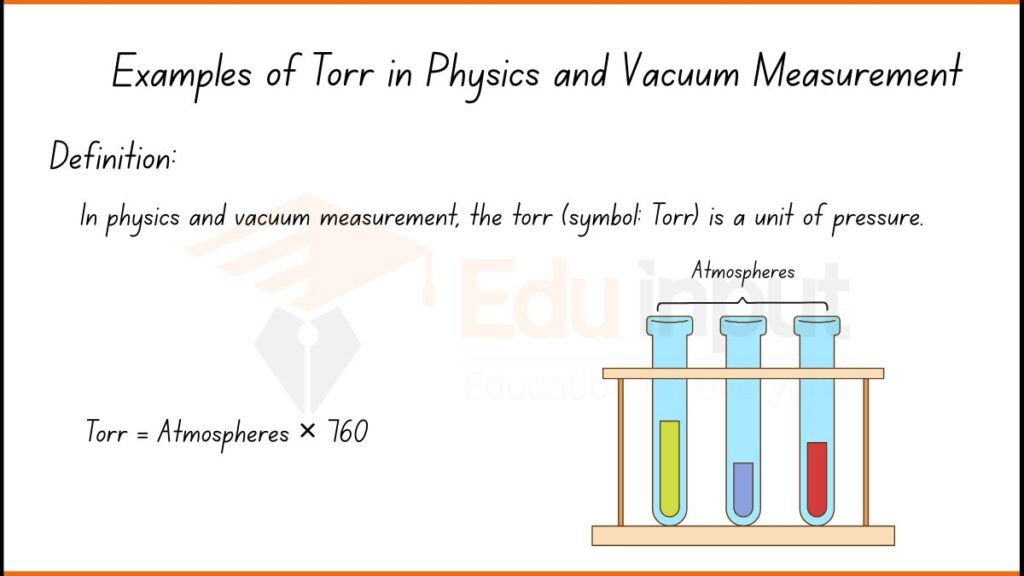
Torr appears in semiconductor manufacturing, freeze-drying, electron microscopes, and barometers. The unit helps measure vacuum levels from laboratory chambers to space simulations. Torr equals 1/760 of atmospheric pressure. That makes it ideal for precise measurements in controlled conditions. Below are clear and simple examples of where and how torr is used across physics, engineering, and science.
Torr is more than just a unit of pressure. It plays a vital role in vacuum science, laboratory physics, chemical engineering, aerospace testing, and more. From making computer chips to studying the stars, torr helps us control pressure with great precision. Whether it’s in millitorr or full torr, its applications are all around us—in research, industry, and medicine.
Torr in Physics Easy Examples
Torr helps scientists measure and control pressure in low-pressure systems like vacuums, labs, and space tests.
Vacuum Testing in Semiconductor Manufacturing
Semiconductor factories need clean environments to make tiny chips. Machines remove air to create a vacuum. They use torr to check pressure inside these vacuum chambers. If the pressure is too high, dust or particles can damage the chips. Most systems operate between 10⁻³ and 10⁻⁶ torr. Torr helps keep conditions perfect for chip-making.
High-Vacuum Physics Experiments
Places like CERN use particle accelerators. These machines shoot particles very fast in tunnels. Inside those tunnels, the pressure must be extremely low, less than 10⁻⁹ torr. Torr is used to measure that vacuum. Without it, particles would hit air and slow down. That would ruin the experiment. So, torr is key for clean and fast particle movement.
Vacuum Distillation in Chemical Engineering
Some chemicals break down if heated too much. Engineers use vacuum distillation to boil them at lower temperatures. They lower the pressure to around 1–10 torr. That way, heat-sensitive chemicals stay safe. Torr helps monitor and adjust pressure during the process. It’s used in pharmaceuticals and petrochemical plants.
Thin-Film Deposition with Millitorr
To coat phone screens or camera lenses, factories use thin-film deposition. They place materials inside a vacuum chamber and use 1–10 millitorr (very tiny pressure) for coating. Torr (and millitorr) helps ensure the coating sticks well and doesn’t get bubbles or dust.
Mercury Barometers
Barometers measure air pressure. Old ones used mercury columns. The height of the mercury told us the pressure in mmHg, which is almost the same as torr. At sea level, pressure is about 760 torr. The name torr comes from Torricelli, who invented the mercury barometer.
Gas Pressure in Lab Experiments
In physics labs, students learn about gases using closed tubes and pumps. These labs often measure pressure in torr. They might do Boyle’s Law or Charles’s Law experiments. Torr helps control gas behavior and compare theory with real results.
Modern Vacuum Gauges
Scientists use gauges to measure pressure in machines or lab setups. These gauges show pressure in torr or millitorr. Types include Pirani gauges and ionization gauges. Torr units make it easy to read and control the vacuum level.
Aerospace Research and Space Simulation
Engineers test satellites and rockets in vacuum chambers. These chambers copy space-like conditions. The pressure inside drops to 10⁻⁴ torr or lower. Torr helps simulate high altitudes or even space vacuum. It’s important for testing how materials and electronics survive outside Earth.
Medical Ventilators and Blood Pressure
While mmHg is more common in medicine, torr is almost the same. Some machines, like ventilators, use torr to measure air pressure inside lungs. This helps doctors set the right airflow for patients. Torr gives precise readings for sensitive care.
Meteorology and Atmospheric Pressure
In older weather stations, air pressure was recorded in torr. At sea level, the pressure is around 760 torr. If the pressure drops, it might mean a storm is coming. Torr is still used in some old barometers and weather tools.
Electron Microscopy
Electron microscopes help scientists see tiny objects like viruses or atoms. These machines need a very strong vacuum inside. The pressure is as low as 10⁻⁶ torr. Torr keeps the machine clean, so electrons don’t bump into air. This gives sharp images at nanoscale.
Freeze-Drying Food and Medicine
Freeze-drying removes water from food or drugs. It uses a vacuum chamber where water changes from ice to vapor. The process needs low pressure, around 0.1 to 1 torr. Torr helps maintain that pressure so materials stay dry and stable.
Mass Spectrometry in Chemistry
Mass spectrometers find out what molecules are inside a sample. They need vacuum inside the machine to move ions easily. The vacuum is measured in torr, often around 10⁻⁵ torr. Torr ensures that nothing blocks or disturbs the ions.


Leave a Reply