
13+ Examples of Triangle Law of Vector Addition in Physics
 written by Sidra Batool
The Triangle Law of Vector Addition helps us find the resultant vector when two vectors act at an angle. It’s useful in physics and engineering to combine forces, velocities, or displacements. This method creates a triangle with two vectors as sides. The third side, from the start of the first to the end of the second, is the resultant. These examples show how the Triangle Law works in mechanics, navigation, electromagnetism, and engineering.
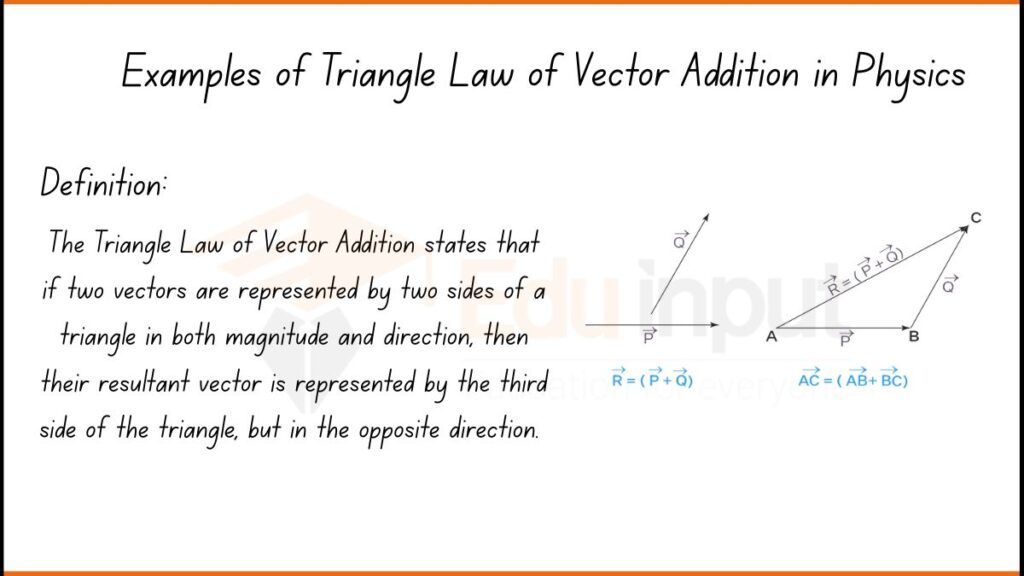
Triangle Law Examples in Physics and Engineering
Learn how forces, displacements, and velocities add up using the Triangle Law in real-life and physics problems.
1. Two Forces Acting on an Object
If two people push a box, one with 4 N to the east and the other with 3 N to the north, the triangle law helps find the final force. These forces make a right-angled triangle. The diagonal shows the total force, about 5 N, using the Pythagorean theorem.
2. Forces in a Rope System
Imagine two ropes pulling a sign. One rope pulls with 20 N and the other with 30 N at a 60° angle. These forces make a triangle. Using the triangle law formula, the total force is about 38.3 N. This helps workers know how strong the support must be.
3. Tug-of-War Resultant
In a tug-of-war, if one team pulls with 100 N left and the other with 80 N right, the triangle becomes a straight line. The resultant is the difference—20 N to the left. Even in one direction, the triangle law helps us find the net force.
4. Force in a Bridge or Truss
Engineers design bridges with many beams meeting at angles. Each beam has a force. The triangle law adds them to find the final load. This ensures the bridge can carry the weight safely. It helps engineers build stable and strong structures.
5. Person Walking in Two Directions
Someone walks 5 km east, then 12 km north. Their actual movement forms a triangle. The diagonal, or straight-line distance, is about 13 km. This is the total displacement using the triangle law.
6. Boat in a River with Current
A boat moves 10 km/h upstream. The river flows 15 km/h downstream. The boat’s path and the current make a triangle. The triangle law shows the boat’s true velocity. It helps boaters and engineers calculate the actual direction and speed.
7. Projectile Motion
A ball is thrown at an angle. Its speed has two parts: horizontal and vertical. The triangle law adds them to find the actual velocity at any point. The horizontal stays the same, but gravity changes the vertical. The result is a moving triangle over time.
8. Airplane Navigation in Wind
A plane flies 500 km/h north, but a wind blows 50 km/h west. The triangle law combines these velocities. It shows the plane’s real path, which is not straight north. Pilots use this method to adjust direction and reach the destination.
9. Electric Fields from Two Charges
Two electric charges create fields at a point. One field is 3 N/C east, the other 4 N/C north. The triangle law finds the net electric field, which is about 5 N/C at an angle. This helps in studying force on a third charge.
10. Merging Streams in Fluid Flow
Two water streams flow into a single pipe at an angle. One flows at 2 m/s, the other at 3 m/s. These form a triangle. The triangle law finds the direction and speed of the combined flow. Engineers use this to design pipe systems.
11. Robotic Arm Movement
A robotic arm moves in two ways: straight and rotating. These motions are vectors. The triangle law helps combine them into one smooth movement. This allows robots to pick up objects in the correct spot with precision.
12. Wind Forces on Turbine Blades
Wind hits a turbine blade at an angle. The wind force and blade structure force form vectors. Engineers use the triangle law to find the total force on the blade. This helps in improving blade design and energy output.
13. Bonus Mathematical Example
Let’s say two vectors are 4 units and 5 units, with a 60° angle between them. Use the triangle law formula:
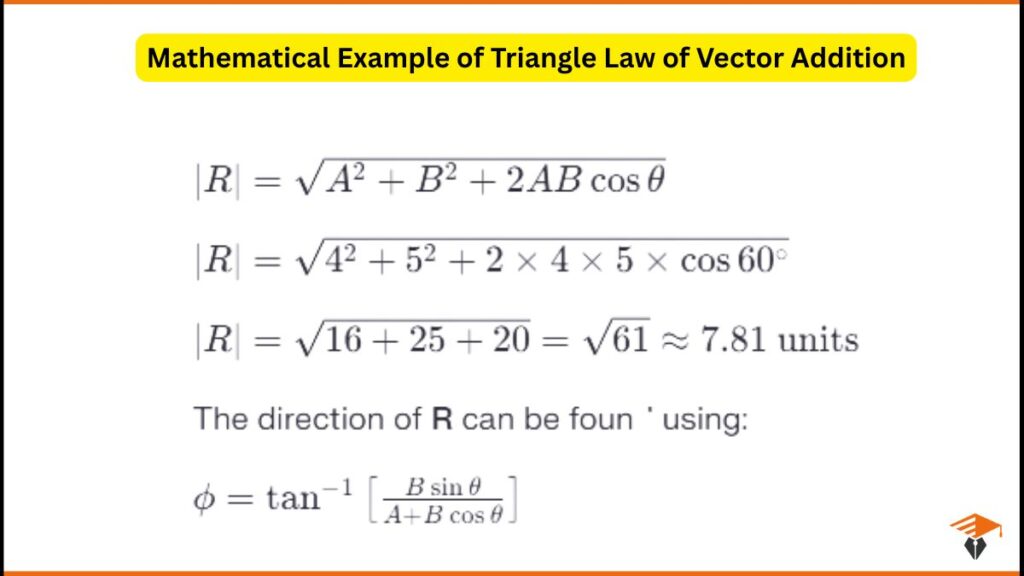
|R| = √(4² + 5² + 2 × 4 × 5 × cos60°)
|R| = √(16 + 25 + 40 × 0.5) = √61 ≈ 7.81 units
This is the magnitude of the resultant vector. The direction can be calculated using:
ϕ = tan⁻¹[(B sinθ) / (A + B cosθ)]
This formula helps when the triangle is not a right angle.


Leave a Reply