
10+ Examples of Analog Data in Computer Science
 written by Sidra Batool
Analog data refers to information represented in a continuous form. Unlike digital data, which consists of discrete 0s and 1s, analog data changes smoothly over time and can take on any value within a range. This type of data is crucial in both the natural world and computer science, especially where physical phenomena like sound, temperature, and motion need to be measured, analyzed, or digitized.
In computer science, analog data often needs to be converted to digital form through devices like Analog-to-Digital Converters (ADCs) so that computers can process it. Below are 13+ real-world examples of analog data in computer science, organized into three categories: natural phenomena, sensors/devices, and legacy media technologies.
Analog Data Examples in Natural Phenomena
These examples show how the continuous nature of the physical world produces analog data that computers must interpret or convert.
1. Sound Waves
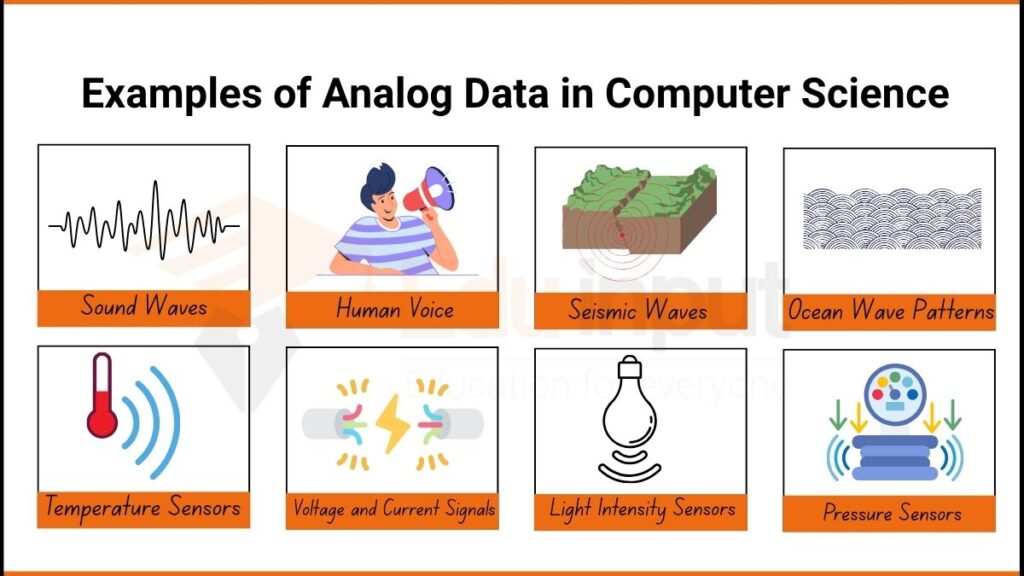
Sound waves are a classic example of analog data in computer science. When you speak or play music, the variations in air pressure create continuous waveforms. These are captured by microphones and converted to digital form for use in applications like voice assistants, phone calls, or music streaming. Without analog-to-digital conversion, apps like Siri or Spotify wouldn’t work.
2. Human Voice
The human voice, when spoken, travels as a smooth vibration through the air. It’s analog in nature, with infinite variations in pitch and volume. In computer systems, this data is recorded and digitized for tasks like speech recognition (as in voice typing or virtual assistants), making it one of the most relatable examples of analog signals.
3. Seismic Waves
When an earthquake occurs, it produces continuous ground vibrations known as seismic waves. These are captured by analog instruments like seismographs. The analog data is then digitized for analysis by geologists and used in earthquake prediction models. It’s a critical example of analog data in environmental computing.
4. Ocean Wave Patterns
The rise and fall of ocean waves are another real-world source of analog data. Buoys with sensors measure the continuous changes in water height and send this data to systems that convert it for tsunami alerts or climate research. These measurements are crucial in marine computing and disaster response.
Analog Data Examples in Devices and Sensors
This section includes modern technology where sensors generate analog data that must be digitized for use in computing systems.
5. Temperature Sensors
Devices like thermistors and thermocouples measure temperature as a continuous value. They output an analog voltage signal proportional to the temperature. This signal is converted for smart systems like thermostats, industrial monitoring, or even weather forecasting apps. It’s one of the most common examples of analog data in computer science.
6. Voltage and Current Signals
Electricity in circuits flows as a continuous wave. Voltage and current vary smoothly over time, which makes them analog. Devices that monitor power consumption, like smart meters or battery management systems in electric vehicles, must convert this analog data into digital form for display and control.
7. Light Intensity Sensors
Photodetectors measure light brightness as a continuously varying signal. In smartphones, these sensors adjust screen brightness automatically based on room lighting. This real-time analog data is constantly converted into digital instructions that help optimize battery life and visibility.
8. Pressure Sensors
Whether it’s air pressure in a weather system or fluid pressure in a hydraulic machine, sensors capture the data in analog form. This is particularly useful in weather forecasting, tire pressure monitoring systems in cars, and even blood pressure monitors.
9. Accelerometers
Accelerometers detect motion or tilt by generating analog signals based on changes in position. These signals are digitized in devices like smartphones, gaming controllers, and wearable fitness trackers. This is why your phone can rotate the screen when you tilt it or measure your steps during a run.
Analog Data Examples in Media and Historical Technology
Many older technologies stored or processed data in analog form before digital systems took over. These still serve as excellent examples of analog-to-digital transitions.
10. Vinyl Records
Vinyl records store sound in continuous grooves etched onto their surface. When played, a needle traces these grooves, producing analog vibrations that are amplified into music. Today, many vinyl records are digitized using audio converters so the analog data can be played on modern devices. This is a nostalgic and technical example of analog data in computer science history.
11. Cassette Tapes
Cassette tapes use magnetic particles to store audio as continuous waveforms. These analog signals are read by tape heads and converted into sound. Old cassette tapes are now often digitized into MP3s using analog-to-digital conversion tools, preserving music from decades past.
12. VHS Tapes
Analog video stored in VHS tapes contains continuously varying brightness and color signals. VHS players read these magnetic patterns and output them to analog displays. Today, many people convert their home videos to digital format using video capture cards, showing how analog video is still part of computing workflows.
13. Analog Radio Signals
AM and FM radios broadcast sound as continuous electromagnetic waves. Analog radio receivers convert these into audible sound. In many modern radio systems, the analog signals are captured and processed digitally for better clarity, streaming, or storage.
Summary – Key Examples of Analog Data
| Analog Data Source | Analog Signal Type | Use in Computer Science |
| Sound Waves | Air pressure variations | Voice assistants, audio processing |
| Human Voice | Air vibrations | Speech recognition, digital assistants |
| Seismic Waves | Ground vibrations | Earthquake monitoring, geoscience |
| Ocean Waves | Water level variations | Tsunami alerts, marine research |
| Temperature Sensors | Voltage from thermistors | Smart thermostats, industrial monitoring |
| Voltage & Current | Electrical signal | Power systems, EVs, smart grids |
| Light Intensity | Light signal | Brightness control in screens, solar panels |
| Pressure Sensors | Pressure signal | Weather stations, automotive, medical devices |
| Accelerometers | Acceleration signal | Phones, gaming, wearables |
| Vinyl Records | Groove vibrations | Analog-to-digital music conversion |
| Cassette Tapes | Magnetic audio pattern | Music digitization |
| VHS Tapes | Magnetic video pattern | Home video digitization |
| Analog Radio | EM wave | Broadcast reception and streaming |


Leave a Reply