
Examples of Mutualism of Polar Bears in Tundra
 written by Sidra Batool
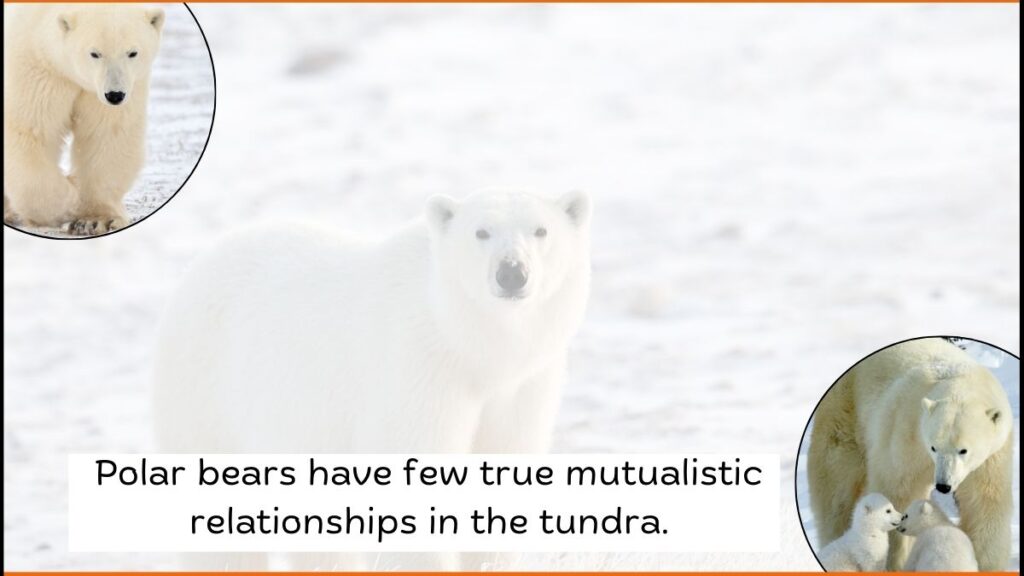
Polar bears have few true mutualistic relationships in the tundra. The most commonly discussed interactions, like with Arctic foxes, are often classified as commensalism rather than mutualism. In commensalism, one species benefits while the other is unaffected. Arctic foxes benefit by scavenging the remains of polar bear kills, but polar bears do not gain anything in return.
Polar bears have few true mutualisms in the tundra relationships. Most interactions with polar bears are commensalism in the tundra. In commensalism, one species benefits. The other species is not helped or harmed. Arctic foxes and polar bears show this type of relationship. Arctic foxes eat leftovers from polar bear kills. The foxes benefit. The polar bears do not gain anything. This is an example of commensalism in the tundra, not mutualism tundra.
True mutualism in tundra environments involving polar bears is rare. Most of their interactions are tundra commensalism. This means only one species benefits. However, their presence in the Arctic influences other species.
Some interactions can look like mutualism in the arctic. Their interactions with seabirds, bacteria, and other scavengers help keep ecological balance. As climate change changes their environment, new forms of arctic tundra mutualism may appear. Understanding these interactions is important for studying Arctic ecosystems. It helps us learn about species survival in extreme conditions.
Common Examples of Mutualism of Polar Bears in Tundra Biome
Mutualism in the tundra happens when two species interact. Both species benefit from the interaction. While true mutualism examples in the tundra with polar bears are rare, some interactions have characteristics of mutualism. These interactions influence the ecosystem. They help keep balance in the harsh Arctic environment.
Polar Bears and Arctic Foxes
Polar bears hunt seals and eat the blubber. Arctic foxes follow polar bears and eat the remains. This helps foxes find food. Food is especially scarce in winter. Polar bears, however, do not benefit from the foxes. Since only one species benefits, this is commensalism tundra, not mutualism in the tundra. This is an example of commensalism in the tundra.
However, in rare cases, Arctic foxes may alert polar bears to threats. They might also alert them to food sources like injured animals. This could create a minor mutualistic aspect. But it is not well-documented in scientific studies. If this happens, it could be considered polar bear and arctic fox mutualism. But most scientists still classify it as commensalism in tundra environments.
Polar Bears and Seabirds
Polar bears search for food in seabird colonies. They look for eggs. They disturb nesting birds while hunting. As the birds fly away, their eggs become exposed. Gulls and other scavenger birds take advantage. They feed on the unprotected eggs.
In this interaction, polar bears get food. Scavenger birds benefit from easier access to eggs. While this is not direct cooperation, it represents an indirect form of mutualism in the arctic tundra. Both species gain something. They do not harm each other. This is one of the tundra mutualism examples involving polar bears.
Polar Bears and Bacteria
Polar bears leave food remains after hunting. These remains break down over time. Bacteria break down the leftovers. They recycle nutrients back into the tundra ecosystem. This is an example of mutualism in the tundra.
This benefits bacteria. It gives them organic material to eat. The environment also benefits. The broken-down matter makes the soil richer. Over time, this helps keep ecological balance. Polar bears contribute by leaving remains. Bacteria contribute by keeping the ecosystem healthy. This is one of the mutualism relationships in the tundra that actually helps both species.
Polar Bears and Marine Algae (Indirect Relationship)
Polar bears hunt seals on sea ice. When they eat seals, nutrients from the remains fall into the water. These nutrients feed marine algae and plankton. The algae grow better with these nutrients. More algae means more food for small fish. Small fish are food for seals. Seals are food for polar bears.
This creates a cycle. Polar bears provide nutrients. The nutrients help algae grow. More algae means more fish. More fish means more seals. More seals mean more food for polar bears. While this is indirect, it shows mutualism in a tundra marine environment. Both polar bears and algae benefit over time.
Polar Bears and Scavenger Birds (Ravens and Gulls)
Polar bears hunt on sea ice and land. After they eat, they leave carcass remains. Ravens and gulls eat these leftovers. The birds get an easy meal. This helps them survive harsh winters.
In return, the birds help clean the environment. They also spread nutrients across the tundra through their droppings. While polar bears don’t directly benefit, the overall ecosystem becomes healthier. This supports the food web that polar bears depend on. This is an indirect example of mutualism in the tundra that supports the whole system.
Climate Change and Potential New Interactions
Climate change is changing Arctic ecosystems. As sea ice melts, polar bears spend more time on land. This has led to new interactions. They now interact more with scavenger birds, land predators, and even humans.
Some scientists believe polar bears may develop new mutualism in the tundra relationships as they adapt. For example, interactions with scavengers like wolves or other land animals could become more important. They might also interact more with land-based bacteria and decomposers. However, more research is needed to confirm these changes. These could become new examples of mutualism in the tundra in the future.
Polar Bear Relationships in Tundra
It’s important to know the difference between mutualism tundra relationships and other types:
Mutualism: Both species benefit. True mutualism in tundra with polar bears is rare. Examples include polar bears with bacteria and indirect relationships with marine algae.
Commensalism: One species benefits. The other is not affected. This is more common with polar bears. Examples of commensalism in the tundra include Arctic foxes eating polar bear leftovers. The arctic foxes and polar bears relationship is mostly tundra commensalism.
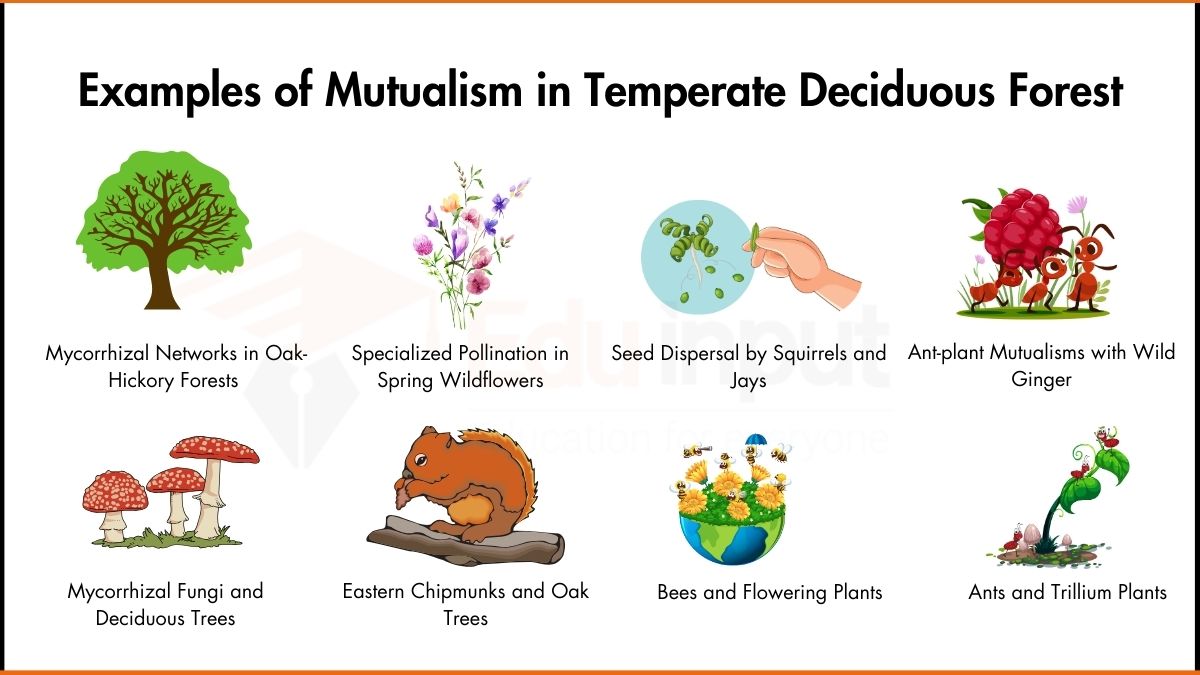
Note about other ecosystems: While we focus on mutualism in the arctic, other places have different relationships. For example, mutualism in temperate deciduous forest includes different species and interactions. Those forests are warmer and have more diverse species.
Why Studying Polar Bear Interactions Matters?
Understanding tundra mutualism examples with polar bears is important. It helps us see how Arctic ecosystems work. Even though true mutualism examples in the tundra with polar bears are rare, their role is still important.
Polar bears affect many other species. They influence the arctic tundra mutualism network even when they’re not directly involved. Their hunting creates food for scavengers. Their waste feeds bacteria. Their presence affects prey populations.
As climate change continues, we may see new mutualism relationships in the tundra. Polar bears may adapt and form new partnerships. Understanding current interactions helps us predict future changes.
What is an example of mutualism in the tundra with polar bears? The best examples are:
- Polar bears and bacteria (decomposition)
- Polar bears and seabirds (indirect feeding)
- Polar bears and marine algae (nutrient cycling)
These show that even top predators like polar bears participate in mutualism in the arctic tundra. Every species plays a role in keeping the ecosystem balanced.
Quiz Polar Bear Interactions and Tundra Symbiosis
1: Most scientists classify the relationship between the polar bear and the Arctic fox as commensalism. Why is this the case?
A. Both the bear and the fox benefit from hunting together.
B. The fox benefits from eating leftovers, while the bear is neither helped nor harmed.
C. The bear eats the fox when seals are scarce.
D. The fox provides the bear with directions to seal dens.
2: How do bacteria and polar bears form a mutualistic-like relationship in the tundra?
A. Bacteria live on the bear’s fur to keep it white.
B. Polar bears eat bacteria to help them digest seal blubber.
C. Polar bears provide organic remains for bacteria to eat, and bacteria recycle those nutrients into the soil.
D. Bacteria protect polar bears from the cold by generating heat.
3: The relationship between polar bears and marine algae is described as an “indirect mutualism cycle.” What is the final link in this chain that eventually benefits the polar bear?
A. Algae grow on the bear’s skin to provide camouflage.
B. Algae produce oxygen that the polar bear breathes.
C. More algae leads to more fish, which leads to more seals for the bear to eat.
D. Algae turn into ice, providing the bear with a place to walk.
4: When a polar bear disturbs a seabird colony to hunt for eggs, scavenger birds like gulls often swoop in to eat the eggs that are exposed. Why is this considered an “indirect mutualism” rather than a “competition”?
A. Because the polar bear and the gulls are sharing the same egg at the same time.
B. Because both the bear and the gulls gain access to a food source without directly harming or fighting one another.
C. Because the gulls help the bear find the nests.
D. Because the gulls protect the bear from other predators.
5: If climate change causes polar bears to move further inland and they begin to interact with land-based wolves to take down larger prey, how might the classification of their relationship change?
A. It would remain commensalism because the bear is larger.
B. It could become a true mutualism if both species work together to survive and get more food than they could alone.
C. It would become parasitism because the bear would steal all the food.
D. It would become a “marine algae” relationship because they are both on land.
Answer Key & Explanations
1: B. The fox benefits from eating leftovers, while the bear is neither helped nor harmed.
In commensalism, the “host” (the bear) provides a benefit to the “commensal” (the fox) without receiving anything in return or being negatively affected.
2: C. Polar bears provide organic remains for bacteria to eat, and bacteria recycle those nutrients into the soil.
This is a foundational mutualism where the bear provides the “raw material” (carcasses) and the bacteria provide the “service” of keeping the ecosystem fertile and balanced.
3: C. More algae leads to more fish, which leads to more seals for the bear to eat.
This shows how mutualism can be a “circle.” The bear’s leftovers feed the bottom of the food chain (algae), which eventually feeds the top of the food chain (the bear).
4: B. Because both the bear and the gulls gain access to a food source without directly harming or fighting one another.
Indirect mutualism occurs when the actions of one species unintentionally create an opportunity for another species to benefit, while also fulfilling its own needs.
5: B. It could become a true mutualism if both species work together to survive and get more food than they could alone.
Mutualism is defined by “mutual benefit.” If a new interaction helps both species get more energy or protection than they would have individually, it becomes a mutualistic partnership.


Leave a Reply