
10+ Examples of Squares in Mathematics, Geometry, and Real-World Applications
 written by Sidra Batool
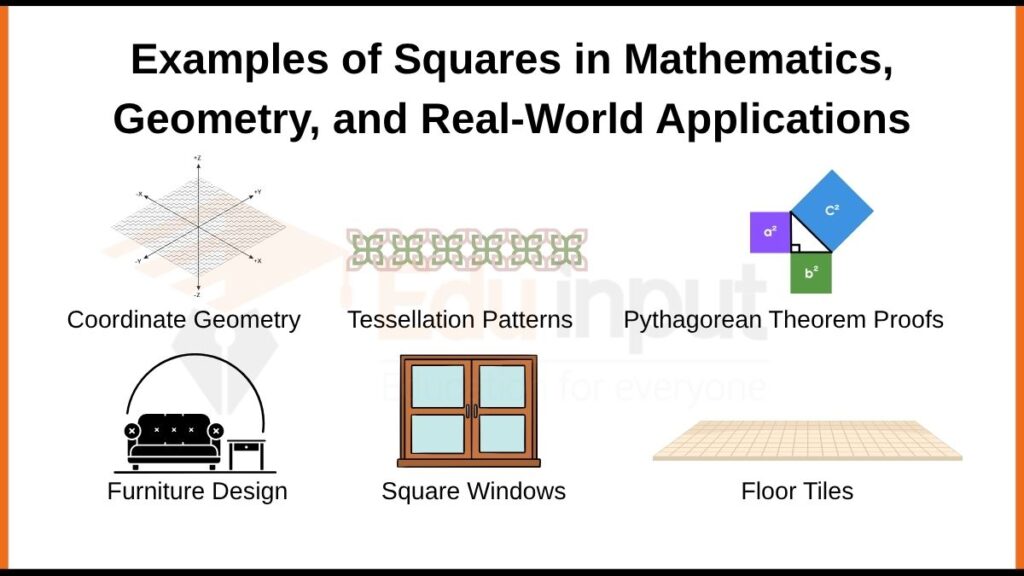
In coordinate geometry, squares help solve problems by using their vertices on a grid. For example, a square with points at (0,0), (3,0), (3,3), and (0,3) allows easy calculation of area and side lengths using distance formulas. In tessellations, squares fit together perfectly without overlapping or leaving gaps. This makes them ideal for floor tiling and art patterns. In geometry proofs like the Pythagorean theorem, squares built on triangle sides help visualize relationships between the lengths. These examples show how squares aren’t just shapes in theory; they appear in real problems, artwork, architecture, and technology.
This makes them ideal for floor tiling and art patterns. In geometry proofs like the Pythagorean theorem, squares built on triangle sides help visualize relationships between the lengths. These examples show how squares aren’t just shapes in theory; they appear in real problems, artwork, architecture, and technology.
Real-Life Examples of Squares
Squares appear in design, science, technology, and games. Their equal sides and angles make them reliable and versatile.
Coordinate Geometry
In coordinate geometry, squares are used to visualize and calculate positions and distances. A square can be drawn using four points like (0,0), (4,0), (4,4), and (0,4). These points make it easy to find side lengths with the distance formula. Squares help solve area and perimeter problems too.
They’re common in math class because they simplify complex shapes. The 90-degree angles help ensure accuracy. Coordinate grids make it simple to test symmetry and transformations. Have you ever plotted a square on graph paper and measured its sides?
Tessellation Patterns
Tessellations are repeating patterns of shapes that fit together without gaps. Squares are perfect for this because all four sides and angles are equal. You see square tessellations in bathroom tiles, game boards, and art designs.
In math, they show symmetry and pattern rules. You can rotate, flip, or slide squares, and the pattern still works. That makes squares important in geometry lessons. Why do you think squares work better for tiling than circles?
Pythagorean Theorem Proofs
The Pythagorean theorem is often proved using squares. When a right triangle is drawn, you can build squares on each of its three sides. The two smaller squares represent a² and b², and the big one shows c².
When arranged carefully, you can see that a² + b² equals c². This makes the idea of the theorem easier to understand. Visual proofs help students connect algebra to geometry. Why do you think squares help us understand this relationship better than other shapes?
Floor Tiles
Square tiles are popular in homes because they fit together neatly. Each side is equal, so they create straight lines and corners. This helps with fast, easy installation. In bathrooms or kitchens, square tiles provide a clean, even look.
You can also mix colors or patterns to make art-like floors. Builders like them because they reduce waste when cutting. Why might a builder choose square tiles over round ones?
Square Windows
Square windows are common in architecture. They let in light and look balanced. In modern homes, they often match the style of furniture and floors. Older buildings may use them for a classic appearance. Their symmetry makes rooms look neat. Builders can group square windows to form larger patterns. Have you seen buildings where all windows are perfect squares?
Furniture Design
Furniture often uses square shapes for legs, seats, or bases. Square table tops are easy to set up in rooms. They provide a stable base and match with other square items like shelves or drawers. Some stools or ottomans are cube-shaped for comfort and stacking. Designers choose square shapes for their neat look. Why do you think square tables are easier to arrange than round ones?
Storage and Packaging
Square boxes are great for storing and shipping items. They stack well because their sides line up without wasted space. In warehouses, square containers help organize items neatly. Even food packaging uses square shapes to save space. Delivery trucks fit more boxes when they are square. Why might companies prefer square packages over odd-shaped ones?
Digital Pixels
Pixels on screens are usually square. TVs, phones, and tablets use square pixels in rows and columns. This helps create clear pictures. Every pixel lights up in different colors to show images. The square shape keeps spacing even so nothing looks stretched. If pixels were round or uneven, pictures would look blurry. Why do you think square pixels make screens look sharper?
Graph Paper
Graph paper uses square grids for plotting data or drawing shapes. Each small box helps you measure length and height easily. Scientists and students use it in labs and math class. It’s helpful for making graphs, charts, or diagrams. Squares keep everything even and easy to follow. Why is it easier to draw lines and shapes on square grid paper?
Square Matrices
In computer science, square matrices are used in programming, image editing, and AI. A square matrix has the same number of rows and columns, like 3×3 or 4×4. These are used to store numbers, colors, or even sound data. They help programs process information faster. In games, they control movement or effects. Why might square matrices be easier to manage than rectangular ones?
Chessboards
A chessboard has 64 squares, arranged in an 8×8 grid. Each piece moves across these squares. The square pattern helps keep the game fair and organized. Players count squares to plan their moves. This grid also appears in checkers. Why do you think board games like chess use square patterns instead of circles?
Quilting
Quilts are often made from square patches sewn together. These squares form colorful patterns and keep the quilt even. Some quilts use thousands of squares. The squares are easy to cut and align. Artists mix fabrics to create pictures or designs. Why do you think squares are easier to sew than other shapes?
City Planning
Many cities are designed with square blocks. Places like Manhattan use grids of streets that form square areas. This helps with traffic and navigation. Builders can fit houses and shops more easily. Square blocks also allow for even land use. Have you walked in a city where every street forms a square corner?
Modern Art
Some modern artists use squares in their paintings. Piet Mondrian painted squares in red, yellow, and blue. The clean edges and balance made his work famous. Squares help show order and contrast in art. You might see square designs in museums or logos. Why might an artist choose a square instead of a messy shape?
Scrabble
In Scrabble, every tile is a square. The game board also has square spaces. This keeps letters lined up neatly. Players form words across and down, just like on graph paper. The square grid helps track scores and turns. Have you ever played a board game that used square tiles?
Examples of Squares
| Category | Example | Description |
| Math & Geometry | Coordinate Geometry | Plotting squares on a grid |
| Tessellation Patterns | Tiling with no gaps | |
| Pythagorean Theorem Proofs | Visualizing area relationships | |
| Real-World Design | Floor Tiles | Uniform, stylish home design |
| Square Windows | Balanced, symmetrical light | |
| Furniture Bases | Stable tables and chairs | |
| Storage & Packaging | Efficient stacking boxes | |
| Technology & Science | Square Pixels | Uniform display screens |
| Graph Paper | Plotting and measuring | |
| Square Matrices | Computer science calculations | |
| Culture & Art | Chessboards | 8×8 game play structure |
| Quilting | Patchwork design | |
| City Planning | Grid-based navigation | |
| Modern Art | Symmetry in visual design | |
| Scrabble | Wordplay using square tiles |


Leave a Reply