
Roman Numerals
 written by Rida Mirza
In mathematics, Roman numerals are a numeral system that originated in ancient Rome and remained the usual way of writing numbers throughout Europe well into the Late Middle Ages.
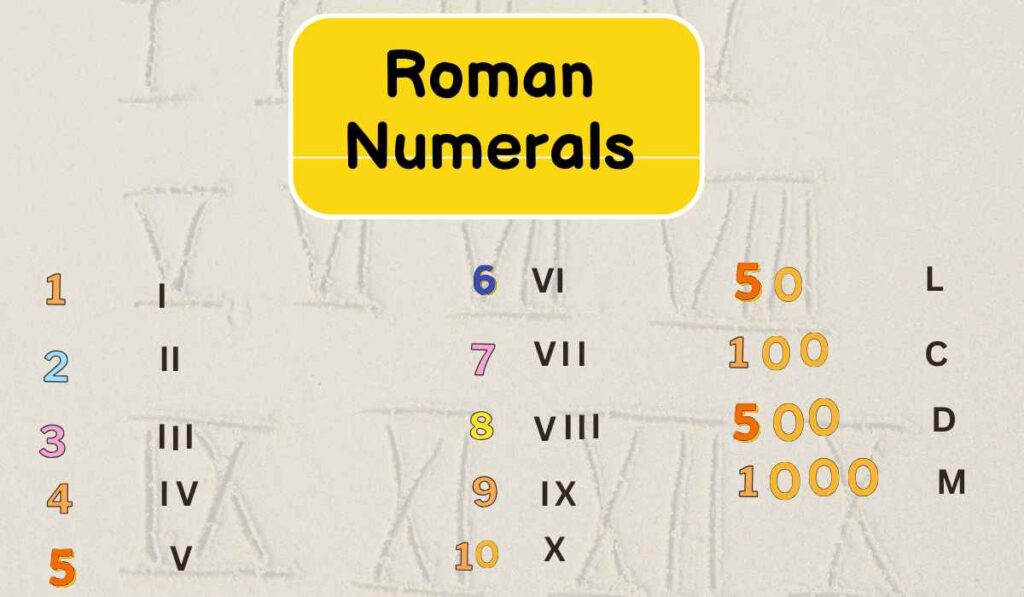
What Are Roman Numerals?
Roman numerals began in ancient Rome. They used letters like I, V, and X to show numbers. Traders, builders, and writers used them to count, record, and label things. The system came from the Etruscans and shaped how the Roman Empire worked. People used these symbols in shops, markets, and public signs. The style later spread across Europe.
What Do the Symbols I, V, X, L, C, D, and M Mean?
Each letter has a set value. I means 1. V means 5. X stands for 10. L is 50. C is 100. D shows 500. M equals 1000. People made larger numbers by joining these letters. For example, VI means 6. XL means 40. You can form many numbers by adding or subtracting values.
How Did Ancient Rome Use Roman Numerals?
Romans used numerals in trade, taxes, and public signs. Builders carved them on temples and milestones. Calendars used them to show dates and years. People saw them on coins, pillars, and statues. The system helped track goods, measure land, and manage time. It worked well for a world without calculators or digital clocks.
Where Do We Still Use Roman Numerals Today?
You still see Roman numerals in many places. Clocks use them on faces—like III, VI, IX, and XII. Books use them to show chapters or parts. Movies and sports events use them too, like Super Bowl LV or Rocky II. Kings and queens also use them in names, like Queen Elizabeth II or Charles III.
What Are the Roman Numerals for 1 to 100?
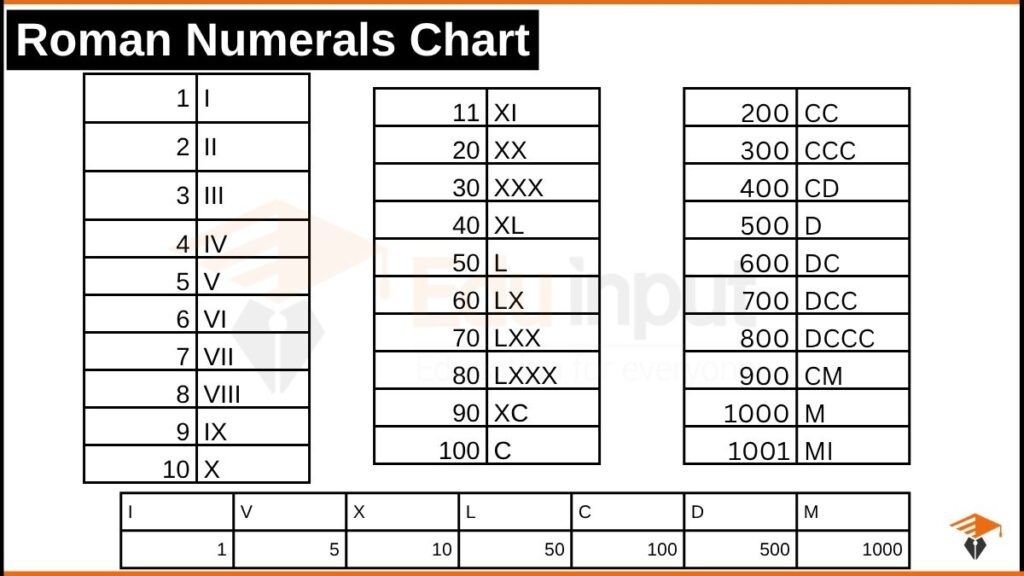
We provide a complete chart from 1 to 100. It helps students learn small Roman numerals step by step. I means 1, V means 5, X means 10, L means 50, and C means 100. Numbers grow by adding or subtracting these letters.
Examples from our chart:
| Number | Roman Numeral |
| 1 | I |
| 4 | IV |
| 9 | IX |
| 10 | X |
| 40 | XL |
| 50 | L |
| 90 | XC |
| 100 | C |
The pattern is easy to see. For example, 30 = XXX, and 80 = LXXX. This method helps beginners master Roman numerals fast.
What Are the Roman Numerals for 100 to 1000?
We also provide a chart from 100 to 1000. C means 100, D means 500, and M means 1000. Learners see how numbers grow in hundreds.
Examples from our chart:
| Number | Roman Numeral |
| 100 | C |
| 200 | CC |
| 300 | CCC |
| 400 | CD |
| 500 | D |
| 600 | DC |
| 900 | CM |
| 1000 | M |
The pattern is clear. For example, 700 = DCC, and 800 = DCCC. This helps students remember rules without confusion.
How Do Charts Help Learners Understand Roman Numerals?
Charts give a clear view of all rules. Students see how each letter builds a number. They don’t guess. They follow patterns. Repetition helps memory. Charts also show when to subtract, like IV for 4 or XL for 40. Our charts are best for quick learning and daily practice.
Basics
Roman numbers a numeric system that originated in ancient Rome. Unlike the Arabic numeral system (1, 2, 3, etc.), Roman numerals use letters of the alphabet to represent numbers. Here’s a quick reference to the most commonly used Roman numerals:
I – 1
V – 5
X – 10
L – 50
C – 100
D – 500
M – 1000
How Do You Convert Roman Numerals to Arabic Numbers?
Roman numerals can convert into regular numbers using a simple method.
Step-by-step method:
- Start from left.
- Compare each symbol to the next.
- If a symbol is equal or bigger, add its value.
- If it is smaller, subtract its value.
- Add all results to get the final number.
Example: Convert MCMLX
| Symbol | Value | Action | Total |
| M | 1000 | Add | 1000 |
| C | 100 | Subtract (next is M) → CM = 900 | +900 |
| L | 50 | Add | +50 |
| X | 10 | Add | +10 |
| Final Total | 1960 |
So, MCMLX = 1960. Always follow symbol order to get the right number.
Examples of Roman Numerals to Arabic Numerals
III is 3 (I + I + I)
VII is 7 (V + I + I)
XV is 15 (X + V)
XCII is 92 (XC + II)
MMXXI is 2021 (M + M + X + X + I)
Table of 50 Roman Numerals
| Roman Numeral | Arabic Numeral |
|---|---|
| I | 1 |
| II | 2 |
| III | 3 |
| IV | 4 |
| V | 5 |
| VI | 6 |
| VII | 7 |
| VIII | 8 |
| IX | 9 |
| X | 10 |
| XI | 11 |
| XII | 12 |
| XIII | 13 |
| XIV | 14 |
| XV | 15 |
| XVI | 16 |
| XVII | 17 |
| XVIII | 18 |
| XIX | 19 |
| XX | 20 |
| XXI | 21 |
| XXII | 22 |
| XXIII | 23 |
| XXIV | 24 |
| XXV | 25 |
| XXVI | 26 |
| XXVII | 27 |
| XXVIII | 28 |
| XXIX | 29 |
| XXX | 30 |
| XXXI | 31 |
| XXXII | 32 |
| XXXIII | 33 |
| XXXIV | 34 |
| XXXV | 35 |
| XXXVI | 36 |
| XXXVII | 37 |
| XXXVIII | 38 |
| XXXIX | 39 |
| XL | 40 |
| XLI | 41 |
| XLII | 42 |
| XLIII | 43 |
| XLIV | 44 |
| XLV | 45 |
| XLVI | 46 |
| XLVII | 47 |
| XLVIII | 48 |
| XLIX | 49 |
| L | 50 |
What Are the Rules for Writing Roman Numerals?
Roman numerals follow fixed rules. These rules help write numbers with accuracy and clarity.
Additive Rule:
Add values when larger symbols come before smaller ones.
Example: VI = V (5) + I (1) = 6.
Subtractive Rule:
Subtract the smaller value if it comes before a larger one.
Example: IV = V (5) – I (1) = 4.
Repetition Rules:
I, X, and C repeat up to three times.
V, L, and D never repeat.
Never write the same symbol four times. Use subtraction instead.
Example: Write IV, not IIII.
These simple rules keep Roman numerals short and easy to read.
What Is Subtractive Rule in Roman Numerals?
Roman numerals also employ the subtractive principle, which allows for more efficient representation. For instance:
IV represents 4 (one less than 5).
XC represents 90 (ten less than 100).
The subtractive rule makes Roman numerals shorter. Place a smaller numeral before a larger one to subtract.
Common subtractive pairs:
| Roman Pair | Arabic Value | Explanation |
| IV | 4 | 5 – 1 |
| IX | 9 | 10 – 1 |
| XL | 40 | 50 – 10 |
| XC | 90 | 100 – 10 |
| CD | 400 | 500 – 100 |
| CM | 900 | 1000 – 100 |
Example: Write 90 as XC, not LXXXX. The subtractive rule keeps numbers clean and correct.
Where Do We Use Roman Numerals Today?
Roman numerals appear in many modern places. Big events like the Super Bowl use them to show edition numbers. For example, Super Bowl LIX stands for the 59th event. Kings and popes also use Roman numerals. Henry VIII is a popular name in history.
Books often start with pages or chapters marked in Roman format, like Chapter IV. Classic clocks also use Roman numerals instead of standard digits. Movie sequels follow the same pattern. Titles like Rocky II or Star Wars Episode IV use them to show sequence. These uses keep Roman numerals relevant in formal and traditional spaces.
What Makes Roman Numerals Hard to Learn?
Many students struggle with Roman numerals at first. The subtractive rule creates confusion. Some mix up IV with IIII. Large numbers like 1987 also feel hard to write or read. Some students forget limits on repetition. Others place symbols in the wrong order. These mistakes lead to wrong answers.
Simple tricks can fix this. Charts help show the correct values. Daily practice builds memory. Learning starts with small numbers. Once the basic rules are clear, bigger numbers feel easy. Examples from clocks, movies, and names also make learning fun. A little focus makes Roman numerals easy to learn.


Leave a Reply