
Someone vs. Somebody – Differences, Usage, Examples
 written by Sidra Batool
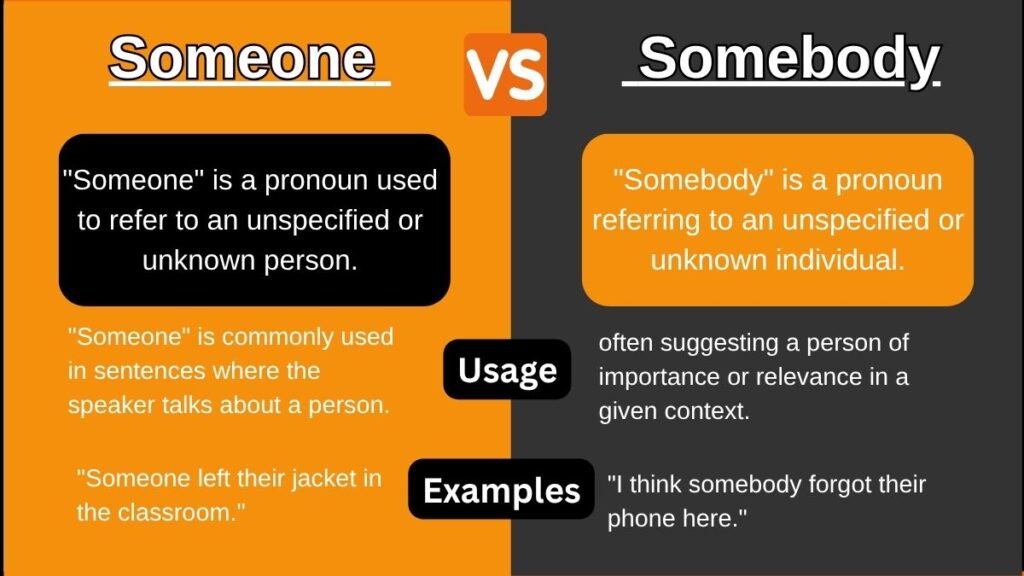
Someone and somebody are two words that mean almost the same thing. Both are used when we don’t know who the person is. We use them when we are talking about a person, but we do not name them. These words are called indefinite pronouns.
They are both correct, but sometimes one fits better than the other. “Someone” sounds a little more formal, and “somebody” sounds more casual. In this guide, you will learn the differences, how to use them, many examples, and simple tips to help you choose the right word every time.
Differences Between Someone and Somebody
What do “someone” and “somebody” mean?
Someone and somebody are indefinite pronouns. That means they are used when we talk about a person, but we do not say who the person is.
Both words mean “an unknown person” or “a person we are not naming.”
Examples:
- “Someone is knocking at the door.”
- “Somebody left their phone here.”
Both sentences mean the same thing. The exact person is not known or not named.
How are they used in grammar?
They are singular.
- They work as subjects or objects in a sentence.
- They are followed by singular verbs.
Examples:
- “Someone is calling.” (subject)
- “Did you see somebody?” (object)
What is the difference in tone or formality?
While both mean the same thing, there is a tiny difference in tone:
- Someone is a bit more formal.
- Somebody is a bit more informal or casual.
Example:
- Formal: “Someone must attend the meeting.”
- Informal: “Somebody forgot their backpack.”
In writing or serious speech, people often choose someone.
In everyday talk, somebody sounds more natural.
Why do people confuse them?
People confuse these two because:
- They mean the same thing.
- They are used in similar sentences.
Many teachers and books say they are interchangeable.
And that’s true in most cases, you can use either one.
But knowing the small tone difference helps you sound more natural in different situations.
Quick Trick to Remember
“Someone” = Formal one
“Somebody” = Casual body
How to Use Someone and Somebody in Different Contexts?
This section answers common questions about when and how to use “someone” and “somebody” in different situations, such as formal writing, casual talking, questions, and negative sentences.
How is “someone” used in formal or written contexts?
Someone is often used in professional, academic, or serious writing. It sounds more polished and neat.
Examples:
- Someone must review the report.
- We need someone with leadership skills.
- Someone should speak to the manager.
- The teacher asked if someone could help.
- Someone forgot to lock the door.
In these cases, “someone” fits better because the tone is serious or polite.
How is “somebody” used in casual or informal speech?
Somebody is more common in everyday conversation or casual writing. You might hear it in stories, movies, or songs.
Examples:
- Somebody left their bag on the bus.
- Can somebody get the lights?
- I think somebody’s at the door.
- Somebody forgot their lunch again.
- Call me if somebody shows up.
These examples sound more relaxed and friendly. That’s why “somebody” fits well in informal situations.
How are “someone” and “somebody” used in questions and negative sentences?
You can use both “someone” and “somebody” in questions and negative sentences. The meaning stays the same, but the tone may shift slightly.
Examples – Questions:
- Is someone there?
- Did somebody call me?
- Can someone help us?
- Is somebody coming to the event?
Examples – Negative Sentences:
- I didn’t see someone outside.
- We didn’t hear somebody knock.
- She hasn’t spoken to someone yet.
- Nobody saw somebody leave.
Both words work well in these types of sentences. You can choose based on tone or personal preference.
| Where | Use “Someone” | Use “Somebody” |
| Formal Writing | Yes | Rare |
| Casual Speech | Okay | Best Fit |
| Questions | “Is someone here?” | “Did somebody come?” |
| Negative Sentences | “I didn’t see somebody.” | “I didn’t see somebody” |
What Are Some Examples of “Someone” and “Somebody”?
This section gives you 25 simple and useful example sentences that show how to use “someone” and “somebody” in real situations. These examples come from formal, casual, and educational contexts. They will help you understand how the two words work in everyday English.
Examples of “Someone” in Formal or Written Contexts
These sentences use “someone” in more serious, polite, or professional situations.
Examples:
- Someone must approve the budget before the meeting.
- Please find someone to take notes during the event.
- We are looking for someone with strong leadership skills.
- Someone will contact you by email.
- The manager asked if someone could explain the report.
Examples of “Somebody” in Conversational or Informal Contexts
These sentences use “somebody” in casual, friendly, or everyday speech.
Examples:
- Somebody left their phone on the table.
- I think somebody’s knocking at the door.
- Can somebody grab me a bottle of water?
- Somebody told me a funny joke yesterday.
- Somebody should clean up this mess.
Examples in Questions or Negative Sentences
These examples show how both “someone” and “somebody” work in questions and sentences with “not” or “didn’t.”
Examples – Questions:
- Is someone going to join us later?
- Did somebody call my name?
- Can someone help with the math problem?
- Is somebody already using this chair?
- Has someone seen my notebook?
Examples – Negative Sentences:
- I didn’t see someone leave the room.
- Nobody knew somebody had arrived early.
- She didn’t hear someone come in.
- They couldn’t find somebody to fix the problem.
- We didn’t expect someone to show up that late.
Examples in Educational or ESL Contexts
These sentences are common in classrooms, learning environments, or ESL lessons.
Examples:
- Someone will need to present the project next week.
- Can somebody read the next paragraph aloud?
- Somebody forgot to hand in their homework.
- Is someone ready to answer question five?
- Please tell someone if you have a question.
How to Use “Someone” and “Somebody”?
This section gives you practical tips to help you choose between “someone” and “somebody” easily. Even though they mean the same thing, small clues can guide you to the best choice based on tone, style, and context.
How can I remember the difference between “someone” and “somebody”?
You can use a simple trick to remember the tone difference.
Think like this:
- “Someone” ends with one → use it in formal situations (like “one professional”).
- “Somebody” includes body → use it in casual situations (like “anybody in the crowd”).
This memory aid can help you quickly choose the word that sounds right for the moment.
What are some quick tips for choosing between “someone” and “somebody”?
Here are easy tips you can follow:
- Use “someone” in business emails, school reports, and formal writing.
- Use “somebody” in friendly conversations, messages, or storytelling.
- Both words are correct in most sentences, so tone is the main difference.
- Read the sentence out loud — choose the word that sounds more natural.
- Stick to “someone” if you’re not sure — it’s slightly more neutral and works in most settings.
How can context clues help me decide?
The sentence’s style, audience, and purpose can help you choose:
- If the sentence is for a teacher, manager, or essay, choose “someone.”
- If the sentence is for a friend, text message, or story, choose “somebody.”
- If the rest of the sentence uses formal words, match it with “someone.”
- If the sentence feels relaxed or emotional, “somebody” may feel better.
Examples:
Formal: “Someone should submit the request form by noon.”
Informal: “Somebody better clean up this mess!”



Leave a Reply