
Why Does Fermentation Produce ATP?
 written by Sidra Batool
Fermentation does not directly produce ATP. Glycolysis produces a net 2 ATP per glucose molecule, while fermentation regenerates NAD⁺ so glycolysis can continue when oxygen is unavailable or insufficient.
Fermentation is an anaerobic process that allows cells to keep obtaining energy from glucose without depending on oxygen-based cellular respiration. During glycolysis, one glucose molecule is broken down into two pyruvate molecules, producing a net gain of 2 ATP and NADH.
Fermentation then regenerates NAD⁺ from NADH. This is important because glycolysis needs NAD⁺ to continue. Without this regeneration, glycolysis would stop and the cell would no longer be able to obtain ATP from glucose through this pathway.
There are different types of fermentation. Lactic acid fermentation occurs in animal cells and some microorganisms, while alcoholic fermentation occurs commonly in yeast and some bacteria.
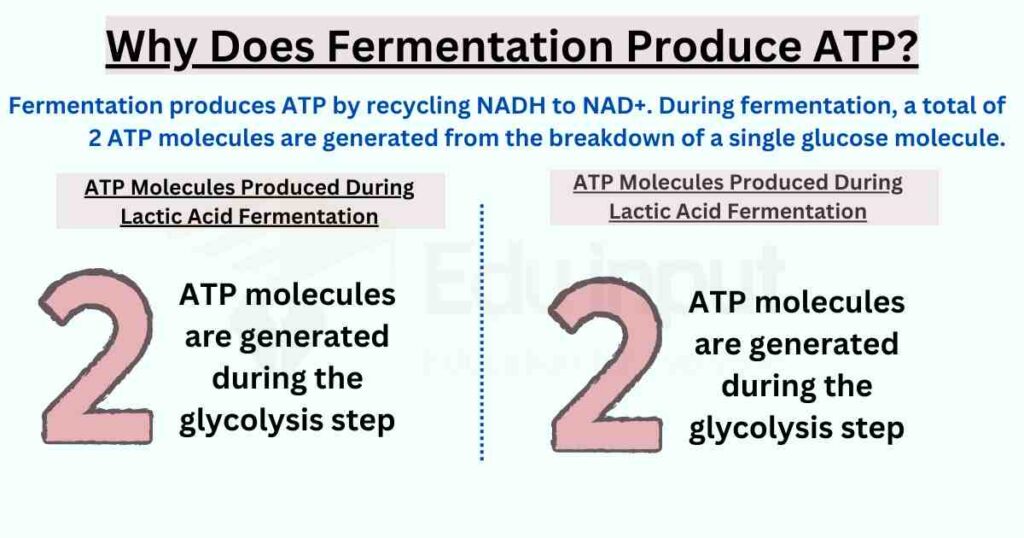
How Many ATP Molecules Does Fermentation Produce?
One glucose molecule provides a net 2 ATP through glycolysis during fermentation, while the fermentation reactions themselves produce no additional ATP.
Glycolysis uses 2 ATP and produces 4 ATP, giving a final gain of 2 ATP per glucose molecule.
For example:
1 glucose → 2 ATP
2 glucose → 4 ATP
4 glucose → 8 ATP
10 glucose → 20 ATP
So, if four glucose molecules undergo glycolysis followed by fermentation:
4 × 2 = 8 ATP
The important difference is that these ATP molecules are produced during glycolysis, not during the fermentation reactions.
Fermentation allows this ATP production to continue by restoring NAD⁺.
ATP Yield in Lactic Acid Fermentation
Lactic acid fermentation does not directly produce ATP. The net 2 ATP per glucose molecule are produced during glycolysis, while lactic acid fermentation regenerates NAD⁺.
The process can be simplified as:
Glucose → Glycolysis → 2 Pyruvate → Lactate
During glycolysis, glucose is converted into pyruvate and NADH is formed. The NADH then transfers electrons to pyruvate, producing lactate and regenerating NAD⁺.
Pyruvate + NADH → Lactate + NAD⁺
The regenerated NAD⁺ can be used again during glycolysis.
Therefore, the ATP yield remains:
1 glucose → 2 ATP net
The conversion of pyruvate into lactate itself produces 0 additional ATP.
ATP Yield in Alcoholic Fermentation
Alcoholic fermentation does not directly produce ATP. The net 2 ATP obtained per glucose molecule come from glycolysis.
The pathway is:
Glucose → Glycolysis → 2 Pyruvate → Acetaldehyde → Ethanol
Glycolysis produces ATP and NADH. Pyruvate is then converted to acetaldehyde, releasing carbon dioxide. Acetaldehyde is then converted to ethanol, and NADH is converted back to NAD⁺.
The regenerated NAD⁺ allows glycolysis to continue.
Thus:
Glycolysis = 2 ATP net
Alcoholic fermentation = 0 additional ATP
How Does Fermentation Produce Alcohol?
Alcoholic fermentation produces ethanol when yeast or certain microorganisms convert pyruvate into ethanol and carbon dioxide in the absence of oxygen.
After glucose passes through glycolysis, the resulting pyruvate undergoes alcoholic fermentation.
Two-Step Conversion of Pyruvate to Ethanol
The conversion takes place in two main steps.
Step 1: Pyruvate → Acetaldehyde + CO₂
Pyruvate loses carbon dioxide and forms acetaldehyde.
Step 2: Acetaldehyde → Ethanol
Acetaldehyde is converted into ethanol using NADH. During this reaction, NADH is converted back into NAD⁺.
The regenerated NAD⁺ returns to glycolysis, helping the cell continue breaking down glucose.
The overall simplified reaction is:
Glucose → 2 Ethanol + 2 CO₂ + 2 ATP
The 2 ATP come from glycolysis, while ethanol and carbon dioxide are products of alcoholic fermentation.
Example
During brewing, yeast uses sugars obtained from malted grains.
The simplified sequence is:
Glucose → Pyruvate → Acetaldehyde → Ethanol
Carbon dioxide is also released.
The ethanol becomes the alcohol in the fermented beverage, while carbon dioxide contributes to carbonation and foam.
The ATP associated with this pathway comes from glycolysis rather than the ethanol-producing reactions.
Which Organisms Can Carry Out Alcoholic Fermentation?
Yeast is the most common organism associated with alcoholic fermentation, although some bacteria can also ferment sugars to produce ethanol.
Yeasts are single-celled fungi commonly used in bread making and the production of fermented beverages. Species such as Saccharomyces cerevisiae can ferment sugars and produce ethanol and carbon dioxide.
Bacteria are single-celled microorganisms found in many environments. Some bacteria, including Zymomonas mobilis, can ferment sugars and produce ethanol.
Examples include:
Saccharomyces cerevisiae — commonly used yeast in baking and brewing
Zymomonas mobilis — a bacterium capable of producing ethanol
Other microorganisms with metabolic pathways that allow alcoholic fermentation
The first stage of alcoholic fermentation involves glycolysis, which produces the net 2 ATP per glucose molecule.
When Does Fermentation Happen in Muscle Cells?
Muscle cells rely more on fermentation when oxygen availability cannot meet the rapid demand for ATP during intense exercise.
Muscle cells contain only a limited amount of stored ATP, so they must continually produce ATP during physical activity.
During short, intense exercise such as sprinting, glycolysis can rapidly break down glucose and provide ATP. However, glycolysis also produces NADH.
When oxygen-dependent metabolism cannot process NADH quickly enough, pyruvate accepts electrons from NADH and is converted into lactate.
Pyruvate + NADH → Lactate + NAD⁺
The regenerated NAD⁺ allows glycolysis to continue.
This means muscle cells can continue obtaining a small amount of ATP from glucose even when oxygen availability is insufficient for their immediate energy requirements.
ATP Yield by Pathway
| Process | Produces ATP directly? | Net ATP per glucose |
| Glycolysis | Yes | 2 ATP |
| Lactic acid fermentation | No | 0 additional ATP |
| Alcoholic fermentation | No | 0 additional ATP |
| Glycolysis + lactic acid fermentation | Yes, during glycolysis | 2 ATP |
| Glycolysis + alcoholic fermentation | Yes, during glycolysis | 2 ATP |
This distinction explains why answers to “how many ATP does fermentation produce?” can be confusing. The fermentation step itself produces no ATP, but fermentation allows glycolysis to continue producing a net 2 ATP per glucose molecule.
Fermentation vs. Cellular Respiration: Why Is ATP Yield So Low?
Fermentation has a low ATP yield because glucose is only partially broken down through glycolysis rather than being completely oxidized through aerobic cellular respiration.
Fermentation-associated glycolysis produces only 2 ATP per glucose molecule. Much more energy remains in the organic end products, such as lactate or ethanol.
For a detailed comparison, see Differences Between Fermentation and Cellular Respiration.
FAQs
Does fermentation produce ATP directly, or indirectly?
Fermentation does not produce ATP directly. It regenerates NAD⁺, allowing glycolysis to continue producing a net 2 ATP per glucose molecule.
Why is fermentation’s ATP yield so much lower than respiration’s?
Fermentation does not completely oxidize glucose. It relies on glycolysis for ATP production, giving a net yield of only 2 ATP per glucose molecule.
Does alcoholic fermentation produce more ATP than lactic acid fermentation?
No. Both pathways provide the same net yield of 2 ATP per glucose when coupled with glycolysis. Neither fermentation pathway directly produces additional ATP.
How many ATP are produced in fermentation?
A net 2 ATP are obtained per glucose molecule through glycolysis associated with fermentation. The fermentation reactions themselves produce 0 additional ATP.
How many ATP are created by fermentation?
The overall pathway provides 2 ATP per glucose, but the ATP is created during glycolysis. Fermentation regenerates NAD⁺ rather than producing ATP.
Does lactic acid fermentation produce ATP?
No, not directly. Lactic acid fermentation regenerates NAD⁺. The associated glycolysis produces a net 2 ATP per glucose molecule.
How much ATP is produced during alcoholic fermentation?
Alcoholic fermentation itself produces 0 ATP directly. Glycolysis produces a net 2 ATP per glucose molecule before the fermentation reactions regenerate NAD⁺.
When does fermentation occur in muscle cells?
Fermentation becomes important during high-intensity exercise, when the muscles need ATP rapidly and oxygen-dependent metabolism cannot meet the immediate demand.
What is the main purpose of fermentation?
The main purpose is to regenerate NAD⁺ from NADH, which allows glycolysis to continue when oxygen is unavailable or insufficient.
What is the role of NAD⁺ in fermentation?
NAD⁺ allows glycolysis to continue. Fermentation converts NADH back into NAD⁺, preventing the shortage of NAD⁺ that would otherwise stop glycolysis.


Leave a Reply