
15 Sublimation Examples in Daily Life (Explained with Images)
 written by shahzad haider
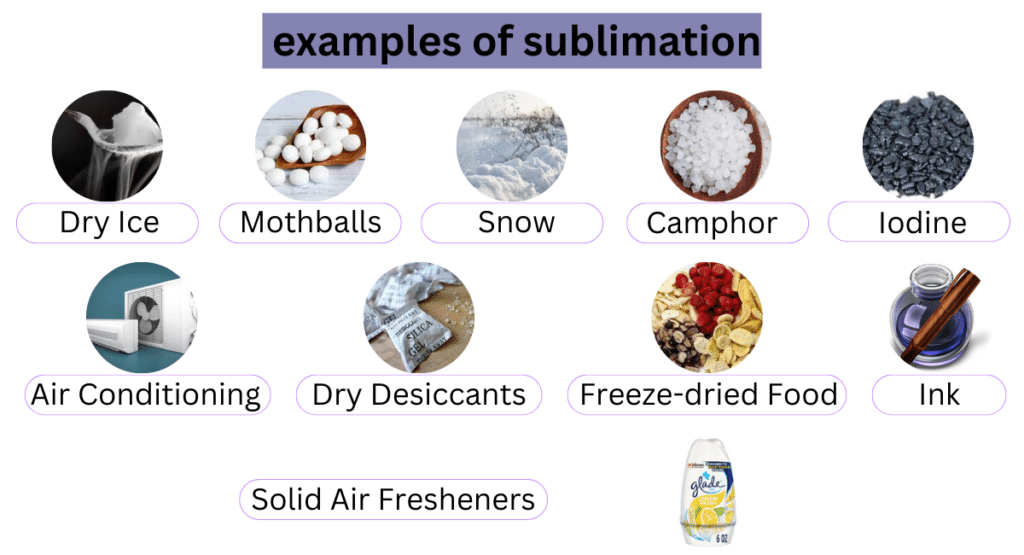
Sublimation happens when something changes from a solid to a gas without becoming a liquid. In simple terms, that’s the sublimate meaning in chemistry. It’s not just a lab concept—you see it in daily life. For example, dry ice is a sample sublimation case because it disappears into the air at room temperature without melting.
Another example of sublimation is iodine, which turns into purple vapor when heated. Snow can also vanish directly into the air below freezing, which gives us one of the best examples of sublimation in states of matter. These solid to gas examples show how matter skips the liquid phase.
If you’re wondering what is an example of sublimation, air fresheners slowly fading away or printers using sublimation technology are good everyday illustrations. In contrast, deposition states of matter examples include frost forming on windows or ice crystals forming in freezers.
So, whether you call it examples of sublimation, examples solid to gas, or just want to know what are two examples of sublimation, the answer is clear: nature and technology are full of them.
Sublimation Examples
From snowy peaks to high-tech labs, sublimation appears in surprising places. Let’s explore each one, and what it means.
1. Dry Ice (Solid Carbon Dioxide)
Dry ice is one of the most common examples of sublimation. It’s made from solid carbon dioxide. When you leave dry ice out in the air, it doesn’t melt into a liquid. Instead, it turns straight into carbon dioxide gas. This is why it looks like it’s smoking or fogging up—it’s the gas forming instantly from the solid. Dry ice is used in fog machines, shipping frozen foods, and creating special effects in movies. It’s also dangerous to touch without gloves because it’s very cold (around -78.5°C). Scientists use dry ice because it shows sublimation very clearly.
Can you imagine why dry ice is better than regular ice when shipping meat or medicine?
2. Iodine Crystals
Iodine is a shiny, dark-gray solid that turns into a purple gas when heated. This is another clear example of sublimation. In chemistry labs, students often heat iodine to see it turn into gas and then form crystals again when cooled. This gas has a strong smell and shows up clearly as purple vapor. The crystals form again on cooler surfaces, proving it skipped the liquid stage. Iodine sublimation is often used to demonstrate changes in state during science lessons. It’s also used in forensics to reveal fingerprints on paper.
Why do you think scientists prefer iodine for showing sublimation in schools?
3. Mothballs (Naphthalene)
Mothballs are made of a chemical called naphthalene. Instead of melting, these small white balls slowly disappear by turning into gas over time. This gas keeps moths and insects away from clothes. You’ll notice that mothballs shrink over days or weeks, even without heat. That’s sublimation happening at room temperature. Some people also use them in closets, drawers, and boxes where clothes are stored. The smell comes from the gas, not from any liquid. Newer mothballs sometimes use paradichlorobenzene, which also sublimates.
Have you ever noticed mothballs getting smaller without melting—how long did it take?
4. Snow Disappearing Without Melting
Snow can disappear from the ground even if the temperature is below 0°C. That means it didn’t melt—it sublimated. This usually happens when the air is dry and windy. The snow turns directly into water vapor without becoming liquid water. You might see this on cold but sunny days when there’s no puddle left behind. This kind of sublimation is common in mountains and polar regions. Meteorologists and climbers often watch it to predict weather or snow loss.
Next time it snows, can you check if it disappears without melting? why do you think that happens?
5. Freeze-Drying (Lyophilization)
Freeze-drying is used to preserve food by removing moisture through sublimation. First, the food is frozen. Then it’s placed in a vacuum so the ice inside turns directly into vapor. This keeps the food’s shape and nutrients without using heat. Freeze-dried fruits, coffee, and even astronaut meals are made this way. It also helps preserve vaccines and medicines. Sublimation makes freeze-drying fast and efficient.
Why do you think freeze-dried food lasts longer than regular dried food?
6. Air Fresheners
Some air fresheners disappear over time without becoming a puddle. These solid-type air fresheners are often made from scented chemicals that sublimate slowly. They release fragrance into the air as gas. You’ll notice the freshener block shrinking day by day. That’s sublimation happening at room temperature. It’s a clean and simple way to spread a scent. Companies use different chemicals depending on how long the scent should last.
Can you guess how fast the freshener disappears in summer compared to winter?
7. Solid Room Deodorizers
Solid deodorizers work just like air fresheners. They’re often made of para crystals or other sublimating compounds. You place them in bathrooms, shoes, or garbage bins. They start releasing gas that smells good. The deodorizer shrinks with time. Unlike liquid sprays, these don’t leave wet surfaces behind. You might not see it, but sublimation is what makes the smell spread. It’s a quiet, effortless process that cleans the air.
Why do you think these deodorizers are safer to use around children or pets?
8. Frost Sublimating on Cold Mornings
Frost forms on cold nights when water vapor freezes on surfaces like car windows or grass. On a clear, sunny morning, you might see the frost vanish without leaving any water behind. This is sublimation. The sunlight provides enough energy for the frozen water to turn straight into vapor. The process is quicker when the air is dry and there’s no wind. That’s why frost can disappear even though the temperature is still below freezing. It’s a quiet change you might not even notice unless you’re watching closely. This kind of sublimation is very common during winter and early spring.
Why do you think frost disappears faster on sunny days than cloudy ones?
9. Sublimation in Comets
Comets are made of frozen gases like carbon dioxide, water, and ammonia. As they move closer to the sun, the heat causes those frozen gases to sublimate. The gas rushes out, creating glowing tails that stretch across space. These tails always point away from the sun because of solar wind. There’s no melting in space—just a direct change from solid to gas. Sublimation is what makes comets look so beautiful in the night sky. Astronomers use this information to study what comets are made of.
How does the sun’s heat cause sublimation in comets without melting the ice first?
10. Dye-Sublimation Printing
Dye-sublimation printing uses heat to turn solid dye into gas, skipping the liquid stage. This gas then binds with fabric or plastic, creating long-lasting, colorful designs. The result is smooth and doesn’t peel off like stickers or paint. It’s used for making T-shirts, mugs, banners, and photo gifts. Because the dye becomes part of the surface, the print doesn’t fade easily. This printing method is popular for sportswear and promotional items. It’s a creative use of sublimation in everyday products.
Why might dye-sublimation be better than regular ink printing for clothes?
11. Pharmaceutical Freeze-Drying
Medicines like vaccines or antibiotics often need to be stored without moisture. Pharmaceutical freeze-drying removes water by freezing the product and then letting the ice sublimate under vacuum. This keeps the medicine stable and ready for long storage or transport. It also makes rehydrating the medicine quick and easy when it’s needed. Hospitals and labs use this method to keep drugs safe and effective. Sublimation helps keep sensitive ingredients from breaking down. It’s one of the most important medical uses of sublimation.
Why is removing water through sublimation better than drying medicines with heat?
12. Semiconductor Manufacturing
Semiconductor chips are made using layers of very pure materials like silicon. Some of these layers are applied using a process where solid chemicals sublimate and settle as thin films. This happens in vacuum chambers where conditions are controlled. The sublimated gas sticks to the surface of microchips, forming precise electronic circuits. This method is used in phones, computers, and all kinds of digital devices. It allows manufacturers to build tiny but powerful processors. Sublimation in this context supports the entire electronics industry.
How do you think sublimation helps keep microchips small and efficient?
13. Dry Ice in Food Storage and Parties
Dry ice is used in coolers to keep frozen foods cold during transport. Because it sublimates, it doesn’t leave any water behind like regular ice. That makes it perfect for shipping meat, seafood, and even medical supplies. At parties, people use it to create fog effects by adding dry ice to warm water. The thick fog is just carbon dioxide gas mixed with cold water vapor. It’s both useful and fun to watch. This makes dry ice a great example of sublimation at home and in events.
Why is dry ice useful in situations where you want coldness without mess?
14. 3D Printing Using Sublimation
Some 3D printing techniques use sublimation to build shapes layer by layer. A solid material is turned into vapor and then redeposited exactly where it’s needed. This allows for printing tiny, complex parts without using liquid plastic. The process is controlled by lasers or heat sources in advanced machines. It’s especially useful in making electronics, medical implants, and prototypes. Sublimation helps create items that are hard to make by melting. It’s a smart way to use heat without going through the liquid stage.
What kinds of products might need this kind of ultra-precise 3D printing?
15. Snowmaking Machines at Ski Resorts
Snowmaking machines are used in ski resorts when there isn’t enough natural snow. These machines spray tiny water droplets into the cold air. In dry and freezing conditions, some of this water can sublimate while the rest freezes instantly. This helps create soft, powdery snow perfect for skiing and snowboarding. Resorts use this process to keep slopes ready even in low-snow winters. Sublimation allows the snow to spread evenly and stay light. Without this method, winter sports would suffer in warmer regions.
How does sublimation make artificial snow better for skiing than ice pellets?


Leave a Reply