
10+ Practical Examples of Abstraction in Computer Science and Everyday Life
 written by Sidra Batool
What Is Abstraction in Computer Science?
Abstraction in computer science means hiding the complex internal workings of a system and showing only the parts the user or programmer needs. It simplifies how we design, build, and use technology by focusing on what something does instead of how it does it.
For example, when you use a web browser, you don’t see the thousands of lines of code that fetch and display the page. You just click a button or enter a web address. That’s abstraction in action.
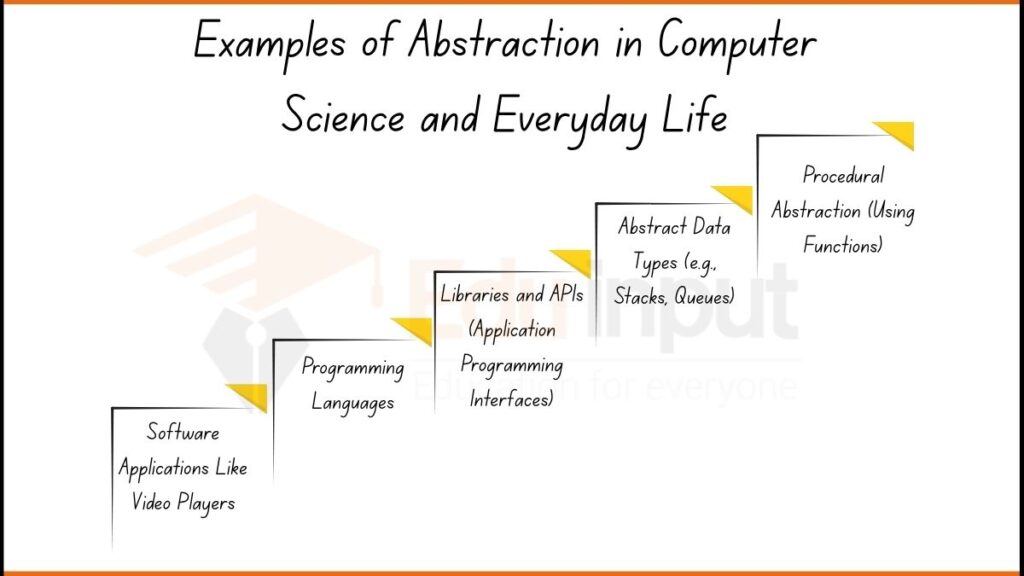
Examples of Abstraction in Software and Programming
1. Software Applications Like Video Players
When you open a video player like VLC Media Player and click “play,” the software instantly starts the video. Behind the scenes, it’s decoding different formats (like MP4 or AVI), buffering data, and rendering video frames — but you never have to worry about those details.
This is a classic example of abstraction in computer science. The application abstracts all the background processing and presents a simple interface: play, pause, stop.
By showing only the basic controls, it hides the complexity of audio/video codecs and processing layers.
2. Programming Languages (e.g., Python or Java)
When you write code in a language like Python, you don’t manage how memory is allocated or how the CPU runs instructions — the language handles it for you.
For instance, if you write a = 5, Python assigns memory and stores the value. You don’t need to know the binary representation or where it’s stored in RAM.
This is language-level abstraction, and it’s one of the most essential examples of abstraction in computer science. It helps developers build programs quickly and efficiently without needing to understand hardware-level details.
3. Libraries and APIs (Application Programming Interfaces)
Let’s say you want to add a map to your website. Instead of building your own mapping service, you can use something like the Google Maps API. With just a few lines of code like getLocation(), your website can display maps, detect locations, or even calculate routes.
This is API abstraction — a powerful technique where you only see the surface (function names), not the complicated logic behind them.
This is a perfect way to explain the concept of abstraction in computer science with examples. Developers interact with simple functions while the system handles the heavy lifting underneath.
4. Abstract Data Types (e.g., Stacks, Queues)
A stack is a structure where you can only add or remove items from the top, like a stack of plates. You use operations like push() to add or pop() to remove.
But how it’s implemented, whether it uses an array, a linked list, or something else, is completely hidden from you. That’s data abstraction.
This allows programmers to focus on how they want to use the data, not how the structure works internally. It’s a fundamental idea in object-oriented and structured programming.
5. Procedural Abstraction (Using Functions)
When you use a function like sort(myList) in Python, it sorts the data for you. But do you know whether it uses bubble sort, merge sort, or quicksort? Probably not — and you don’t need to.
That’s procedural abstraction: hiding the algorithm inside a function and letting users interact with a simple name or command. It improves code reuse and readability and is one of the most common examples of abstraction in programming.
6. Object-Oriented Programming (OOP) and Classes
In OOP, you can create a Car class with methods like start() or accelerate(). You use these methods to control the object, but you don’t have to deal with how the fuel is injected or how the engine ignites.
The class hides the inner logic and only exposes useful actions, making it easier to understand and use. This kind of abstraction in computer science makes it possible to build complex systems from simpler building blocks.
Examples of Abstraction in Systems and Hardware
7. Operating Systems (e.g., Windows or Linux)
Your operating system manages a lot of complexity, like memory management, file systems, and CPU scheduling. But you never see any of this when you drag and drop a file or open an app.
This is system-level abstraction; the OS acts as a bridge between you and the hardware. It gives you a simple user experience while managing technical operations behind the scenes.
This is another important way to explain the concept of abstraction in computer science with examples, especially for beginner students.
8. Device Drivers (e.g., Printer or Keyboard Drivers)
Device drivers are small programs that let software talk to hardware. For example, when you click “Print,” the computer doesn’t talk directly to the printer hardware. Instead, it sends instructions to a printer driver, which translates them into signals the printer understands.
This is hardware abstraction: software doesn’t need to know the printer’s internal language — the driver hides that detail.
Without this kind of abstraction, every program would need to be rewritten for every hardware model.
9. Virtual Machines (e.g., VMware or VirtualBox)
A virtual machine lets you run multiple operating systems on a single computer. Even though your machine may be using Windows, you can create a virtual machine and install Linux on it.
This is possible because the virtual machine pretends to be real hardware. It’s a layer of abstraction that hides your actual hardware and provides a simulated environment.
This makes testing, software development, and cloud computing more flexible and efficient.
Examples of Abstraction in Everyday Life
Let’s now look at some examples of abstraction in everyday life to help you connect the idea to things you already know.
10. Driving a Car
When you drive, you use the steering wheel, accelerator, and brake , that’s all. You don’t need to understand how the engine works, how the brake pads apply pressure, or how the gears shift.
This is real-life abstraction. The car hides complex mechanical processes and gives you a few simple controls. It’s a great way to explain abstraction in computer science with examples because it’s similar to how software hides code complexity behind buttons and menus.
11. Using a Smartphone
You tap icons to open apps or take pictures. But inside the phone, there are codes, circuits, sensors, and operating systems working together. You don’t see or manage any of it.
Smartphones offer interface-level abstraction — all the complexity is hidden behind a screen full of simple actions.
This is why examples of abstraction in everyday life (computer science context) are so effective — they help people understand how hidden systems work through simple tools.
12. Reading a Train Map
Train maps simplify a city’s transportation routes. They show colored lines and stations — but not real distances, traffic, or underground paths.
The map is an abstraction of a complex transportation system, just like a simplified user interface is an abstraction of a complex software system. It’s designed to help you focus only on what matters: where you’re going and how to get there.
13. Using a TV Remote
When you press a button to change the channel, you’re not thinking about infrared signals or how the TV decodes them. The remote control abstracts all the electronic communication so that users can just press “Volume Up” or “Next.”
This is a simple but powerful example of abstraction in daily life and is closely related to how graphical interfaces abstract code in computers.


Leave a Reply