
What is Physics?
Physics is the natural science that studies matter and energy, their fundamental constituents, and their motion and behavior through space and time.
The study of physics involves the investigation of such things as
- The law of motion
- The structure of space and time
- The nature and type of forces that hold different materials together
- The interaction between different particles
- The interaction of electromagnetic radiation with matter and so on
History Of Physics
The history of physics can be traced back to the ancient Greeks, who made significant contributions to astronomy, optics, and mechanics. Archimedes (287-212 BC), for example, developed the laws of levers and buoyancy, and Ptolemy (100-170 AD) wrote a comprehensive treatise on astronomy.
In the Middle Ages, physics was largely dominated by Aristotelian physics, which was a philosophical system that attempted to explain all natural phenomena. Aristotle’s ideas were widely accepted for centuries, but they were eventually challenged by the rise of modern science.
In the 16th and 17th centuries, a number of scientists, including Galileo Galilei (1564-1642) and Isaac Newton (1643-1727), laid the foundations of classical physics. Galileo developed a new experimental method for studying physics, and he made important discoveries in motion, gravity, and astronomy. Newton is best known for his three laws of motion and his law of universal gravitation, which provided a unified explanation of many different physical phenomena.
The 18th and 19th centuries saw further advances in classical physics, with important discoveries in electricity, magnetism, thermodynamics, and optics. James Clerk Maxwell (1831-1879) developed a set of four equations that unified the theories of electricity and magnetism, and Albert Einstein (1879-1955) developed the theory of special relativity, which revolutionized our understanding of space and time.
In the early 20th century, physicists began to develop a new branch of physics called quantum mechanics. Quantum mechanics is necessary to explain the behavior of matter at the atomic and subatomic levels. Two of the most important pioneers of quantum mechanics were Max Planck (1858-1947) and Niels Bohr (1885-1962).
In the second half of the 20th century, physicists made further advances in quantum mechanics, and they also developed new theories such as quantum field theory and the Standard Model of particle physics. These theories have provided us with a deep understanding of the fundamental structure of matter and energy.
Some of the key milestones in the history of physics include:
- 5th century BC: Democritus proposes the atomic theory of matter.
- 4th century BC: Aristotle developed his system of physics, which dominated Western thought for centuries.
- 16th century: Nicolaus Copernicus proposes that the Sun is at the center of the solar system.
- 17th century: Galileo Galilei developed a new experimental method for studying physics and made important discoveries in motion, gravity, and astronomy.
- 17th century: Isaac Newton developed the three laws of motion and the law of universal gravitation, which provide a unified explanation of many different physical phenomena.
- 18th century: Benjamin Franklin made significant contributions to the understanding of electricity.
- 19th century: James Clerk Maxwell developed a set of four equations that unify the theories of electricity and magnetism.
- 19th century: Albert Einstein developed the theory of special relativity, which revolutionized our understanding of space and time.
- 20th century: Max Planck and Niels Bohr develop the foundations of quantum mechanics.
- 20th century: Albert Einstein developed the theory of general relativity, which describes gravity as a curvature of spacetime.
- 21st century: Physicists continue to advance in quantum mechanics, quantum field theory, and the Standard Model of particle physics.
Physics is a vast and ever-evolving field, and it has had a profound impact on our understanding of the universe and our place within it. From the smallest subatomic particles to the largest galaxies, physics helps us to understand the world around us.
Fathers of Physics
Physics, often referred to as the “queen of sciences,” is a discipline that seeks to understand the fundamental principles that govern the universe. Throughout the history of physics, there have been several visionary thinkers who laid the foundation for our modern understanding of the physical world.
These trailblazers, often called the “Fathers of Physics,” made significant contributions that continue to shape the field today.
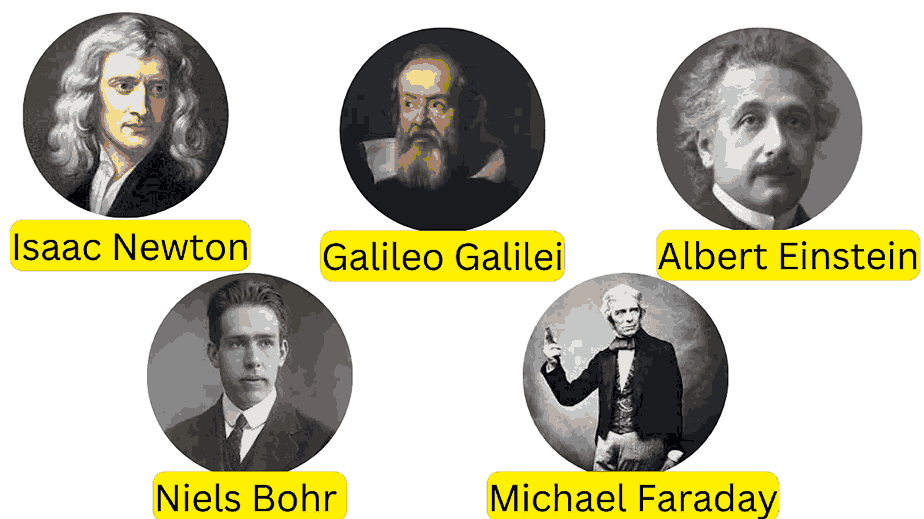
Isaac Newton (1643-1727)
Isaac Newton, an English physicist, mathematician, and astronomer, is perhaps one of the most well-known figures in the history of physics. His groundbreaking work in the late 17th century revolutionized our understanding of the universe. Newton’s laws of motion and the law of universal gravitation laid the groundwork for classical mechanics and the concept of gravity. His masterpiece, “Mathematical Principles of Natural Philosophy” (1687), often referred to as the Principia, remains a cornerstone of physics and mathematics.
Galileo Galilei (1564-1642)
Galileo Galilei, an Italian physicist and astronomer, was a key figure in the Scientific Revolution. He made significant contributions to the field of astronomy, using telescopes to observe celestial bodies. Galileo’s meticulous observations and discoveries, including the phases of Venus and the moons of Jupiter, challenged the geocentric model and supported the heliocentric model proposed by Nicolaus Copernicus. His work led to a broader acceptance of the scientific method and the idea that the Earth orbited the sun.
Albert Einstein (1879-1955)
Albert Einstein, a German-born theoretical physicist, is renowned for his theory of relativity, which fundamentally altered our understanding of space and time. In 1905, he introduced the theory of special relativity, which posited that the laws of physics are the same for all non-accelerating observers.
His equation, E=mc², demonstrated the equivalence of mass and energy, leading to the development of nuclear energy. In 1915, Einstein presented the theory of general relativity, which provided a new framework for understanding gravitation, proposing that mass warps spacetime.
Niels Bohr (1885-1962)
Niels Bohr, a Danish physicist, was a pioneer in the field of atomic and quantum physics. He introduced the Bohr model of the atom, which explained the spectral lines of hydrogen and laid the foundation for modern quantum mechanics.
Bohr’s model, with its quantized energy levels, was a significant step in our understanding of atomic structure and the behavior of electrons. He made vital contributions to the development of quantum theory and the atomic nucleus.
James Clerk Maxwell (1831-1907)
James Clerk Maxwell, a Scottish physicist, is celebrated for his work in electromagnetism. He formulated a set of equations, known as Maxwell’s equations, that unified electricity and magnetism into a single theory.
This unification led to the prediction of electromagnetic waves, which later proved the existence of radio waves and laid the foundation for modern communication technology. Maxwell’s work paved the way for the development of electric circuits, radio, and the theory of light as an electromagnetic wave.
Michael Faraday (1791-1867)
A British physicist and chemist, is celebrated as one of the most influential figures in the history of science. His pioneering work in the fields of electromagnetism and experimental physics laid the foundation for modern electrical technology and our understanding of the physical world.
Scope of Physics
Physics is a remarkably broad and versatile field that opens up a wide array of career options for students. As a physics major, you will develop exceptional analytical and problem-solving skills that are highly valued across many industries. Your training in understanding complex systems at a deep theoretical level will enable you to tackle challenging technical problems in fields like engineering, computer science, finance, data science, and more.
With a physics degree, you can work in industry research labs, pursue advanced degrees, or become a teacher. Opportunities are abundant in the private sector, government agencies, and academia. While some careers like becoming a professor focus directly on physics research and education, you will find that a physics background prepares you for success in many other roles as well.
My advice as a senior physics teacher is to take advantage of all the hands-on research opportunities available as an undergraduate to discover which career paths excite you. The quantitative expertise and physical intuition you will gain make physics graduates versatile and lucrative in today’s job market.
Branches of Physics
Physics is a vast and ever-evolving field, and physicists have divided it into many different branches. Some of the main branches of physics include:
Classical physics:
This branch of physics deals with the laws of motion and attraction, as stated in Newton and Clark Maxwell’s dynamic thermodynamics.
Classical physics, also known as Newtonian physics, encompasses various sub-branches that focus on specific aspects of classical mechanics and the physical world. These sub-branches include:
Mechanics
Classical mechanics, often simply referred to as mechanics, is the fundamental branch of classical physics. It deals with the motion of objects under the influence of forces. The key subfields within mechanics include:
- Kinematics: Kinematics is the study of the motion of objects without considering the forces that cause the motion. It involves concepts such as velocity, acceleration, and displacement.
- Dynamics: Dynamics is the study of the forces and interactions that cause the motion of objects. It includes Newton’s laws of motion and explores concepts related to forces, mass, and acceleration.
- Statics: Statics is concerned with objects that are in equilibrium, meaning they are at rest or moving at a constant velocity. It deals with the balance of forces and the conditions for stability.
Wave Mechanics
Wave mechanics, a sub-branch of classical physics, focuses on the behavior of waves, which can describe phenomena like sound, light, and electromagnetic radiation. Key subfields include:
- Optics: Optics is the study of the behavior of light and its interaction with matter, including topics like reflection, refraction, and the behavior of lenses and mirrors.
- Acoustics: Acoustics deals with the properties of sound waves and their transmission. It is vital in the study of musical instruments, communication systems, and noise control.
Thermodynamics:
Thermodynamics is the study of heat and energy transfer, as well as the behavior of matter at the macroscopic level. Sub-branches within thermodynamics include:
- Classical Thermodynamics: This deals with the fundamental principles of heat and energy transfer, often expressed in terms of the laws of thermodynamics.
- Statistical Mechanics: Statistical mechanics uses statistical methods to explain the behavior of a large number of particles and their interactions. It connects microscopic behavior to macroscopic observations.
Electromagnetism
Electromagnetism explores the relationship between electric and magnetic fields and their interaction with charged particles. Key subfields include:
- Electricity: Electricity involves the study of electric charge, electric fields, and electric currents. It is essential in the understanding of circuits, electronics, and electrical power.
- Magnetism: Magnetism deals with the properties of magnets and magnetic fields. It is critical in applications like generators, motors, and the behavior of compass needles.
Optics and Light
While optics was mentioned earlier as a sub-branch of wave mechanics, it is worth emphasizing that the study of light and its properties is a significant sub-area within classical physics. This includes the behavior of light in various media and the study of color.
Sound and Waves
The study of sound waves and their properties, including the physics of musical instruments, propagation of sound in different media, and the behavior of waves in general.
These sub-branches collectively form the foundation of classical physics, which laid the groundwork for the development of modern physics. While classical physics remains highly relevant and applicable in many everyday situations, it has been extended and, in some cases, replaced by the theories of quantum mechanics and relativity to describe the behavior of matter and energy on a broader scale and under more extreme conditions.
Modern physics
This branch of physics deals with the laws of motion and attraction at the atomic and subatomic levels. Modern physics is an expansive field that encompasses several sub-branches, each of which focuses on specific aspects of the physical world and extends beyond the limitations of classical physics. These sub-branches include:
Quantum Mechanics:
Quantum mechanics is one of the most foundational sub-branches of modern physics. It deals with the behavior of matter and energy on the smallest scales, where classical physics breaks down. Key subfields and concepts within quantum mechanics include:
- Wave-Particle Duality: Particles like electrons and photons exhibit both wave-like and particle-like behavior. This duality is a fundamental concept in quantum mechanics.
- Quantization: In quantum mechanics, certain physical properties, such as energy levels and angular momentum, are quantized, meaning they can only take on discrete values.
- Schrodinger Equation: The Schrödinger equation is a fundamental equation in quantum mechanics that describes how the quantum state of a physical system evolves with time.
- Quantum States and Wavefunctions: Quantum mechanics uses wavefunctions to describe the state of a quantum system, and these wavefunctions can be used to calculate probabilities.
Quantum Field Theory:
Quantum field theory extends quantum mechanics to incorporate the behavior of fields, such as the electromagnetic field. It underlies the Standard Model of particle physics, which describes the fundamental particles and forces of the universe.
Relativity
Relativity, developed by Albert Einstein, is another foundational aspect of modern physics. It includes:
- Special Relativity: Special relativity deals with the behavior of objects moving at high speeds relative to each other. It introduces the concept of spacetime and time dilation.
- General Relativity: General relativity is a theory of gravitation that describes how mass and energy warp spacetime, leading to the behavior of gravity.
Particle Physics
Particle physics, also known as high-energy physics, explores the fundamental particles and forces of the universe. Subfields within particle physics include:
- Particle Accelerators: The study of particle accelerators, like the Large Hadron Collider (LHC), which allows scientists to collide particles at high energies to probe the fundamental constituents of matter.
- Elementary Particles: The classification and study of fundamental particles, including quarks, leptons, and bosons.
Cosmology
Cosmology focuses on the large-scale structure and evolution of the universe. Topics include the Big Bang theory, dark matter, dark energy, and the formation of galaxies and cosmic structures.
Condensed Matter Physics
Condensed matter physics explores the properties and behavior of matter in its solid and liquid states. Subfields within condensed matter physics include:
- Superconductivity: The study of materials that exhibit zero electrical resistance at low temperatures.
- Semiconductors: The physics of semiconductors is crucial in electronics and microchip technology.
- Magnetism: The study of magnetic materials and their properties.
Nuclear Physics
Nuclear physics delves into the structure and behavior of atomic nuclei, as well as nuclear reactions, nuclear decay, and applications in nuclear energy.
Astrophysics
Astrophysics applies the principles of physics to the study of celestial objects and phenomena. It includes the behavior of stars, galaxies, black holes, and cosmic phenomena.
High-Energy Astrophysics:
High-energy astrophysics explores extreme astrophysical environments, such as neutron stars, black holes, and gamma-ray bursts.
Plasma Physics:
Plasma physics focuses on the behavior of ionized gases (plasmas), which are crucial in understanding nuclear fusion, the behavior of stars, and astrophysical phenomena.
These sub-branches collectively represent the cutting-edge of modern physics and have led to groundbreaking discoveries and advancements in science and technology. They continue to expand our understanding of the universe, from the behavior of particles on the smallest scales to the structure and evolution of the cosmos on the grandest scales.
Applied Physics
This branch of physics deals with the application of physics principles to solve real-world problems. This branch of physics plays a vital role in developing innovative solutions and technologies for various industries. The sub-branches of applied physics include:
Engineering Physics:
Engineering physics combines physics with engineering principles to design and develop new technologies and devices. This field bridges the gap between theoretical physics and practical engineering applications.
Materials Science and Engineering:
Materials science and engineering focuses on the study and development of new materials with specific properties for various applications. It involves understanding the properties and behavior of materials at the atomic and molecular levels.
Environmental Physics:
Environmental physics studies the physical processes that affect the environment, including climate change, atmospheric physics, and pollution monitoring. It plays a role in developing clean energy technologies and sustainable environmental practices.
Astronomy and Space Physics:
Applied physics is essential in the field of astronomy and space physics for designing telescopes, satellites, and spacecraft. It also involves space exploration and the study of celestial bodies.
Nuclear Physics Applications:
Nuclear physics has numerous applications, such as nuclear energy generation and nuclear medicine. It plays a vital role in energy production and medical diagnosis and treatment.
Optoelectronics:
Optoelectronics combines optics and electronics to develop devices that utilize light and electronic signals. Applications include lasers, fiber optics, and optoelectronic sensors.
Quantum Computing and Information Science:
Applied physics is crucial in the development of quantum technologies, such as quantum computers and quantum cryptography, which have the potential to revolutionize computing and secure communications.
Renewable Energy Physics:
Applied physics is central to the development of renewable energy technologies, including solar panels, wind turbines, and advanced energy storage systems.
Semiconductor Physics:
This sub-branch is critical in the semiconductor industry, contributing to the development of microchips, transistors, and integrated circuits that power modern electronics.
Fluid Dynamics and Aerodynamics:
The study of fluid dynamics and aerodynamics is essential for designing aircraft, vehicles, and optimizing fluid flow in various engineering applications.
Acoustic Engineering:
Applied physics is used in the design of acoustic systems, such as soundproofing, audio equipment, and noise reduction in industries like automotive and construction.
Instrumentation and Metrology:
This subfield involves the development of precise measurement instruments and techniques, which are essential in research, industry, and quality control processes.
Energy Physics:
Applied physics contributes to the development and optimization of energy technologies, including fossil fuel-based systems and emerging clean energy solutions.
These sub-branches of applied physics are interdisciplinary in nature and often overlap with other fields, such as engineering, chemistry, and biology. They bridge the gap between theoretical physics and practical applications, driving innovation and technological advancements in a wide range of industries.
Relation of Physics with other branches
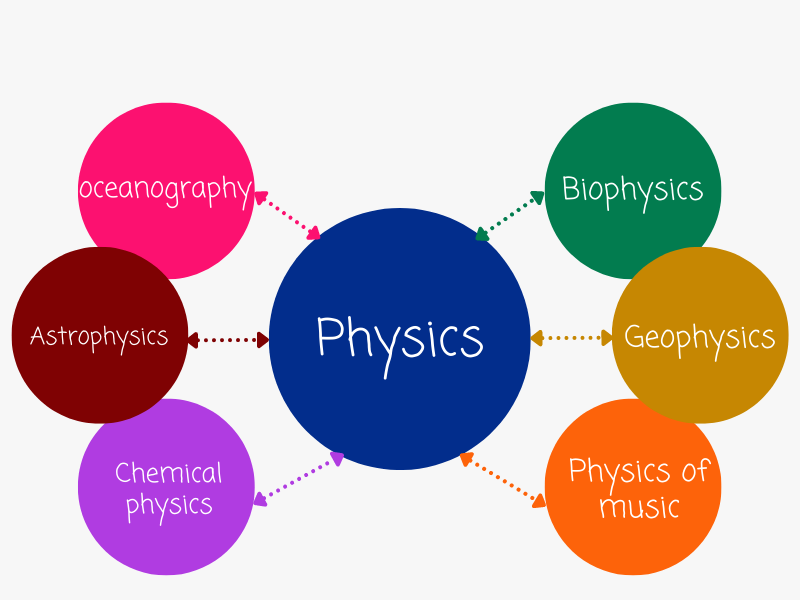
Physics is the most fundamental of all sciences and provides other branches of science, basic principles,s, and fundamental laws. This overlapping of physics and other fields gave birth to new branches.
Biophysics
Biophysics is the study of life and the ways in which biological systems work. It is a science using methods and theories from physics to study biological systems.
Geophysics
Geophysics is a subject of natural science concerned with the physics of the Earth and the space environment around it. It uses mathematical models and statistical techniques for its analysis. It is concerned with physical processes and physical properties of the earth.
Medical Physics
Medical physics deals with the application of the concepts and methods of physics to the prevention, diagnosis, and treatment of human diseases. It’s a specialty that tries to improve human health and well-being but can also help to prevent human disease.
Astrophysics
Astrophysics is a branch of space science that uses the laws of physics and chemistry to understand the universe. It’s sometimes called ‘cosmology’ or ‘astronomy’.
It deals with the physics of the universe, especially with the nature of heavenly bodies, instead of their position and motion in space.
Chemical physics
Chemical physics is a branch of chemistry and physics that investigates chemical processes with techniques from atomic and molecular physics. It focuses more on the elements and theories of physics than the molecules.
Oceanography
The study of all aspects of the ocean is referred to as Oceanography. Oceanography covers a wide range of topics, from marine life and ecosystems to currents and waves, the movement of sediments, and seafloor geology. It covers a wide range of topics, including ocean currents, waves, and geophysical fluid dynamics.
Topic Wise Physics Articles
Electrostatic
Current electricity
Electromagnetic Induction
Dawn Of Modern Physics
Atomic Spectra
Motion and Force
Law of Conservation of Momentum
Why rolling friction is less than sliding friction?
Importance of Rolling Friction
How is rolling friction caused?
How to calculate rolling friction?
How to increase rolling friction?
How to reduce rolling friction?
How strong is rolling friction?
10 Examples of Non-Contact Forces
Why projectile motion is important?
How Does Air Resistance Affect Projectile Motion?
Why Donot Fans Stop Immediately When Turned Off?
Why Do We Lose Our Balance When We Step Down From a Moving Train?
Work and Energy
Waves
Does The Speed Of Wind Affect How Fast Sound Waves Travel Through It?
Transverse Waves in the Electromagnetic Spectrum
Why is ultrasound a longitudinal wave?
Why do longitudinal waves travel faster in solids?
How does the energy in a longitudinal wave move?
Can longitudinal waves be polarized?
How does Longitudinal Wave Propagate?
Does wave interference occur with transverse waves?
Can transverse waves be Polarized?
Why is Electromagnetic Wave a Transverse Wave?
Does light have transverse waves?
Relation Between Frequency and Wavelength
Heat and Thermodynamics
Atmosphere
Celestial Bodies
Optical instruments
Examples in Physics
10 Examples of Statistical Mechanics
10 Examples of Nanotechnology in Physics
10 Examples of Superconductivity
10 Examples of Optics in Modern Technology
10 Examples of Magnetic Confinement Fusion
10 Examples of Electroweak Theory
10 Examples of Quantum Chromodynamics
10 Examples of Quantum Electrodynamics
10 Examples of Quantum Field Theory
10 Examples of Space-time Curvature
10 Examples of Gravitational Waves
10 Examples of Extra Dimensions
10 Examples of Cosmic Microwave Background
10 Example of Hawking Radiation
10 Example of Quantum Superposition
10 Example of Heisenberg Uncertainty Principle
10 Example of Schrodinger Equation
10 Examples of Wave Particle Duality
10 Example of Harmonic in Music
10 Examples of Wave Interference
10 Examples of Magnetic Induction
10 Examples of Circuits in Parallel
10 Examples of Circuits in Series
10 Examples of Particle Acceleration
10 Examples of Quantum Sensors
10 Examples of Quantum Tunneling
10 Examples of Plasma in Physics
10 examples of resistors in circuits
10 Examples of General Relativity
10 Examples of Special Relativity
10 Examples of Quantum Computing
10 Examples of Fusion Reactions
10 Examples of Fission Reaction
10 Examples of Strong Nuclear Force
10 Examples of Weak Nuclear Force
10 Examples of Quantum Entanglement
10 Examples of Newtons Third Law
10 Examples of Newtons Second Law
10 Examples of Nuclear Reactions
10 Examples of Electric Fields
10 Examples of Quantum Mechanics
10 Examples of the Doppler effect
10 Examples of Entropy in Everyday Life
10 Examples of Total Internal Reflection
10 Examples of Bose Einstein Condensate
10 Examples of Reflection of Light
10 Examples of Refraction of Light
10 Examples of Radio Waves That Surround Us
10 Examples of Nuclear Energy That Shape Our World
10 Examples of Electromagnetic Waves
10 Examples of frictional force
10 Examples of gravitational force
10 Examples of Compression Molding
10 Examples of Compression Waves
Application Of Physic in Everyday Life
Physcis has numerous applications in real life.
1: Transportation
Physics plays a crucial role in all forms of transportation, from cars and planes to trains and rockets. Concepts like thermodynamics, aerodynamics, and friction help engineers design vehicles that are safer, more fuel efficient, and capable of traveling faster. Global transportation has increased by over 250% in the last 50 years thanks in large part to physics-based advances.
2: Electricity
Our ability to generate, transmit, and use electricity depends entirely on the laws of physics. Electromagnetism, materials science, and knowledge of circuits are behind the reliable power grids that keep our homes, offices, and cities running. Access to electricity has risen dramatically from under 20% of the global population in the 1940s to over 80% today.
3: Computing
The transistors and integrated circuits that enable modern computers leverage quantum physics and semiconductor properties. Compared to the first room-sized computers built when I was a young professor, today’s computers use physics principles to be millions of times smaller and more powerful. Personal computer ownership has grown from near zero to over 75% of households in developed countries.
4: Medical Imaging
Medical scanning devices like MRI machines and tiny cameras in smartphones rely heavily on physics. Advanced imaging has led to earlier disease detection, improved health outcomes, and the ability to visually share our lives with others around the world. Medical imaging market has expanded over 10% annually in recent years.
5: Satellite Communications
Physics principles like electromagnetic waves and optics have enabled satellites to beam data and communications signals around the world. Global satellite industry revenue has grown from $126 billion in 2005 to over $260 billion today.
6: GPS Technology
By applying concepts like special relativity and quantum physics, engineers have developed global positioning systems that can pinpoint a receiver’s location anywhere on earth. GPS and navigation app usage has risen from under 10% to over 80% of smartphone owners.
7: Renewable Energy
Our ability to capture power from sources like sunlight, wind, and water relies on physics properties like photoelectric effect, fluid dynamics, thermodynamics. Renewables have gone from providing under 1% of global electricity in 2000 to over 10% today.
8: Advanced Materials
Manipulating materials at molecular scale using physics and nanotechnology has led to stronger, lighter, and more adaptive materials being used in everything from aircraft to sports equipment. Global nanomaterials market has increased at an average annual growth rate of over 25% this past decade.
9: Food Preservation
Cooling food requires principles like thermodynamics and heat transfer. Physicists helped develop modern refrigeration and freezing tech that has reduced food waste and allowed preservation for longer periods. Global frozen food market has grown from $166 billion in 2000 to over $290 billion today.
10: Filteration system
Filtration systems that remove contaminants from drinking water rely heavily on physics concepts like fluid flow through porous media. Access to clean drinking water has risen from under 60% globally in 1980 to over 85% of world population today.
11: Electronic appliances
Washing machines, vacuum cleaners, microwaves and other appliances take advantage of physics topics like centrifugal force, electromagnetic induction, and alternating current to function. Ownership of household appliances has risen dramatically in the past 60 years.
12: Construction
Knowledge of loads, stresses, vibrations, and acoustics guide the design of safe, stable building and infrastructure. Use of steel and other engineered materials in construction has more than doubled globally since the 1970s.
13: Entertainment Tech
Game consoles, VR headsets, HD televisions and more are only possible through applying physics concepts like optics, electromagnetism, acoustics, and signal processing. The global entertainment technology industry now generates over $200 billion annually.
Related FAQs
Can Physics exist without Maths?
It is possible for theoretical physics to exist without a mathematical hypothesis, but it is difficult to analyze and calculate the laws of physics without maths.
What is the importance of studying Physics?
We can understand how the world around us works, from can openers, light bulbs, and cell phones to muscles, lungs, and brains, from paints, piccolos, and pirouettes to cameras, cars, and cathedrals, and from earthquakes
What is the role of physics in science education?
Part of the natural science area is physics, which is one of the disciplines of science. The main goal of physics is to study how the universe works. The oldest academic discipline was physics, which has evolved throughout the years.
What is physics?
The branch of science called physics deals with the structure of matter and how it interacts with the fundamental elements of the universe. It studies objects ranging from the very small using quantum mechanics to the entire universe using general relativity.
What is the role of physics in daily life?
Physics is the science that helps us understand the physical world that surrounds us.
Physics is the most important science in life. Whether it is walking, cutting, watching, cooking, or opening and closing things; we use physics.
What does a physicist do?
Physicists study the behavior of the physical world at the most basic level in order to find practical ways to apply new knowledge gained from their research in areas of science and technology.
Who does a Physicist work with?
Physicists and Data Scientists will work together to organize and interpret large amounts of data in an experiment. A physicist also works with many other professionals from different fields like mathematicians and engineers.
What Can You do With a Physics Degree?
The modern world would not be where it is today if it weren’t for physicists. The study of physics underlies many pivotal discoveries of the 20th century, such as the laser, television, radio, computer technology, and nuclear weapons, and has played a vital role in the development of quantum theory.
Many physics graduates go on to work in research roles in many different industries, including education, automotive and aerospace industries, defense, the public sector, healthcare, energy, materials, technology, computing, and IT.

